Venezuela’s $170 billion debt is twice the size of its economy and 10 times its 2025 oil revenues.
This is why investment banks are lining up to take one of the most complex sovereign debt restructurings in the world.
But behind these $170 billion, there is a lot to unpack 🧵
This is why investment banks are lining up to take one of the most complex sovereign debt restructurings in the world.
But behind these $170 billion, there is a lot to unpack 🧵
https://twitter.com/OrlvndoA/status/2066186718374469938
First of all, the number:
Where does $170 billion come from?
1st) The Chavez administration consistently running budget deficits to sustain its web of populism, despite receiving $800 billion in oil revenues.
2nd) International arbitration cases against Venezuela.
Where does $170 billion come from?
1st) The Chavez administration consistently running budget deficits to sustain its web of populism, despite receiving $800 billion in oil revenues.
2nd) International arbitration cases against Venezuela.
Now let's compare Venezuela's liabilities with its finances:
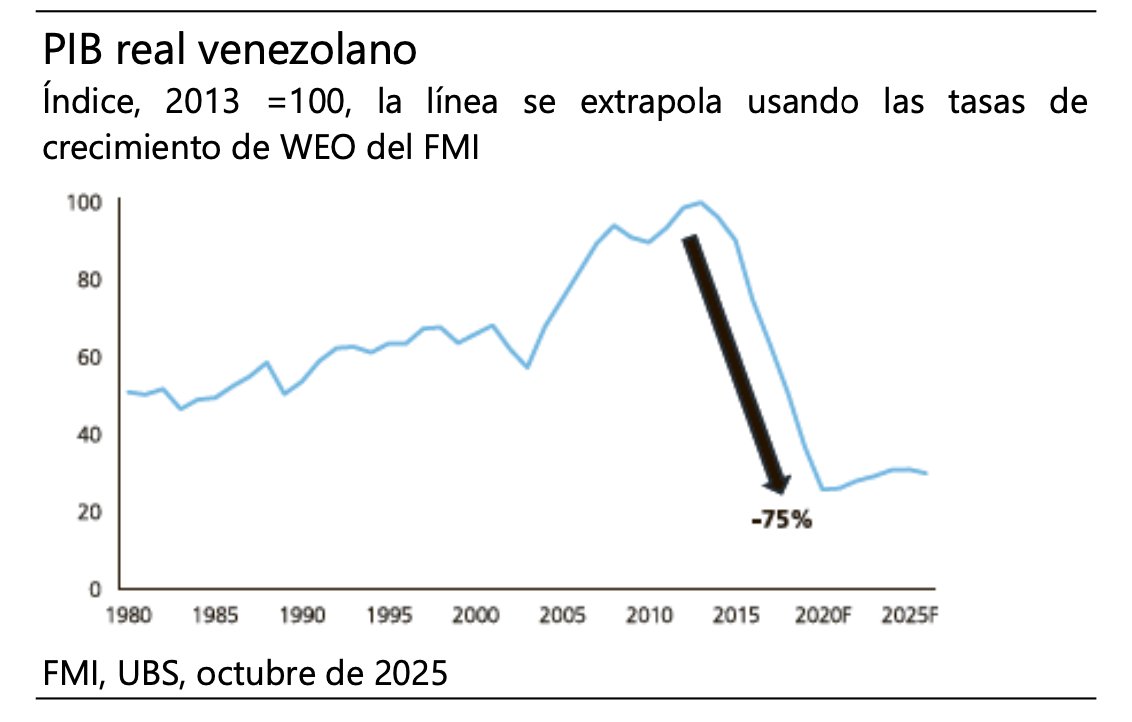
Venezuela's 2025 GDP is $83 billion (IMFNews), and the country's 2025 oil exports revenues were $18.2 billion.
Venezuela's reported debt is therefore 200% of its GDP and 1000% its 2025 oil exports.
Venezuela's 2025 GDP is $83 billion (IMFNews), and the country's 2025 oil exports revenues were $18.2 billion.
Venezuela's reported debt is therefore 200% of its GDP and 1000% its 2025 oil exports.
This is not sustainable. For Venezuela to start rebuilding its economic muscle, it cannot commit to repay most of its debt.
The country simply does not have the finances to simultaneously rebuild its infrastructure, financial system and overall economy, while repaying this debt.
The country simply does not have the finances to simultaneously rebuild its infrastructure, financial system and overall economy, while repaying this debt.
Understanding this, banks like @citi have estimated a haircut of 50% of the debt, which would be in line with @IMFNews conditions.
@Citi argues that Venezuela could offer creditors a 20-year bond with a coupon of around 4%, alongside a 10-year zero-coupon note.
@Citi argues that Venezuela could offer creditors a 20-year bond with a coupon of around 4%, alongside a 10-year zero-coupon note.
Yet, not all creditors are the same.
A serious restructuring has to distinguish between the $60 billion of defaulted bonds outstanding, PDVSA's obligations, bilateral loans and international arbitration cases against Venezuela.
A serious restructuring has to distinguish between the $60 billion of defaulted bonds outstanding, PDVSA's obligations, bilateral loans and international arbitration cases against Venezuela.
And ultimately, the most important factor here is to negotiate the debt with transparency and the interest of Venezuela's reconstruction in mind.
@puzkas: "National Academy of Economic Sciences calls for transparency in Venezuela's debt restructuring."
@puzkas: "National Academy of Economic Sciences calls for transparency in Venezuela's debt restructuring."
https://x.com/puzkas/status/2065896765522432391?s=20
Venezuela's debt restructuring cannot be done in the dark, as many Venezuelans have stated, including @docedelpatibulo, @MiCarratu,@ahernandezof, @luispenavalero and @estebangerbasi.
https://x.com/MiCarratu/status/2065881760710484032?s=20
As of now, the investment banks bidding to manage Venezuela's debt restructurings are @Lazard and Centerview Partners.
While Centerview made a $150 million proposal (monthly retainer + 0.1% success fee), @Lazard's proposal today situates at $25 million.
While Centerview made a $150 million proposal (monthly retainer + 0.1% success fee), @Lazard's proposal today situates at $25 million.
https://x.com/business/status/2066163958210289854?s=20
Transparency and efficiency in the process of cleaning up Venezuela’s finances are not only necessary to reach a good restructuring deal.
They are a fundamental step toward building a new Venezuela where our public finances are managed with the responsibility they require.
They are a fundamental step toward building a new Venezuela where our public finances are managed with the responsibility they require.
• • •
Missing some Tweet in this thread? You can try to
force a refresh