
NEW from me @reason. Can AI drastically cut budget deficits and even balance the budget - as Musk and Amodei suggest?
I estimate AI budget effects on productivity, revenues, job displacement benefits, Social Security, health, defense, interest, govt jobs, and govt admin. 🧵
I estimate AI budget effects on productivity, revenues, job displacement benefits, Social Security, health, defense, interest, govt jobs, and govt admin. 🧵

Here's the link to my @Reason article going through the federal budget to estimate AI savings.
My central estimate is that a healthy AI boom can shave perhaps $600 billion off the 2036 projected budget deficit of $4.4 trillion. Helpful, but not balance.
reason.com/2026/06/16/eve…
My central estimate is that a healthy AI boom can shave perhaps $600 billion off the 2036 projected budget deficit of $4.4 trillion. Helpful, but not balance.
reason.com/2026/06/16/eve…
Revenues: If we match the internet boom's decade-long 1% annual productivity bump - plus the IRS better collecting unpaid taxes - we get around $1 trillion in added revenues annually by 2036.
It could be less if most of the gains accrue to (lower-taxed) capital over labor.
It could be less if most of the gains accrue to (lower-taxed) capital over labor.

However, the more AI adds to growth, the greater the resulting job displacement. Two scenarios:
1) Big layoffs of mid-career professionals.
2) Fewer good entry-levels jobs for younger grads.
Scenario 2 is looking more likely.
May consume 15-40% of revenue bump. We'll say 25%.
1) Big layoffs of mid-career professionals.
2) Fewer good entry-levels jobs for younger grads.
Scenario 2 is looking more likely.
May consume 15-40% of revenue bump. We'll say 25%.

Interest costs: Big AI means an investment gold rush that pushes up interest rates - including on the debt. Big range of possibilities, but central estimate is rates rising around 0.4%, costing the govt around $240 billion annually by 2036.

Other budget effects are minor:
-Medicare & Medicaid savings would be modest.
-Social Security shortfalls would worsen a bit.
-DOD savings would be small and reprogrammed into new capabilties.
-Govt employee reduction at most 10%.
-Admin efficiencies offset by up-front costs.
-Medicare & Medicaid savings would be modest.
-Social Security shortfalls would worsen a bit.
-DOD savings would be small and reprogrammed into new capabilties.
-Govt employee reduction at most 10%.
-Admin efficiencies offset by up-front costs.
So the net effect is perhaps $1 trillion in annual revenues by 2036 - with half of those savings then lost to job displacement and interest costs.
Add in deficit reduction savings, and we save perhaps $600 billion by 2036. Which is really good! but nowhere near balance.
Add in deficit reduction savings, and we save perhaps $600 billion by 2036. Which is really good! but nowhere near balance.
AI enthusiasts can build scenarios where productivity leaps 2%, 3%, even 4%. Great!
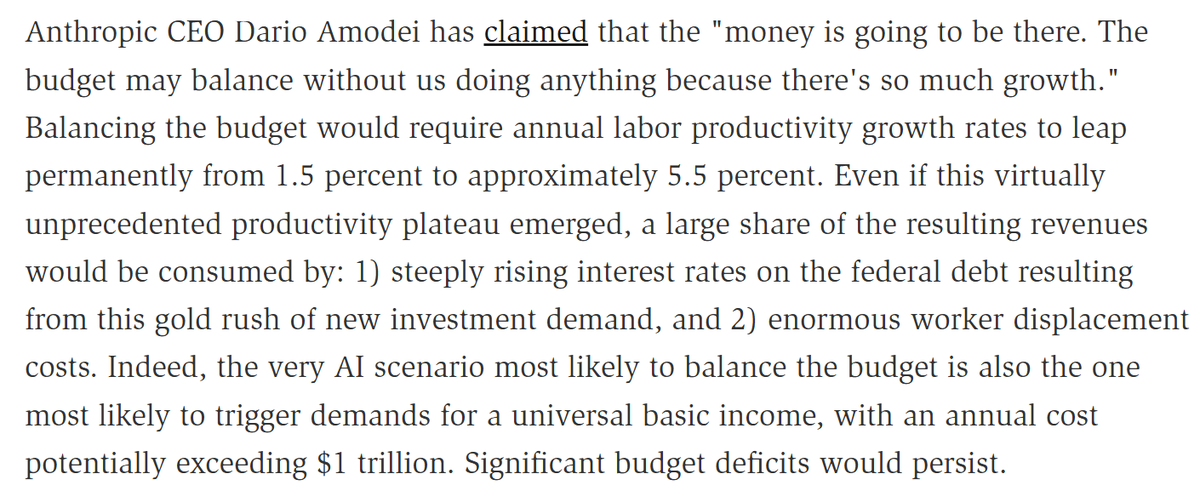
But then interest rates and debt interest costs would rise faster too - as would job displacement costs. Plus that in turn may trigger a UBI that wipes out all the budget savings.
But then interest rates and debt interest costs would rise faster too - as would job displacement costs. Plus that in turn may trigger a UBI that wipes out all the budget savings.
And no, Washington taking 50% ownership in AI companies would not be a major new revenue resource. Unless Washington unloads the stocks, they become paper gains with modest dividends once investment costs trail off and profits emerge. Plus govt. meddling would chase investors.

Anyway, this is not AI-doomerism. $600 billion annually within a decade would be real money! But the deficit is too big for AI to "solve" - we still need the tough decisions.
The article has MUCH more detail. Enjoy! /F
reason.com/2026/06/16/eve…
The article has MUCH more detail. Enjoy! /F
reason.com/2026/06/16/eve…
• • •
Missing some Tweet in this thread? You can try to
force a refresh






