On the evening of D-Day, 5 June 1944, Paul Hamilton parachuted into Normandy as a Pathfinder with the 12th Battalion Parachute Regiment, landing ahead of the main airborne assault.
I've attached a thread I wrote last year about his Normandy parachute jump:
On 17 Dec 1942, the British Parliament fell silent as they learned the full horror of the Nazi extermination programme.
Britain's 'Secret Listeners' had captured chilling eyewitness evidence.
What they overheard stunned even the most hardened intelligence officers:
(🧵)
On 17 December 1942, concern about the fate of Jews in Poland and other Nazi-occupied countries received the full attention of the British parliament when Anthony Eden read the Allied Declaration to the House of Commons.
The declaration included words of condemnation from other nations, including the United States, Soviet Union and various governments-in-exile: Belgium, Czechoslovakia, Greece, the Netherlands, Norway, Poland and Yugoslavia.
(continued)
All were united in condemnation, ‘in the strongest possible terms of this bestial policy of cold-blooded extermination ... None of those taken away are ever heard of again. The infirm are left to die of exposure and starvation or are deliberately massacred in mass executions.’
In reference to the deportation of Jews, MPs were shocked to hear from foreign secretary, Mr Eden: ‘I regret to inform the House that reliable reports have recently reached His Majesty’s government regarding the barbarous and inhuman treatment to which Jews are being subjected in German-occupied Europe.’
On 18 October 1943, a captured German parachutist stunned his British interrogator with detailed eyewitness accounts of Nazi concentration camps and something far darker...
He calmly described Hitler's secret stud farms where SS officers bred the 'master race':
(🧵)
German parachutist Hauptmann, who was captured in Italy on 18 October 1943, provided the most information from a single prisoner about the extent of the Nazi genocide.
Many transcripts survive of his conversations with a British army officer who was a fluent German speaker. Hauptmann was given the codename M350 by MI19.
All that was noted about him was his claim to have been a fugitive after shooting a Nazi official in Hamburg. MI19 was not sure what to make of some of his statements in interrogation and, unusually, added to his transcripts: ‘He has given a certain amount of information, some of which appears to be accurate and some highly improbable. His statements should therefore be treated with reserve.’
(continued)
With the benefit of hindsight, it can now be shown that Hauptmann was remarkably accurate. He spoke to a British army officer about Sachsenhausen and Dachau concentration camps, and told him that Sachsenhausen had seven to eight thousand people there and considerably more in Dachau. The British officer asked him if there were only three concentration camps, to which Hauptmann replied, ‘Oh, there are a lot.’
In a separate conversation that day, possibly with the same British officer, Hauptmann talked about Hitler’s use of ‘stud farms’ to breed a pure Aryan German race. This was part of the regime’s Lebensborn programme to create a perfect master race. Such breeding camps or ‘farms’ existed across Nazi-occupied Europe.
In 1944, one of Hitler’s most decorated paratroop generals was captured in Brest and secretly brought to a grand English country house.
Hidden microphones recorded every word he said about the German war effort.
What he revealed still surprises historians today:
(🧵)
One of the most interesting and high-ranking German officers to be held at Trent Park was General der Fallschirmtruppe Hermann-Bernhard Ramcke, a highly decorated and battle-hardened paratroop commander who had earned a formidable reputation within the Wehrmacht for his leadership and determination.
(continued)
Ramcke was captured in September 1944 following the fierce and prolonged fighting for the strategically important port of Brest in Brittany.
After his capture he was quickly transferred to Britain and brought to the secret MI6 interrogation centre housed in the elegant surroundings of Trent Park in North London.
In 1941, bugged German pilots at Trent Park revealed a towed 5,000kg “Max” bomb with detachable wings – and Britain’s first warnings of Hitler’s build-up for the invasion of Russia.
Morale was cracking and Hitler worship was fading...
(🧵)
Trent Park, North London:
Naval prisoners from two Kondor aircraft discussed the new German 109 fighter and the long-distance bomber HE177. Further discussions on navigation and communication on aircraft provided extremely useful information to MI9. Prisoners continued to mention Knickebein, Elecktra and X-Gerät, and Britain’s interference with navigational beams.
One of the most significant pieces of intelligence in this period related to the new heavy bomb termed ‘Max’ (2,500kg), mine-laying techniques and ‘the introduction of 1lb incendiaries with a small explosive charge’.
(continued)
At the end of April 1941, two bomber pilots were recorded talking about bombs on aircraft. After interrogation, A830 (captured 8 April 1941) told his cellmate A777 (captured 13 March 1941), ‘They knew about our new 5,000kg bomb here’, prompting A777 to ask: ‘Really! What aircraft carries it?’
‘It is not carried. It is towed. It has sort of little wings which somehow fall off at the moment the bomb is released ... Here they know that 5,000kg bomb exists, but they maintain that we have no aircraft capable of carrying them. They don’t know that it has wings and is towed,’ replied A830.
Britain’s 'Secret Listeners' sat in the M Room at Trent Park surrounded by 15 hidden pressure microphones, acetate discs and old-fashioned switchboards.
They recorded every word from bugged German POWs.
This was WW2's most sophisticated eavesdropping operation:
(🧵)
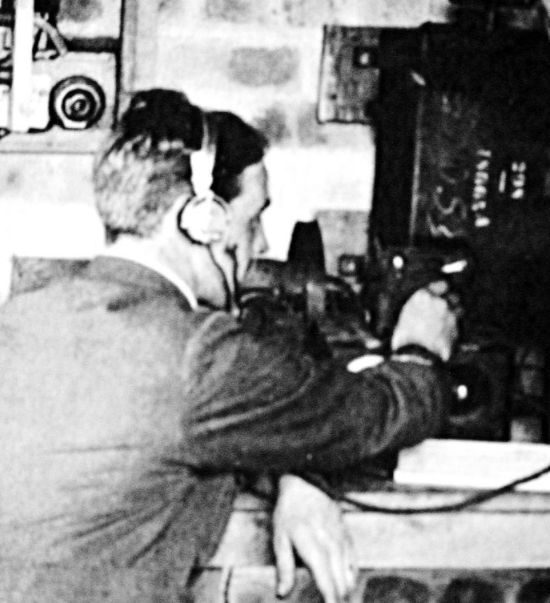
During WW2, the new intelligence site Trent Park was kitted out with fifteen type 88A pressure microphones, nine portable disc recorders, five high quality headphones, one amplifier for loudspeaker monitoring, four switchboard assemblies, one mainframe assembly and a transformer.
The operators were supplied with 525 12-inch double-sided acetate recording discs for recording conversations, and 58 steel recording styli, 10 sapphire recording styli and spare parts.
Very little is known about the microphones that were used, except from a report which stated: ‘It was proved in practice, as was anticipated in laboratory work, that the moving coil type of microphone was the only practicable type for concealing purposes. Firstly, its size and shape were suitable, and secondly, it could be fitted and forgotten; only 2 failures were experienced over a period of three years.’
(continued)
The equipment allowed for complete versatility and flexibility. Any or all operators could listen singly or together into any one of the bugged rooms, including the interrogation rooms. Each of the eight machines could record conversations in any of the wired rooms.
A separate playback room was equipped with four playback units with turntable and variable speed motor, amplifier, hypersensitive pick-up, power control switch and pilot lamps and twin output jacks. Eight headsets and eighty silent styli were also part of the equipment supplied. This allowed two translators to listen simultaneously to the recordings.
After the murder of 50 escapees from the Great Escape, MI9 issued the controversial ‘Stay Put Order’ telling Allied airmen and soldiers to stop escaping and remain hidden after D-Day.
But one man fiercely disagreed and the row reached top command:
(🧵)
At the beginning of 1944, IS9 was in discussion with the Air Ministry and other departments about the security of Allied personnel after D-Day. The discussion raised the issue of the ‘Stay Put Order’ and whether personnel should return to the lines rather than remain in hiding.
It was advocated that lessons should be learnt from North Africa (Western Desert) including that, in spite of capture, immediate escape was possible during the confusion of battle and counter-orders within enemy ranks.
(continued)
It was argued that thousands of personnel could find themselves cut off from their unit. Escaping back to their units was considered of prime importance because, if uninjured, these men were valuable fighting forces: ‘It is once more pointed out that the experience of the battles fought in the Western desert taught us that, provided men are properly trained and briefed, it is surprising how many will be able to return to their own lines after being cut off from their units and being captured by the enemy.’
The point was made too that escapers could bring operational intelligence and by staying put valuable intelligence could be lost to the fighting units. This exchange demonstrated the belief that escapers were an important source of intelligence as well as fighting power.