On 31 October 1943, a captured SS officer from Hitler's brutal death squad was bugged at Latimer House by the British.
He calmly described seeing Auschwitz from the train and knowing no one came out alive.
Then he recounted mass executions of 5000 Jews in one day:
(🧵)
On 31 October 1943, an SS officer was brought to Latimer House after capture in Italy. He was no ordinary SS officer, but from one of Hitler’s infamously brutal and merciless death squads – Einsatz-Kommando 3, Sicherheits-Polizei (Security Police).
Holding a rank equivalent to sergeant major, this SS Hauptscharführer came from one of the highest positions in Hitler’s Secret Police. Special reports generated from the M Room merely give him the codename M320.
(continued)
M320: I know the Auschwitz concentration camp in Poland by hearsay. Actually you can see it from the train. It is a hutted camp for Jews. I heard say that there’s a crematorium there, and that no one who enters the camp comes out alive.
M322: I heard a lot in Vienna about Mauthausen.
M320: I personally haven’t seen any concentration camp, apart from Auschwitz, which I saw from the train. It’s not far from Cracow.
M322: Oh, down there.
M320: Yes. When you go through by train you can see it.
M322: Were mainly Jews sent there?
M320: Yes. I should be interested to know what they have done with all the Jews in the Reich, and then the ones from Austria, since they started to get rid of the Jews. I wonder whether they’ve slaughtered them?
(continued)
In a different conversation, this time with a British army officer (below, BAO), M320 spoke at length about mass executions by firing squads in the village of Ananyev in the province of Kherson, and referred to the shooting of as many as 5,000 Jews there in a single day.
BAO: How many people were shot at a time?
M320: They were always shot in groups of ten.
BAO: With tommy-guns?
M320: With rifles. One man to each. Ten men with rifles to ten.
(continued)
Continued:
BAO: Did they simply fall down into trenches or what?
M320: Yes. They had to get down into a trench – it was a kind of anti-tank trench. It was about two and a half to three metres deep and wide as this room, we’ll say. You had to shoot down at them from above.
BAO: Were they all killed instantaneously?
M320: Yes. There were men with tommy-guns who finished them off. The cars drove away one after the other and they could see the others being taken up and shot, and they knew that it might be their turn next. You’d see a woman holding a little child on each of her arms, and she might be pregnant as well – and there were whole families.
M320 was one of the longest-held lower-rank prisoners at Latimer House, possibly because of his position in the SS death squad.
He was still being questioned by British intelligence into 1944.
(continued...ending)
Did you learn something new from this harrowing thread?
If so, please consider showing your support by Reposting it and 'Follow' my X page @DrHelenFry for more unique WW2 content like this.
I have plenty more history to share!
(end).
• • •
Missing some Tweet in this thread? You can try to
force a refresh

On 29 August 1944, General von Choltitz confessed to another general that the liquidation of the Jews was the worst job he had ever carried out and that he had done it with great consistency down to the very last detail.
Hitler's own commanders admitted their guilt:
(🧵)
In an astonishing turn of events, the generals at Trent Park divulged their own guilt to each other. In a conversation recorded on 29 August 1944, von Choltitz confessed to von Thoma: ‘The worst job I ever carried out – which, however, I carried out with great consistency – was the liquidation of the Jews. I carried out this order down to the very last detail.’
Von Thoma’s reply laid the blame on Hitler for issuing the orders, as he sniggered: ‘Ha! Ha! Ha! It’s a good thing that you can now produce such unimpeachable proofs.’ Even von Thoma’s laughter was written on the transcript of the conversation by 'secret listeners'..
Two months later, the secret listeners picked up another frank admission from von Choltitz: ‘We are also to blame. We have cooperated and have almost taken the Nazis seriously . . . I’ve persuaded my men to believe in this nonsense ... I feel thoroughly ashamed of myself. May be we are far more to blame than those uneducated cattle [the Nazis].’ Von Choltitz appeared only to express remorse after he knew he could face charges of war crimes and the death penalty.
(continued)
General Liebenstein told von Thoma, ‘We once shot forty thousand Poles in a concentration camp.’ Von Thoma replied, ‘Out at Dachau in 1940 were a great part of the Polish intelligentsia, university professors, doctors, lawyers – that’s the pathological part of it, this mania.’ In a separate conversation, von Thoma said the killings were committed on Hitler’s orders.
Neuffer and Bassenge discussed crimes committed by the German army. Bassenge told Neuffer that the Goering Regiment was a wild lot. ‘I know officially,’ Bassenge said, ‘because part of the paratroops were formed from the Goering Regiment.’
‘Did they commit murders?’ asked Neuffer.
‘Yes,’ replied Bassenge. ‘They secretly condemned and murdered people in the barracks and the officers took part.’
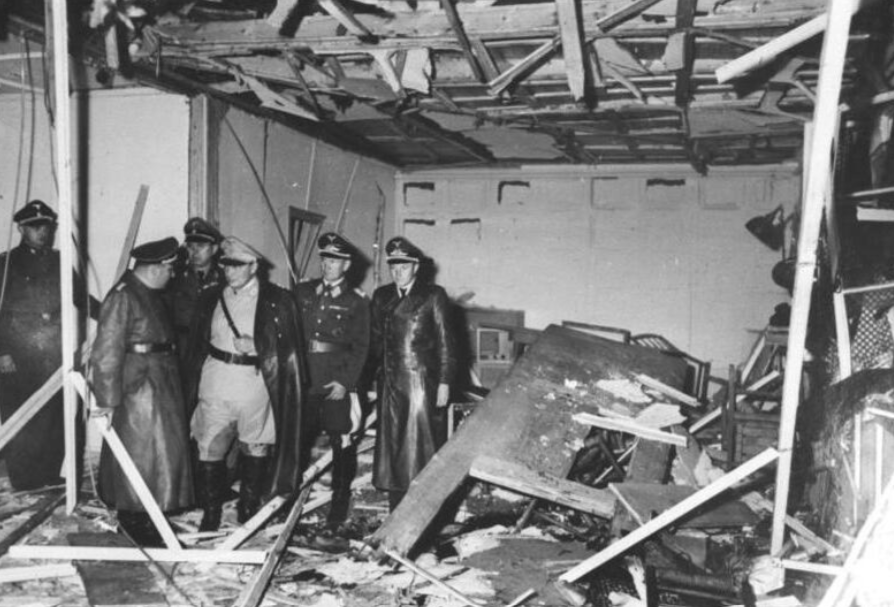
On 20 July 1944, the news reached Trent Park that Hitler had survived an assassination attempt.
The bugged conversations of the captured German generals revealed shock, suspicion and even bitter regret that the plot had failed!
Let's explore:
(🧵)
At 1800 hours on 20 July 1944, a British army officer sent for Sponeck and gave him the news that an attempt had been made on Hitler’s life, but he had survived with minor injuries. The assassination attempt ‘caused a stir at No.11 Camp,’ the intelligence report said. MI19 prepared a special report on the generals’ reactions (housed at Trent Park) to the news. The failed putsch came as a shock to Sponeck who told the British officer that it was a put-up job by the Nazis as an excuse for a purge of the anti-Nazi generals.
The bungled plot, led by German army officer Claus von Stauffenberg, an aristocrat, became widely known as Operation Valkyrie. He had smuggled a small bomb in a briefcase into a meeting room with the Führer at his Wolf’s Lair field headquarters in East Prussia. Von Stauffenberg placed the briefcase between Hitler’s legs, then made an excuse to leave. Alfred Jodl, Chief of the Operations Staff of the German army, had called out ‘Stay here!’, but von Stauffenberg simply made an excuse that he had an urgent phone call to make and hadn’t had breakfast.
(continued)
Outside the room, von Stauffenberg waited about 300 metres away and on hearing the bomb blast decided that no one could have survived. He boarded an aircraft to Berlin where he declared the attempt had been successful, without checking if, indeed, it had been, for at the crucial moment, Hitler had moved away from the briefcase and was only slightly wounded when the device went off.
Staff at MI9/MI19 were amongst the first to hear about the attempted assassination before it became public knowledge. Commenting on those events, Catherine Townshend said: ‘A camp bed was made up next to the scrambler telephone that had to be manned around the clock; a clerk and despatch rider were on hand in case of need. Most dramatic of all the news that arrived by scrambler telephone was the attempted assassination of Hitler ... We knew that retribution would be swift and merciless.’
On 17 Dec 1942, the British Parliament fell silent as they learned the full horror of the Nazi extermination programme.
Britain's 'Secret Listeners' had captured chilling eyewitness evidence.
What they overheard stunned even the most hardened intelligence officers:
(🧵)
On 17 December 1942, concern about the fate of Jews in Poland and other Nazi-occupied countries received the full attention of the British parliament when Anthony Eden read the Allied Declaration to the House of Commons.
The declaration included words of condemnation from other nations, including the United States, Soviet Union and various governments-in-exile: Belgium, Czechoslovakia, Greece, the Netherlands, Norway, Poland and Yugoslavia.
(continued)
All were united in condemnation, ‘in the strongest possible terms of this bestial policy of cold-blooded extermination ... None of those taken away are ever heard of again. The infirm are left to die of exposure and starvation or are deliberately massacred in mass executions.’
In reference to the deportation of Jews, MPs were shocked to hear from foreign secretary, Mr Eden: ‘I regret to inform the House that reliable reports have recently reached His Majesty’s government regarding the barbarous and inhuman treatment to which Jews are being subjected in German-occupied Europe.’
On 18 October 1943, a captured German parachutist stunned his British interrogator with detailed eyewitness accounts of Nazi concentration camps and something far darker...
He calmly described Hitler's secret stud farms where SS officers bred the 'master race':
(🧵)
German parachutist Hauptmann, who was captured in Italy on 18 October 1943, provided the most information from a single prisoner about the extent of the Nazi genocide.
Many transcripts survive of his conversations with a British army officer who was a fluent German speaker. Hauptmann was given the codename M350 by MI19.
All that was noted about him was his claim to have been a fugitive after shooting a Nazi official in Hamburg. MI19 was not sure what to make of some of his statements in interrogation and, unusually, added to his transcripts: ‘He has given a certain amount of information, some of which appears to be accurate and some highly improbable. His statements should therefore be treated with reserve.’
(continued)
With the benefit of hindsight, it can now be shown that Hauptmann was remarkably accurate. He spoke to a British army officer about Sachsenhausen and Dachau concentration camps, and told him that Sachsenhausen had seven to eight thousand people there and considerably more in Dachau. The British officer asked him if there were only three concentration camps, to which Hauptmann replied, ‘Oh, there are a lot.’
In a separate conversation that day, possibly with the same British officer, Hauptmann talked about Hitler’s use of ‘stud farms’ to breed a pure Aryan German race. This was part of the regime’s Lebensborn programme to create a perfect master race. Such breeding camps or ‘farms’ existed across Nazi-occupied Europe.
In 1944, one of Hitler’s most decorated paratroop generals was captured in Brest and secretly brought to a grand English country house.
Hidden microphones recorded every word he said about the German war effort.
What he revealed still surprises historians today:
(🧵)
One of the most interesting and high-ranking German officers to be held at Trent Park was General der Fallschirmtruppe Hermann-Bernhard Ramcke, a highly decorated and battle-hardened paratroop commander who had earned a formidable reputation within the Wehrmacht for his leadership and determination.
(continued)
Ramcke was captured in September 1944 following the fierce and prolonged fighting for the strategically important port of Brest in Brittany.
After his capture he was quickly transferred to Britain and brought to the secret MI6 interrogation centre housed in the elegant surroundings of Trent Park in North London.
In 1941, bugged German pilots at Trent Park revealed a towed 5,000kg “Max” bomb with detachable wings – and Britain’s first warnings of Hitler’s build-up for the invasion of Russia.
Morale was cracking and Hitler worship was fading...
(🧵)
Trent Park, North London:
Naval prisoners from two Kondor aircraft discussed the new German 109 fighter and the long-distance bomber HE177. Further discussions on navigation and communication on aircraft provided extremely useful information to MI9. Prisoners continued to mention Knickebein, Elecktra and X-Gerät, and Britain’s interference with navigational beams.
One of the most significant pieces of intelligence in this period related to the new heavy bomb termed ‘Max’ (2,500kg), mine-laying techniques and ‘the introduction of 1lb incendiaries with a small explosive charge’.
(continued)
At the end of April 1941, two bomber pilots were recorded talking about bombs on aircraft. After interrogation, A830 (captured 8 April 1941) told his cellmate A777 (captured 13 March 1941), ‘They knew about our new 5,000kg bomb here’, prompting A777 to ask: ‘Really! What aircraft carries it?’
‘It is not carried. It is towed. It has sort of little wings which somehow fall off at the moment the bomb is released ... Here they know that 5,000kg bomb exists, but they maintain that we have no aircraft capable of carrying them. They don’t know that it has wings and is towed,’ replied A830.