PaulsCorner-VerseQuest Profile picture
Jun 26 7 tweets 14 min read Read on X
The Devil’s Music Still Corrupts Holy Ears – You Can’t Worship God with the World’s Rhythm

Introduction

There is a lie running through modern Christianity that says music is neutral, that rhythm has no moral direction, that sound carries no spirit, that a beat is just a beat, that the world’s music can be baptized if you sprinkle a few religious words over it, and that God is so desperate for worship that He will accept anything as long as somebody claims their heart is sincere. That lie has filled churches with noise, emotion, performance, sensuality, confusion, and flesh while calling it revival. The Bible never treats worship as a playground for human preference. God is holy, and holy worship must be governed by holy truth. John 4:24 says, “God is a Spirit: and they that worship him must worship him in spirit and in truth.” Not in flesh and trend. Not in emotion and entertainment. Not in rebellion and rhythm. Not in the world’s sound with Christian stickers pasted on it. Spirit and truth. That is the standard, and the standard has not changed because a generation with earbuds and fog machines thinks it has improved on the old paths.

The devil has always understood music better than most Christians do. He knows music bypasses the front door of argument and slips into the heart through desire, memory, mood, and appetite. He knows sound can stir flesh before words are even understood. He knows rhythm can train the body, melody can soften resistance, and repetition can condition the mind. He knows how to take rebellion, lust, pride, anger, sensuality, despair, vanity, and self-worship and carry it on a sound that people defend as “just music.” The devil does not need a song to openly say “worship Satan” if it can make the flesh move, weaken conviction, dull spiritual appetite, and make holy things feel dull by comparison. He does not need every lyric to blaspheme if the spirit of the music already drags the listener toward the world. First John 2:15 says, “Love not the world, neither the things that are in the world.” That includes the world’s worship, the world’s entertainment, the world’s spirit, and the world’s music when it is built to stir the flesh that God told you to crucify.

This is not about being old-fashioned for the sake of nostalgia, and it is not about pretending that every older song was holy or every newer song is wicked. There is plenty of dead formalism in old hymnbooks if nobody believes what he sings, and there is plenty of shallow religious syrup in new songs that never gets above feelings. The issue is not merely age. The issue is holiness. The issue is whether the sound, words, spirit, purpose, and fruit of the music line up with the God of the Bible or the appetites of the world. Ephesians 5:19 says, “Speaking to yourselves in psalms and hymns and spiritual songs, singing and making melody in your heart to the Lord.” Colossians 3:16 says we are to sing “with grace in your hearts to the Lord.” The New Testament standard is not performance for the crowd, not sensuality for the flesh, not imitation of the world, and not emotional manipulation. It is spiritual songs, truth-filled songs, heart songs, grace songs, songs to the Lord. You cannot worship a holy God by borrowing the atmosphere of Babylon and pretending the lyrics sanctify it.

Chapter One: Music Is Not Treated as Neutral in the Bible

Music is not treated as neutral in the Bible because worship is never neutral. Sound has direction because the heart producing it has direction. A song may be offered to God, to idols, to the flesh, to vanity, to victory, to grief, to lust, to rebellion, or to praise. The Bible shows music connected with worship, celebration, prophecy, idolatry, war, sorrow, deliverance, and judgment. Moses and Israel sang unto the Lord after the Red Sea victory in Exodus 15. David played before Saul, and the evil spirit departed from him. The temple had ordered music in connection with theImage
the service of God. The Psalms are full of singing unto the Lord. So nobody with a Bible should say music is unimportant. God made the ability to sing and play, and when that ability is yielded to Him, it can be a vessel of praise. But that also means music is not a spiritual toy. It is powerful, and powerful things must be submitted to God.

The devil’s crowd always runs to the word “neutral” when they want to defend something worldly. They say music is neutral, clothing is neutral, entertainment is neutral, language is neutral, associations are neutral, atmosphere is neutral, and then, after declaring everything neutral, they wonder why the church has no discernment left. A knife can be used in surgery or murder, but the knife in a murderer’s hand is not neutral in that moment. A mouth can bless or curse, but the tongue speaking blasphemy is not neutral in that moment. Music placed in the service of lust, rebellion, pride, idolatry, and sensuality is not neutral because it is being harnessed to a spirit and purpose contrary to God. First Corinthians 10:21 says, “Ye cannot drink the cup of the Lord, and the cup of devils.” There are mixtures God rejects.

The Bible believer must judge music by more than personal taste. The question is not, “Do I like it?” The question is, “What does it stir? Where did it come from? What spirit does it carry? What crowd produced it? What appetite does it feed? What does it make holy worship resemble? Does it magnify Christ or magnify flesh? Does it make the words clearer or bury them under performance? Does it bring the heart under truth or carry the body into sensual excitement?” Those are not legalistic questions. Those are discernment questions. Philippians 1:10 says believers are to “approve things that are excellent.” That means not everything acceptable to the crowd is excellent before God. Music used for holy worship must be tested by holy standards.

Chapter Two: Lucifer’s Fall Shows That Giftedness Can Become Corruption

Ezekiel 28 gives a picture that Bible believers have long understood as reaching beyond the earthly king of Tyrus to the anointed cherub who fell through pride. The passage says, “Thou art the anointed cherub that covereth,” and speaks of his beauty, wisdom, precious stones, and the workmanship of “thy tabrets and of thy pipes.” However much men want to argue over every detail, one thing is clear in the Bible’s larger witness: Satan was not a crude idiot who stumbled into evil. He was brilliant, beautiful, elevated, and gifted, and his gifts did not keep him from corruption. Iniquity was found in him. Pride lifted him up. That should warn every musician, singer, worship leader, preacher, and church that talent is not holiness.
The devil knows how to use giftedness without godliness. He knows how to make skill look spiritual. He knows how to make emotional effect look like anointing. He knows how to make a powerful voice, a polished arrangement, a dramatic pause, a swelling chorus, a dimmed room, and a perfectly timed musical rise feel like the presence of God when it may only be the manipulation of the flesh. Churches today are so easily impressed by talent that they have forgotten God never needed Hollywood to help Him. A voice can be beautiful and still be fleshly. A musician can be skilled and still be carnal. A song can be moving and still be shallow. A performance can make people cry without making them holy. The question is not whether the music works on emotion. The question is whether it bows to truth.

This is why Satan’s corruption of giftedness is so dangerous. He does not always destroy gifts by making them ugly. He often destroys them by making them proud, sensual, self-serving, and worldly. He takes music that should have been directed to God and turns it toward self-display. He takes praise and makes it performance. He takes singing and makes it seduction. He takes worship and makes it atmosphere. He takes instruments and makes them weapons for the flesh. He takes the congregation and turns it into an audience. He takes God’s glory and gives it to the singer, the band, the stage, the lights, the sound system, and the emotional experience. The devil does not mind religious music if it produces fleshly worship. He hates holy music that humbles man and exalts Christ.

Chapter Three: Idolatry Has Always Had a Soundtrack

Idolatry has always had a soundtrack. Daniel 3 shows Nebuchadnezzar setting up an image and commanding people to fall down and worship when they heard the sound of “the cornet, flute, harp, sackbut, psaltery, dulcimer, and all kinds of musick.” That is not accidental. The music was part of the system. It created the moment. It signaled the act. It unified the crowd. It moved masses into religious obedience to an idol. That chapter should make a Bible believer careful about music tied to false worship, crowd control, emotional pressure, and public conformity. The sound went out, and the world bowed. Three Hebrews refused because they feared God more than the orchestra of Babylon.

Exodus 32 shows the same principle in another form. While Moses was on the mount, Israel made a golden calf. When Joshua heard the noise of the people, he thought there was war in the camp, but Moses said it was not the voice of them that shout for mastery or defeat. It was the noise of them that sing. The people sat down to eat and drink and rose up to play. That was religion mixed with flesh. Aaron even called it “a feast to the LORD,” while an idol stood in the middle of the camp. That is the old trick: put the Lord’s name on something He hates and expect Him to accept it because the vocabulary sounds religious. Israel did not stop being religious when they sinned. They became religiously corrupt.
That is exactly what happens when churches take the world’s sound, world’s methods, world’s atmosphere, world’s beat, world’s performance model, and world’s emotional manipulation and call it worship because the lyrics mention Jesus. Aaron could say “to the LORD” while Israel danced around a calf. Modern Christians can say “for Jesus” while importing Babylon’s entertainment into the sanctuary. The label does not sanctify the thing. God did not accept the calf because Aaron attached God’s name to the feast. God will not accept fleshly worship because a church attaches Christian lyrics to a worldly sound. Idolatry is not only bowing to statues. It is also shaping worship according to man’s desires instead of God’s holiness.

Chapter Four: The World’s Rhythm Feeds the Flesh, Not the Spirit

The phrase “the world’s rhythm” is not merely about a technical time signature or a drum pattern sitting on a page. The issue is the spirit and purpose of a musical form built to move the flesh, excite sensuality, and carry the atmosphere of rebellion into the heart. The world does not produce its dominant music to make men holy. It produces music to sell lust, pride, violence, rebellion, vanity, despair, self-worship, intoxication, and pleasure. The sound is often designed to bypass restraint and stir appetite. Then Christians come along and say, “Let us borrow the sound, clean up a few words, and use it for worship.” That is like taking a cup from Babylon’s altar, rinsing it once, and setting it on the Lord’s table.

Galatians 5:17 says, “For the flesh lusteth against the Spirit, and the Spirit against the flesh.” That means the flesh and Spirit do not need the same feeding program. What excites the old man does not strengthen the new man. What the club uses to inflame the body is not suddenly spiritual because it is played behind a chorus. What the world uses to move people into sensual abandon does not become holy because a church slows it down and adds religious language. Romans 12:2 says, “be not conformed to this world.” That verse applies to worship as much as to clothing, speech, thinking, ambitions, entertainment, and fellowship. If the church has to sound like the world to reach the world, it has already admitted the world is discipling its taste.

Holy music does not need to imitate the world to have power. The power of Christian worship is not in copying the sound of rebellion and hiding it under pious language. The power is in truth, grace, melody, doctrine, reverence, spiritual affection, and the witness of the Holy Ghost. Ephesians 5 connects spiritual singing with being filled with the Spirit, not with being filled with the world’s atmosphere. The Spirit-filled believer sings psalms and hymns and spiritual songs, making melody in the heart to the Lord. That kind of worship can be joyful, strong, moving, beautiful, reverent, and deeply affecting, but it does not need to drag its methods from the world’s gutter to prove it is alive.
Chapter Five: Lyrics Alone Do Not Sanctify a Worldly Sound

One of the biggest excuses in modern Christian music is, “But the words are good.” Words matter, but words alone do not sanctify everything carrying them. You could put Bible verses on a liquor bottle, and it would not become communion. You could print John 3:16 on a casino chip, and it would not sanctify gambling. You could write “Jesus saves” on a nightclub sign, and the spirit of the place would still be wrong. The words are part of the matter, not the whole matter. Worship includes the message, the music, the spirit, the atmosphere, the purpose, and the fruit. If the words say “holy” while the sound says “flesh,” the believer should not pretend there is no conflict.

First Corinthians 14:15 says, “I will sing with the spirit, and I will sing with the understanding also.” That verse includes both spirit and understanding. The understanding deals with truth, doctrine, clarity, and meaning. The spirit deals with the inner man, reverence, direction, and spiritual affection. A song can fail in either area. It can have vague words and no doctrine, or it can have decent words carried in a spirit that does not match the holiness of those words. God is not honored by contradiction. If a song about the blood of Christ is performed like a sensual stage act, the problem is not solved because the word “blood” appears in the chorus.

Churches must stop being naive about packaging. The world understands packaging better than Christians do. It knows the same words delivered in different sounds can produce different effects. A lullaby, a military march, a funeral dirge, a romantic ballad, a drinking song, and a dance track do not carry the same emotional and bodily direction even if someone forced similar words into them. The form serves the message or fights it. Holy truth deserves a holy vessel. The words of God, the cross of Christ, the blood of the Lamb, the coming judgment, the blessed hope, the holiness of God, and the worship of the Lord should not be dressed in musical clothing borrowed from rebellion and sensuality.

Chapter Six: Churches Lose Discernment When They Worship Like the World

Churches lose discernment when they worship like the world because worship trains appetite. What a church sings repeatedly shapes what it loves, what it tolerates, what it expects, and what it thinks spiritual life feels like. If worship becomes performance-driven, emotional, sensual, repetitive, shallow, and worldly, the people begin to associate spirituality with excitement rather than truth. They begin to crave atmosphere more than doctrine. They begin to judge a service by how it made them feel rather than whether God was honored and the word of Christ dwelt in them richly. Colossians 3:16 connects singing with “teaching and admonishing one another.” Modern music often teaches almost nothing and admonishes nobody.

This is one reason so many churches can have loud worship and weak doctrine. They can raise hands for thirty minutes and then tolerate false gospels, Bible corruption, worldliness, immodesty, emotionalism, shallow preaching, and powerless Christianity. Why? Because their worship trained them to feel spiritual without being grounded. The song service became a substitute for substance. The atmosphere became the proof. The crowd response became the measure. But Bible worship is not measured by volume, tears, goosebumps, lighting, repetition, or a well-timed musical swell. It is measured by truth, reverence, holiness, spiritual fruit, and obedience.
Second Corinthians 6:17 says, “Wherefore come out from among them, and be ye separate, saith the Lord.” Separation is not a dirty word. It is Bible. The church is not called to be an echo of the world with religious lyrics. It is called to be a holy people. First Peter 1:16 says, “Be ye holy; for I am holy.” That holiness should affect preaching, doctrine, dress, entertainment, associations, speech, and music. A church that cannot tell the difference between holy worship and worldly performance has already surrendered its ears. Once the ears are surrendered, the heart is not far behind.

Chapter Seven: The Believer Must Guard His Ears as Part of His Walk with God

The believer must guard his ears because what enters the ear does not remain outside the soul. Proverbs 4:23 says, “Keep thy heart with all diligence; for out of it are the issues of life.” The heart is affected by what it hears, sees, meditates on, enjoys, and repeats. A Christian who spends hours feeding on the world’s music and then wonders why prayer feels dull, Scripture feels dry, holiness feels extreme, and worship feels boring is not facing a mystery. He is facing a diet problem. You cannot feed the flesh all week and expect the spirit to be strong on Sunday. You cannot fill the mind with rebellion and then wonder why submission to God feels strange.

Music has memory. A song can resurrect old sins, old moods, old lusts, old relationships, old bitterness, old pride, and old rebellion in a moment. The devil knows that. He uses sound like a hook. A backslidden song from years ago can drag a man’s mind back into places God delivered him from. That does not mean the believer lives in fear, but it does mean he lives with discernment. Psalm 101:3 says, “I will set no wicked thing before mine eyes.” The same principle belongs to the ears. A believer should not willingly set wicked sounds before his soul and then claim grace as an excuse for carelessness.

The answer is not merely to stop listening to wrong music, but to replace corruption with truth. Fill the heart with psalms, hymns, and spiritual songs. Sing doctrine. Sing the blood. Sing the cross. Sing the resurrection. Sing the blessed hope. Sing holiness. Sing the fear of God. Sing Scripture. Sing songs that make sin ugly, Christ precious, the Bible dear, heaven real, hell serious, the church sober, and the believer strong. The ear is a gate. Do not hand the gate to the devil and then complain that the city is under attack. Guard the gate. Sanctify the sound. Let holy ears be filled with holy truth.

Conclusion

The devil’s music still corrupts holy ears because the devil has not retired from using sound to shape desire. He used music around idolatry in Babylon. He used noise and singing around corruption in Israel’s camp. He still uses music to glorify rebellion, lust, pride, vanity, despair, and sensuality today. The names change, the instruments change, the platforms change, the production improves, but the spirit of the world remains the same. A Bible believer should not be surprised that the world’s music carries the world’s values. The world loves its own, and its songs preach its gospel.

You cannot worship God with the world’s rhythm because holy worship is not merely religious words riding on fleshly sound. God is not honored by mixture. He does not need Babylon’s orchestra, Egypt’s beat, Canaan’s sensuality, or Hollywood’s atmosphere to receive praise from His people. He gave the church something better: truth, grace, the Holy Ghost, the word of Christ, psalms, hymns, spiritual songs, melody in the heart, and worship directed to the Lord. The church does not need to sound like the world to reach the world. It needs to sound like a people who have been redeemed out of it.
Let the world keep its music if it wants the world’s spirit. Let Babylon blow its horns. Let Egypt sing its songs. Let the golden calf have its noise. Let the flesh have its beat. Bible believers ought to guard their ears, sanctify their homes, clean up their churches, and worship God in spirit and in truth. The issue is not whether music is powerful. It is. The issue is who gets that power. The devil has had enough pulpits, enough stages, enough speakers, enough playlists, enough hearts, and enough homes. Holy ears belong to a holy God. Sing to the Lord, not to the flesh. Worship in truth, not in trend. Keep the world’s rhythm out of God’s worship and let the redeemed make melody in their hearts to the Lord.

• • •

Missing some Tweet in this thread? You can try to force a refresh

 

Keep Current with PaulsCorner-VerseQuest

PaulsCorner-VerseQuest Profile picture

Stay in touch and get notified when new unrolls are available from this author!

Read all threads

This Thread may be Removed Anytime!

PDF

Twitter may remove this content at anytime! Save it as PDF for later use!

Try unrolling a thread yourself!

how to unroll video
  1. Follow @ThreadReaderApp to mention us!

  2. From a Twitter thread mention us with a keyword "unroll"
@threadreaderapp unroll

Practice here first or read more on our help page!

More from @TNTJohn1717

Jun 17
The Day Heaven Went Silent

Key Passage: Malachi 4 to Matthew 1

There is a terrible silence between the last page of Malachi and the opening of Matthew, and if a man reads his Bible too quickly, he can flip past it without feeling the weight of it. One page says, “lest I come and smite the earth with a curse,” and the next page opens with “The book of the generation of Jesus Christ, the son of David, the son of Abraham.” Between those two pages sits roughly four hundred years of prophetic silence, temple activity, political upheaval, Gentile dominion, religious development, national longing, Roman boots, priestly corruption, synagogue instruction, rabbinic traditions, and a Jewish people waiting under the shadow of promises they could quote but could not manufacture. God had spoken by Malachi, and then heaven went quiet. No Isaiah thundered. No Jeremiah wept with a fresh scroll. No Ezekiel saw wheels. No Daniel interpreted another dream. No Malachi stood up with “Thus saith the LORD.” The prophetic voice stopped, and the nation had to live with the light already given.

That silence does not mean God was absent. That is where shallow readers get into trouble. Silence is not absence. Delay is not denial. A closed canon in that period did not mean a closed providence. God was not sitting in heaven wringing His hands while empires shifted across the earth. He had already told Daniel that Gentile kingdoms would rise and fall. He had already shown that Babylon, Medo-Persia, Greece, and Rome would have their place in the times of the Gentiles. History moved exactly where prophecy said it would move, even while no new inspired prophet was speaking. That is one of the great lessons of the silent years: God does not have to keep explaining Himself in order to keep ruling. He can be quiet and still be sovereign. He can withhold a fresh word and still bring every old word to pass. The world may think silence means nothing is happening, but heaven’s silence can be the sound of prophecy ripening.

The four hundred silent years are not a blank page because God had no plan. They are a divine pause before the greatest interruption in human history. When Matthew opens, it does not open with philosophical speculation, Greek wisdom, Roman power, or Jewish tradition as final authority. It opens with a genealogy. God starts talking again by reminding Israel of Abraham and David. “Jesus Christ, the son of David, the son of Abraham.” That is not filler. That is covenant language. That is royal language. That is seed language. That is God saying after four centuries, “I have not forgotten what I promised.” Heaven had been silent, but heaven had not been confused. The silence ended with the arrival of the King’s line, the coming of the forerunner, the birth of the virgin-born Son, and the voice crying in the wilderness. The long night did not end because man found God; it ended because God stepped into history exactly when He chose.

Chapter One
The Last Word Before the Silence Was a Warning

The Old Testament does not end with mankind congratulating itself. It ends with warning. Malachi 4:5-6 says, “Behold, I will send you Elijah the prophet before the coming of the great and dreadful day of the LORD,” and then, “lest I come and smite the earth with a curse.” That is how the last prophetic book closes in the Hebrew prophetic line as arranged in our English Bible. Not with man’s progress. Not with a round of applause for religious improvement. Not with Israel saying, “We finally got it right.” It ends with the possibility of a curse and the promise of a coming messenger. That should sober any reader. God had spoken through Moses and the prophets, given law, promises, covenants, judgments, mercy, temple worship, sacrifices, kings, priests, warnings, captivities, returns, and prophetic light, and still the final tone before the silence is warning.Image
Malachi’s day was not a day of spiritual fire. It was a day of religious weariness, polluted offerings, priestly contempt, mixed marriages, robbed tithes, cold worship, and people asking crooked questions as if God were the problem. They said, “Wherein hast thou loved us?” They said, “Wherein have we despised thy name?” They said, “Wherein have we polluted thee?” That is the tone of self-satisfied religion under rebuke. The people were not openly atheistic in the modern sense. They still had religion. They still had sacrifices. They still had temple language. But their hearts were rotten, and their worship was diseased. That is why Malachi is so powerful. It shows a people close enough to holy things to handle them and cold enough to despise them. That is always dangerous.

When heaven went silent, it went silent after enough had already been said. That matters. God did not owe Israel more light before they obeyed the light they already had. That is one of the great problems with man. He often demands a fresh word from God because he refuses the old one. He wants another sign because he despised the first ten. He wants God to speak again because he did not like what God said last time. Malachi’s generation had enough truth to repent, enough Scripture to obey, enough warning to tremble, and enough promise to hope. The silence that followed was not evidence that God had run out of things to say. It was evidence that man had better start taking seriously what God had already spoken.

Chapter Two
Silence Does Not Mean God Is Doing Nothing

The silent years are only silent in the sense that there was no new inspired prophetic voice added to the Old Testament Scriptures. They were not silent in the sense that God stopped governing. That distinction must be clear. God is not merely active when He is speaking through a prophet. He is active when kingdoms rise, when kings fall, when languages spread, when roads are built, when religious systems harden, when expectations sharpen, when promises wait, and when the world unknowingly moves into position for His appointed time. Galatians 4:4 says, “But when the fulness of the time was come, God sent forth his Son.” That phrase “fulness of the time” is loaded. God did not send His Son randomly. He sent Him when the time was full.

During those centuries, human history was not drifting. Persia gave way to Greek influence. Greek language and culture spread widely. Rome eventually rose and established an empire with roads, law, military force, and political control. Israel lived under foreign shadow. Religious groups developed. Synagogues became significant places of instruction. The Jewish people were scattered in many places, and the Scriptures were read and discussed beyond the land itself. All of that looked like history to men, but it was providence under God. By the time the Lord Jesus Christ came, the world was prepared in ways men could not have coordinated if they had tried. God was not speaking a new prophetic book, but He was arranging the world into the stage on which the Word would be made flesh.
This is an important lesson for believers who panic when God is quiet. A quiet heaven is not an empty heaven. A quiet season is not a season outside God’s rule. There are times when God does not give the answer, does not change the circumstance, does not explain the delay, and does not send a fresh word of personal comfort the way we expected. But that does not mean nothing is happening. Roots grow underground. Children form in the womb unseen. Seeds germinate in darkness. Prophecy matures across centuries. God can do more in silence than men can do with a thousand speeches. The four hundred years teach us that God’s silence may be the womb of fulfillment.

Chapter Three
The People Had Scripture, But No Fresh Prophet

One of the great tests of the silent years was this: would the people live by the Scripture they already possessed? They had Moses. They had the prophets. They had the Psalms. They had the promises. They had the sacrifices. They had the pattern. They had the prophecies of Messiah. They had Daniel’s visions. They had Isaiah’s suffering servant. They had Micah’s Bethlehem. They had Malachi’s messenger. They had enough light to watch, wait, obey, and hope. What they did not have was a fresh “Thus saith the LORD” from a living prophet adding inspired Scripture. That is not a small thing. It forced the nation to sit under the authority of what was written.

This is exactly where religious flesh gets restless. It does not like living by a Book when it can invent a system. It does not like waiting on God when it can build tradition. It does not like simple obedience when it can create layers of human authority. By the time the Lord Jesus Christ appears in the Gospels, the religious world of Israel is thick with traditions, factions, interpretations, religious power structures, and leaders who know how to strain at a gnat and swallow a camel. The silence did not produce humility in everyone. In many cases, it produced a religious class that could discuss Scripture while missing the One to whom Scripture pointed. Jesus said in John 5:39, “Search the scriptures; for in them ye think ye have eternal life: and they are they which testify of me.” They had the Book and missed the Person.

That is a warning for today. Having Scripture is a blessing, but handling Scripture without humility can produce a Pharisee with a Bible in his hand and murder in his heart. A man can have a King James Bible on his desk and still resist the truth in it. He can quote verses and still miss Christ’s authority. He can study prophecy and still fail to worship the Lord. He can argue doctrine and still refuse correction. The silent years remind us that when God gives His word, man’s responsibility is not to improve it, bury it under tradition, or use it as a ladder for religious pride. Man’s responsibility is to believe it, obey it, preserve it, and wait for God to do what He said.

Chapter Four
Religion Kept Moving While Revelation Stopped

This is one of the most frightening truths about the silent years: religion kept moving even when revelation stopped. The temple still mattered. Priests still functioned. Sacrifices continued. Feasts were observed. Synagogues taught. Scribes copied. Religious leaders debated. The machinery kept turning. But no fresh inspired prophet stood in the land saying, “Thus saith the LORD.” That is a dangerous combination. Religious activity without fresh submission to God’s already-given word can become a factory for tradition. It can produce movement without life, sound without authority, and appearance without power.

By the time Christ comes, the religious world is full of people who are highly serious about religion and yet deeply wrong about God. The Pharisees are separated, disciplined, zealous, and outwardly moral. The Sadducees are connected to power, temple interests, and religious influence. The scribes know the texts. The lawyers know the arguments. The priests know the ceremonies. But when John the Baptist
Read 6 tweets
Jun 16
The Double-Minded Man — James 1:8

James 1:8 says, “A double minded man is unstable in all his ways.” There is the Holy Ghost’s diagnosis, and it is short enough for a child to memorize and sharp enough to cut a grown religious man wide open. James does not say a double minded man is unstable in some of his ways. He does not say he is unstable in his prayer life only, or his doctrine only, or his emotions only, or his decisions only. He says, “in all his ways.” That is the frightening thing about double mindedness. It is not a small crack in one room of the house; it is a foundation problem. When the foundation is split, the walls shift, the doors stick, the windows crack, and the whole structure starts telling on itself. A man divided at the center will eventually show instability at the edges.

The context begins with trials, wisdom, prayer, faith, wavering, and the wave of the sea. James has already told the man who lacks wisdom to ask of God. God gives liberally and upbraideth not. But then comes the warning: “But let him ask in faith, nothing wavering.” The wavering man is compared to “a wave of the sea driven with the wind and tossed.” Then James adds, “For let not that man think that he shall receive any thing of the Lord.” Why? Because “a double minded man is unstable in all his ways.” That means double mindedness is not just an emotional struggle; it is a spiritual condition where a man tries to face God and the world at the same time. He wants wisdom from above, but still reserves the right to listen to Egypt. He wants God’s blessing, but keeps Babylon’s phone number in his pocket.

Rightly divided, this is written to “the twelve tribes which are scattered abroad.” That must stay on the page, or the interpreter goes crazy and starts making James fight Paul. James is Jewish, prophetic, practical, and severe. Its doctrinal weight fits Israel, especially Israel under pressure, and ultimately points toward the final testing in the Tribulation when the nation’s divided heart will be exposed before Messiah returns. Yet the Church Age believer would be a fool to ignore the practical application. A saved man can be eternally secure in Christ and still walk like a spiritual schizophrenic, split between what he knows in the Book and what he wants in the flesh. He can be sealed and still unstable. He can be justified by faith without works and still ruin his testimony by living double minded. Eternal security is not a license to live like a weather vane in a hurricane.

Chapter One — Double Mindedness Is a Divided Inner Government

The phrase “double minded” describes a man with two minds, two loyalties, two operating systems, two internal governments trying to run the same life. One mind says, “Believe God.” The other says, “Trust circumstances.” One mind says, “Ask wisdom from above.” The other says, “Take counsel from the world.” One mind says, “The Bible is final.” The other says, “But what will people think?” This is not honest growth, where a believer is learning and being corrected by Scripture. This is division. The double minded man does not merely lack information; he lacks surrender. He is not simply undecided because the facts are unclear. He is divided because his heart has not bowed to God’s authority.

That is why double mindedness affects “all his ways.” A man’s ways flow out of the condition of his heart and mind. If the inner throne is contested, the outer walk will stumble. If two voices are treated as final authority, the life becomes contradictory. He prays one way and acts another way. He praises God in public and fears man in private. He claims the Bible is preserved and then corrects it with scholars. He says salvation is by grace and then talks like works keep him saved. He preaches separation and then envies the world. He says Christ is enough and then panics when Babylon will not applaud him. That is not spiritual maturity. That is two-minded instability with a hymnbook.Image
For Israel, this divided inner government has a long history. Israel said she belonged to the LORD, then went after Baal. Israel had the temple, the sacrifices, the covenants, the prophets, and the promises, yet still trusted idols, alliances, kings, horses, Egypt, Assyria, and her own righteousness. Elijah’s question on Carmel still rings: “How long halt ye between two opinions?” That is double mindedness before James ever names it. If the LORD be God, follow Him. If Baal, follow him. The problem with double minded religion is that it wants the benefits of Jehovah and the convenience of Baal. It wants the covenant name but not covenant obedience. It wants deliverance without allegiance. That divided heart will reach its final crisis in the Tribulation.

Chapter Two — Double Mindedness Begins With Authority Confusion

The double minded man is unstable because he has not settled the question of authority. That is always the root. Who has the final word? God or man? Scripture or feeling? The King James Bible or the latest corrected manuscript theory? Paul’s gospel or religious tradition? Christ’s finished work or a sacramental system? The doctrine rightly divided or the blended stew of covenant theology, charismatic presumption, and denominational fog? Until authority is settled, everything downstream stays unstable. A man who has two final authorities has no final authority at all. He has a courtroom with two judges banging gavels and issuing contradictory verdicts.

This is why the attack on the words of God produces unstable Christians. If the Bible can be corrected every time it rebukes a man’s system, then the Bible is no longer judging the man; the man is judging the Bible. That is double mindedness dressed up as scholarship. The fellow says, “I believe the Bible,” then says, “But the better rendering is…” every time the verse gets in the way. He says, “The word of God is my authority,” but his real authority is the invisible committee of scholars, lexicons, commentaries, and manuscript fragments that allow him to escape the plain words on the page. A man who cannot trust the Book in his hand will not stand steady in the storm under his feet.

For the Jewish remnant in the Tribulation, authority confusion will be deadly. The beast will speak. The false prophet will speak. Apostate religion will speak. Signs and wonders will speak. The world system will speak. Family pressure will speak. Hunger will speak. Fear will speak. But God has already spoken. Daniel has spoken. The Lord Jesus in Matthew 24 has spoken. Revelation has spoken. The prophets have spoken. James, in its Jewish setting, has spoken. When the abomination of desolation appears, that will not be the hour to hold a conference on whether the Lord was literal. That will be the hour to believe the words of God and move. A double minded Israel will be carried by the lie. A faithful remnant will be anchored by the word.

Chapter Three — Double Mindedness Makes Prayer Unstable

James places double mindedness in the context of prayer. The man asks for wisdom, but he wavers. He wants something from the Lord, but he does not come in faith. James says, “For let not that man think that he shall receive any thing of the Lord.” That is not because God lacks generosity. Verse 5 has already said God gives liberally and upbraideth not. The problem is not in God’s willingness; the problem is in the man’s divided approach. He comes to God as one option among several. He asks wisdom from heaven while still planning to use earthly wisdom if heaven’s answer crosses his will. That is not prayer. That is religious bargaining.

Double minded prayer often sounds spiritual, but it has a hidden escape clause. “Lord, show me what to do,” says the man who already knows what the Bible says but does not like it. “Lord, give me wisdom,” says the woman who already has five worldly counselors lined up to confirm her flesh. “Lord, lead me,” says the believer
who refuses to obey the last clear thing God showed him. That kind of praying is not faith; it is delay tactics with holy vocabulary. A man does not need fresh wisdom to obey old light. Many saints do not lack guidance; they lack obedience. They are not waiting on God. God is waiting on them to stop pretending confusion is the same as submission.

For the Church today, this is practical and plain. We do not pray to manipulate God. We do not pray to get God to baptize our double minded plans. We come boldly to the throne of grace, but we do not come arrogantly to the throne of grace. We ask according to His will. We bring our cares to Him. We ask for wisdom, strength, provision, open doors, boldness, patience, and deliverance, but we do so with the Bible open and the heart bowed. A double minded believer may still be saved, but his prayer life will be full of fog. He will call it “waiting for peace” when he is really avoiding truth. He will call it “seeking counsel” when he is really shopping for permission. God is not confused by the costume.

Chapter Four — Double Mindedness Makes Doctrine Unstable

The double minded man is unstable doctrinally because he does not build line upon line from a final authority. He collects fragments that suit the mood of the moment. Today he sounds Pauline. Tomorrow he sounds like James ripped from context. The next day he sounds Catholic. Then he sounds charismatic. Then he sounds Calvinist. Then he sounds like a Hebrew Roots teacher. Then he sounds like a liberal scholar. Then he says, “Well, I just follow Jesus,” which often means he has no intention of obeying the doctrinal divisions the Lord Himself placed in the Book. That man is not deep. He is drifting. Depth has roots. Drift has movement but no foundation.

Right division is one of God’s great cures for doctrinal double mindedness. When a man sees the difference between Israel and the Church, prophecy and mystery, law and grace, kingdom gospel and gospel of the grace of God, the earthly calling and the heavenly calling, James and Romans stop being enemies. Paul says, “to him that worketh not,” and James says, “by works a man is justified.” The double minded interpreter panics or blends them into confusion. The rightly divided Bible believer asks, “Who is speaking? To whom? Under what doctrinal setting? In what dispensation? With what application?” Then the fog lifts. The contradiction was never in the Scriptures. It was in the interpreter’s failure to divide.

Israel’s doctrinal instability has always centered on mixing what God separated. The nation mixed Jehovah with idols. The Pharisees mixed Scripture with tradition. Apostate Israel will one day mix temple religion with Antichrist deception. The final hour will expose whether Israel receives the true Christ or the false christ. In that sense, James 1:8 is prophetic dynamite. A double minded nation is unstable in all her ways. She cannot reject Messiah and still have peace. She cannot trust a covenant with death and expect life. She cannot receive the man of sin and inherit the kingdom by that route. The Tribulation will force the issue. The divided heart must be judged, purged, and brought to repentance.

Chapter Five — Double Mindedness Makes Morality Unstable

A man who is double minded doctrinally will eventually be double minded morally. He will not keep his life straighter than his authority. If Scripture is negotiable in his doctrine, it will become negotiable in his conduct. If he can explain away verses he dislikes, he can explain away sins he enjoys. That is why James does not leave double mindedness in the prayer closet. The book goes after temptation, lust, wrath, the tongue, partiality, rich oppressors, worldly friendship, pride, strife, and practical righteousness. James is not interested in a man who says he believes God but lives like the devil’s cousin. The double mind eventually becomes double living.

This is where many modern Christians
Read 5 tweets
May 31
The Mysteries Given to Paul: Why the Church Must Recover the Revelation Christ Gave Through His Apostle

Robert Breaker recently gave a helpful reminder that much of modern Christianity is doctrinally confused because it neglects the revelation Christ gave to Paul. That is not an attack on the words of Jesus. It is obedience to the risen Christ who chose Paul as the apostle to the Gentiles. Brother Robert Breaker did a service by putting this subject back on the table. This essay is not written to pick apart his message, but to build upon the same burden: that Bible believers must recover the mysteries committed to Paul and stop treating them like optional side doctrines. A man does not have to agree with every outline, every label, every arrangement, or every homiletical heading in order to recognize the truth of the main point. The main point is this: the Lord Jesus Christ gave the Apostle Paul specific revelation for the Church Age, and when that revelation is ignored, blurred, denied, or stolen from Paul and thrown backward into Matthew, Mark, Luke, and John without distinction, doctrinal confusion follows like night follows sunset.

Paul was not a religious philosopher sitting in a cave inventing doctrines because he wanted his own denomination. Paul was not a frustrated Pharisee trying to outdo Peter. Paul was not a man who came along and “changed Christianity,” as the liberals and Judaizers like to pretend. Paul was a chosen vessel, arrested by the risen Christ on the road to Damascus, taught by revelation, and sent to preach among the Gentiles “the unsearchable riches of Christ.” Galatians 1:11-12 says, “But I certify you, brethren, that the gospel which was preached of me is not after man. For I neither received it of man, neither was I taught it, but by the revelation of Jesus Christ.” That one passage ought to shut the mouth of every red-letter idolater who claims to follow Jesus while rejecting the doctrine Jesus revealed from heaven through Paul. You are not more loyal to Jesus by ignoring Paul. You are disobedient to Jesus when you ignore the apostle Jesus sent.

That is why this subject is not a secondary curiosity for prophecy buffs, dispensationalists, or people who enjoy charts. This is Bible doctrine. This is foundational. Romans 16:25 speaks of “my gospel, and the preaching of Jesus Christ, according to the revelation of the mystery, which was kept secret since the world began.” Ephesians 3 speaks of a dispensation of grace given to Paul and a mystery “which in other ages was not made known unto the sons of men.” 1 Corinthians 4:1-2 says, “Let a man so account of us, as of the ministers of Christ, and stewards of the mysteries of God. Moreover it is required in stewards, that a man be found faithful.” The modern pulpit is filled with entertainers, therapists, motivational speakers, church-growth managers, and religious salesmen, but what God requires is a faithful steward. A steward does not own the treasure. He guards it. He distributes it. He does not bury it because it offends denominational tradition. He does not water it down because the crowd likes Matthew 5 better than Romans 5. He opens the Book, rightly divides it, and gives the saints what Christ gave through Paul.

Chapter One: The Forgotten Apostle in Modern Christianity

The great disease of modern Christianity is not that men never mention Jesus. They mention Jesus constantly. They sing about Jesus, advertise Jesus, brand their churches around Jesus, print red-letter slogans about Jesus, and tell lost sinners to “be like Jesus” until the sinner thinks salvation is a moral improvement program instead of a bloody redemption purchased at Calvary. The problem is not that Jesus is ignored as a name. The problem is that the risen Christ’s revelation through Paul is ignored as doctrine. There is a world of difference between quoting the Sermon on the Mount to build a social ethics club and preaching the gospel of the grace of God asImage
revealed through Paul. The earthly ministry of Christ was real, holy, inspired, perfect, and necessary, but it was primarily directed to Israel. Jesus said in Matthew 15:24, “I am not sent but unto the lost sheep of the house of Israel.” He told the twelve in Matthew 10:5-6, “Go not into the way of the Gentiles, and into any city of the Samaritans enter ye not: But go rather to the lost sheep of the house of Israel.” That is not a contradiction. That is a division. That is not an excuse to ignore Matthew, Mark, Luke, and John. That is a command to read them where God put them.

The issue is not Paul versus Jesus. That is the straw man built by theological children who cannot handle a Bible with more than one audience in it. The issue is Jesus Christ on earth ministering to Israel under the law versus Jesus Christ from heaven revealing Church Age doctrine to Paul after Israel’s national rejection. Same Saviour. Same Lord. Same Bible. Different dispensation. Different commission. Different doctrinal emphasis. If a man cannot understand that, he will spend the rest of his ministry trying to cram the Church into Israel’s promises, drag the Sermon on the Mount into justification, make water baptism part of salvation, make tongues the evidence of the Spirit, put the Church in the Tribulation, and turn the Christian life into a nervous probation where the believer is saved today, lost tomorrow, saved again Wednesday, and hanging by a thread until Saturday night. That is not sound doctrine. That is doctrinal soup cooked by a man who never learned 2 Timothy 2:15: “rightly dividing the word of truth.”

Paul is the apostle who explains the cross doctrinally. The twelve preached the fact of the resurrection in Acts, and they preached it truly, but Paul gives the full doctrinal meaning of the cross for the Church Age: justification by faith without works, the believer crucified with Christ, the body of Christ, the sealing of the Spirit, the imputed righteousness of God, the blessed hope, the judgment seat of Christ, the one new man, the mystery of Israel’s blindness, and the coming man of sin after the catching away. If you remove Paul, you do not get “pure Jesus.” You get confusion. You get Rome with sacraments. You get Campbellites with baptismal regeneration. You get Pentecostals with signs and wonders as proof. You get Calvinists forcing the Church into covenants that were never made with the Church. You get Hebrew Roots people dragging saved Gentiles back under ordinances. You get post-tribulation teachers beating the bride and telling her to prepare for the wrath appointed to Jacob. The forgotten apostle is not forgotten by accident. The devil knows that if he can blind men to Paul, he can scramble the Church’s doctrine from top to bottom.

Chapter Two: The Mystery of Godliness

The first great mystery that must be recovered is the mystery of godliness, and the verse is as plain as a lightning bolt in a midnight sky: “And without controversy great is the mystery of godliness: God was manifest in the flesh.” That is 1 Timothy 3:16, and it is one of the reasons the King James Bible is hated by every Alexandrian Bible corrector who wants to weaken the deity of Christ. The verse does not say merely that “he appeared in a body” or that “the one was manifested.” It says, “God was manifest in the flesh.” That is not theological fog. That is not seminary mist. That is a direct statement that the child in the manger was God, the man at the well was God, the preacher on the mount was God, the sufferer at Calvary was God, and the risen Lord who called Saul of Tarsus was God. The mystery is not that a good teacher appeared. The mystery is not that a prophet came. The mystery is that the eternal God stepped into flesh, entered the human race without sin, and manifested Himself in the person of the Lord Jesus Christ.
This doctrine guards the Church against every cult that tries to put a question mark where God put a period. The Jehovah’s Witness denies the eternal deity of Christ. The Mormon multiplies gods until the word “God” becomes a ladder of exalted flesh. The liberal says Jesus was a moral revolutionary. The Muslim says He was a prophet but not God. The New Ager says He was a Christ-consciousness teacher. The modernist says the virgin birth is symbolic. The Bible believer says, “God was manifest in the flesh.” John 1:1 says, “In the beginning was the Word, and the Word was with God, and the Word was God.” John 1:14 says, “And the Word was made flesh, and dwelt among us.” Matthew 1:23 says His name is Emmanuel, “which being interpreted is, God with us.” Colossians 2:9 says, “For in him dwelleth all the fulness of the Godhead bodily.” You can keep your councils, creeds, philosophical fog machines, and Greek professors who need seventy pages to explain why the Bible does not mean what it says. I will take the Book. Jesus Christ is God Almighty in the flesh.

And that mystery matters because salvation depends upon who He is. If Jesus Christ is merely a man, His blood cannot redeem the world. If He is merely a created being, His death cannot satisfy eternal justice. If He is merely a prophet, He cannot be the mediator between God and men in the way the Bible declares. But because He is God manifest in the flesh, His blood has infinite value, His sacrifice has eternal power, and His resurrection has absolute authority. The mystery of godliness is not a cold doctrine for systematic theology charts. It is the blazing center of the faith. God did not send an assistant to Calvary. God did not send a committee. God did not send an angel to bleed for sinners. Acts 20:28 speaks of “the church of God, which he hath purchased with his own blood.” That will choke a cultist to death, and it ought to make a Bible believer shout. The God who made man became man to redeem man, and any church that gets soft on the deity of Christ has already started its slide into apostasy.

Chapter Three: The Mystery of the Gospel

The mystery of the gospel is not that God is merciful in some vague religious sense. Men knew God was merciful in the Old Testament. David knew the blessedness of forgiveness. Abraham believed God and it was counted unto him for righteousness. The mystery revealed through Paul is the full doctrinal revelation of the gospel of Christ in this age: that Christ died for our sins according to the scriptures, was buried, and rose again the third day according to the scriptures, and that a sinner is justified by faith in that finished work without the deeds of the law. Paul says in 1 Corinthians 15:1-4, “Moreover, brethren, I declare unto you the gospel,” and then he defines it by the death, burial, and resurrection of Christ “for our sins.” Romans 16:25 ties establishment to “my gospel, and the preaching of Jesus Christ, according to the revelation of the mystery.” That means the Church does not get established by sacraments, feelings, altar calls, emotional experiences, denominational loyalty, or trying to imitate Jesus’ earthly life as a substitute for trusting His finished work. The Church gets established by Paul’s gospel.

This is where religion shows its fangs. Religion always wants to add something to the blood. Rome adds sacraments, priests, masses, confessionals, purgatory, and Mary. Campbellism adds water baptism as a condition of remission. Adventism drags sinners back under Sabbath bondage. Calvinism often confuses the simplicity of believing with philosophical decrees and proves more interested in defending a system than preaching “Christ died for our sins.” The Hebrew Roots crowd wants feast days, dietary laws, Hebrew names, and a return to shadows after the substance has come. The charismatic crowd often mixes salvation with signs, tongues, healing claims, and emotional manifestations. But Paul says in
Read 8 tweets
May 11
Behold, the Man Is Become as One of Us - The Terrible Knowledge of a Fallen Mind

Key Passage: Genesis 3:22

Introduction

There are some verses in the Bible that men quote lightly because they do not feel the weight of what is actually being said. Genesis 3:22 is one of them. “And the LORD God said, Behold, the man is become as one of us, to know good and evil.” A modern reader, drunk on the devil’s old sales pitch, might hear that and think man has been elevated, enlarged, enlightened, and improved. But that is not what happened in Eden. Man did gain a kind of knowledge, but it was not holy enlargement. It was not divine purity. It was not noble ascent. It was corrupted awareness. It was the knowledge of good and evil gained, not by standing above evil in righteousness, but by falling into evil in transgression. That makes all the difference. Man did not become godlike in holiness. He became guilty in consciousness.

That is why this verse is so severe. It exposes the whole lie of the serpent. Satan promised opened eyes, and Adam and Eve got them. He promised knowledge, and they got it. He implied a kind of godlike awakening, and in a twisted sense, they entered a new realm of awareness. But what kind of awareness was it? Not the clear, serene, undefiled knowledge of a holy God. It was the miserable, inwardly stained knowledge of creatures who now knew good by memory and evil by participation. Before the fall, they knew goodness in innocence. After the fall, they knew evil in guilt. That is not advancement. That is ruin. That is what the modern world still cannot seem to understand. It keeps treating transgression like enlightenment and corruption like growth. But Genesis 3:22 stands there like a sword and says otherwise.

This is one of the most urgent truths for the hour we are living in. The age worships knowledge. It worships exposure, experience, experimentation, boundary-breaking, and self-discovery. It tells people they become deeper, wiser, and more complete by tasting what God forbade. It glorifies the fall as if corruption were maturation. But the Bible says man’s great problem is not a lack of forbidden knowledge. It is the possession of forbidden knowledge in a corrupt condition. Fallen man now knows too much in the wrong way. He knows evil by stain, shame, appetite, memory, and guilt. So this essay must deal with that terrible knowledge, the false enlightenment of the fallen mind, and the profound difference between innocent understanding and guilty consciousness. Man did become something after disobedience, but not what the serpent advertised. He became mentally enlarged in the worst possible way - aware, but ruined.

Chapter 1: The Serpent Promised Enlightenment Through Disobedience

The road to Genesis 3:22 begins with Satan’s pitch in Genesis 3:5. “For God doth know that in the day ye eat thereof, then your eyes shall be opened, and ye shall be as gods, knowing good and evil.” That is the original sales pitch of rebellion. The devil does not present sin first as filth. He presents it as awakening. He markets disobedience as enlightenment. He does not begin by saying, “You will be ashamed, afraid, hiding, cursed, and dying.” He says, in effect, “You will be expanded. You will be initiated. You will be upgraded.” That is how temptation still works. It wraps transgression in the language of deeper perception.

This is why the devil’s lie has such staying power. It appeals to human pride. Men do not only want pleasure. They want elevated self-consciousness. They want to believe that by stepping outside God’s word they are becoming more than they were. That is why sin is often defended as discovery, freedom, authenticity, or the breaking of childish restraints. The serpent offered Eve something that sounded like maturity. He made obedience sound like limitation and rebellion sound like enlargement. Hell has never found a better sales strategy. It is still using it in classrooms, entertainment,Image
politics, false religion, and the imaginations of private sinners.

But the lie was in the way the knowledge would be gained and the condition in which it would be held. God knows good and evil in absolute holiness, sovereign righteousness, and uncorrupted judgment. Man would know good and evil as a fallen creature pierced by shame and stained by sin. That is the trap. The devil often promises a result while hiding the condition attached to it. Yes, they would know. But they would know as ruined beings. Yes, their eyes would be opened. But they would be opened onto nakedness. Yes, they would enter a new awareness. But it would be awareness under guilt. That is the false enlightenment of the serpent.

Chapter 2: Man Did Gain Knowledge, but Not the Knowledge of God

Genesis 3:22 does not deny that something happened. The Lord says, “Behold, the man is become as one of us, to know good and evil.” That means the change was real. This is not a case where nothing at all was gained. Something was gained, but the gain itself was terrible. Man now possessed a consciousness he did not possess before. He had crossed a line. Innocence was gone. He could no longer know the world as one who had never transgressed. The knowledge was real, but it was not the knowledge of God in kind. It was not divine omniscience or holy judicial purity. It was creaturely knowledge under corruption.

That distinction is everything. God’s knowledge of evil does not defile Him. He knows evil exhaustively while remaining infinitely pure, untouched, and sovereign over it. Man’s post-fall knowledge of evil is not like that. It is the knowledge of one who has entered into evil. It is participatory knowledge. It is guilty knowledge. It is not the surgeon’s knowledge of disease from outside the infection; it is the patient’s knowledge of disease from within the sickness. That is what changed in Eden. Man did not gain noble judicial distance. He gained inward contamination. He knew evil because evil had now gotten into him.

This is why the phrase must never be preached like a compliment to fallen humanity. It is not God congratulating Adam for reaching a higher plane. It is God stating, with judicial solemnity, what man has now become through transgression. The verse is descriptive, not celebratory. It tells the truth about the altered state of man’s consciousness. He is no longer innocent. He is no longer simply a recipient of good in purity. He now carries a divided awareness. He knows what goodness is because he has lost it. He knows what evil is because he has joined it. That is not godhood. That is tragedy.

Chapter 3: Innocence and Guilty Awareness Are Not the Same Thing

Before the fall, Adam and Eve were not ignorant in the childish sense. They were innocent. That is different. The modern world treats innocence as deficiency, as though the person who has not tasted corruption simply lacks education. But the Bible presents innocence as a clean state, not a stunted one. Adam and Eve knew God, knew their place, knew the garden, knew one another, knew command, knew blessing, and knew obedience before the fall. What they did not know was evil by participation. They had not entered the realm of guilt, shame, and inner stain. That was not immaturity. That was purity.
After the fall, that innocence is gone forever. It cannot be recovered by experience. Once a soul knows evil by joining it, it cannot unknow it in that original Edenic way. That is why sin is so devastating. It does not merely add a layer of information. It alters the knower. It changes consciousness itself. Adam and Eve do not merely become aware of a new category. They become guilty selves living with a knowledge now tied to their own corruption. Innocence does not mature into guilt the way a child matures into adulthood. Innocence is shattered by guilt. That is what happened in Eden.

This is one of the great lies of modern education divorced from Scripture. It assumes that every boundary crossed is growth and every experience absorbed is enrichment. But Scripture says otherwise. Some knowledge is defiling when gained through disobedience. Some awareness is ruinous. Some eyes are better left unopened to certain things. That is not anti-knowledge. That is moral sanity. There is a profound difference between innocent understanding under God and guilty consciousness after rebellion. The world mocks that difference because it has swallowed the serpent’s language. But Genesis 3 says the loss of innocence is not enlightenment. It is damage.

Chapter 4: The Opened Eyes of Fallen Man First Saw Nakedness

The first evidence of this terrible knowledge is not philosophical sophistication. It is shame. “And the eyes of them both were opened, and they knew that they were naked” (Genesis 3:7). That is what the enlightenment produced. Not serenity. Not power. Not glory. Nakedness, shame, fear, and hiding. The first fruit of the fallen mind is not high culture. It is inward exposure. The awakened consciousness of sinful man first turns on himself and discovers he is no longer right. That is why Genesis 3 is so honest. It lets the devil’s promise be tested by the immediate result.

This tells you something crucial about false enlightenment. It promises expansion but produces exposure. It promises wisdom but produces shame. It promises liberation but produces hiding. That is because the knowledge gained is not held in a clean vessel. The mind has been altered morally. So the first thing the enlightened sinner discovers is not that he has become more. He discovers that he is now less at ease before God than he ever was before. He sees himself, but not in glory. He sees himself in guilt. The opened eyes are turned first toward a ruined self-awareness.

That pattern has never changed. Fallen man calls corruption education, but the result is still often the same inward turmoil, shame, fragmentation, and self-conscious misery that appeared in Eden. Men and women may boast for a season in what they now know, what they have seen, what they have tasted, and what they have become aware of. But under the surface there is often fear, confusion, bondage, and hiding. The ancient sequence remains intact. Opened eyes without holiness do not produce peace. They produce nakedness felt as guilt. That is the first sermon of the fallen mind.

Chapter 5: Fallen Man Knows Good by Loss and Evil by Experience

One of the most devastating aspects of this new knowledge is the way it is structured. Before the fall, man knew good by dwelling in it. After the fall, he knows good partly by loss. He knows what he had because he no longer has it as before. He remembers purity because purity has been wounded. He feels peace by contrast because peace has been disturbed. At the same time, he knows evil no longer as a category merely warned against, but as a reality entered by his own act. That is what makes this knowledge terrible. Good is remembered in loss, and evil is known in experience.
Read 5 tweets
Apr 30
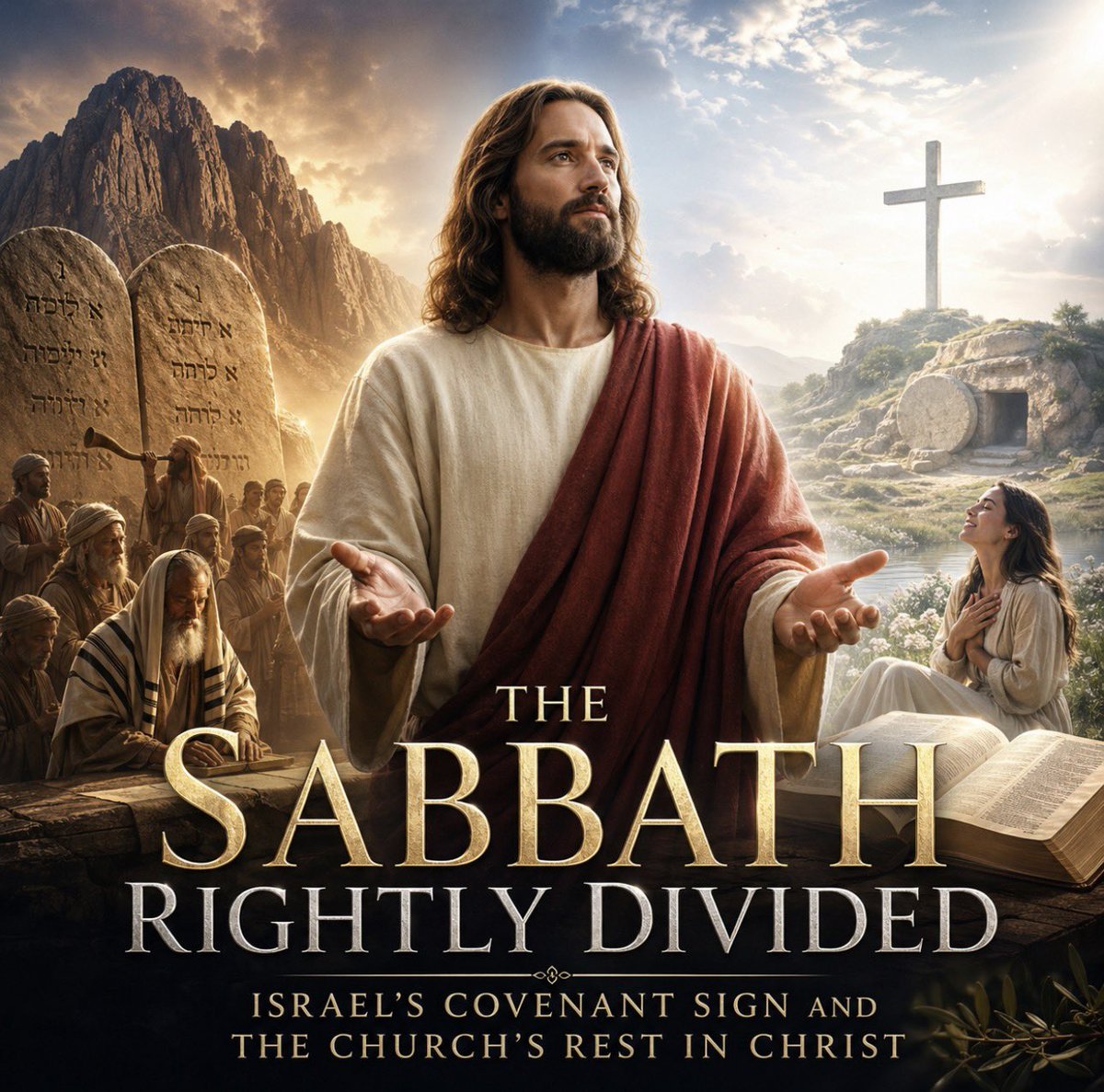
The Sabbath Rightly Divided: Israel’s Covenant Sign and the Church’s Rest in Christ

Main Point: The Sabbath was a holy covenant sign given to Israel under the law, but the Church is not commanded to keep the Sabbath as Israel did. The believer’s rest is found in Christ, and no man is allowed to judge the body of Christ by Sabbath days.

Introduction

The Sabbath is one of those subjects where people can take a Bible truth, refuse to rightly divide it, drag it across dispensational lines, and then beat the Church over the head with a commandment God gave to Israel under the law. That is how bondage gets built. A man opens Exodus 20, sees the fourth commandment, reads “Remember the sabbath day, to keep it holy,” and then runs straight into a Church Age believer’s life demanding Saturday observance, Sabbath restrictions, and Old Testament penalties, without stopping long enough to ask who was being addressed, under what covenant, for what purpose, and how Paul teaches the body of Christ to handle days under grace. That is not careful Bible study. That is stealing Israel’s mail, ignoring Paul, and then acting like you are more spiritual because you put people under a yoke God did not put on the Church.

Now let us be plain from the start. The Sabbath was not evil. The Sabbath was not unimportant. The Sabbath was not a mistake. God sanctified the seventh day in Genesis 2 after His work of creation was finished. Later, under Moses, He gave Israel the Sabbath as part of the law. It was serious. It was holy. It was tied to Israel’s covenant relationship with God. Exodus 31 says the Sabbath was a sign between God and the children of Israel. That is the key that unlocks the door. The question is not whether the Sabbath mattered. Of course it mattered. The question is whether the Church, the body of Christ, saved by grace after the finished work of Jesus Christ, is placed under Israel’s Sabbath command as a binding ordinance today. The answer from Paul is no. Colossians 2:16 says, “Let no man therefore judge you… in respect of… the sabbath days.” That verse alone should settle the matter for anyone who believes the words on the page.

The Bible believer does not throw away the Sabbath. He rightly divides it. He sees creation rest in Genesis, covenant command in Exodus, national sign in Exodus 31, kingdom and Jewish context in the Gospels, transitional history in Acts, liberty in Romans 14, warning against bondage in Galatians 4, freedom from Sabbath judgment in Colossians 2, and spiritual rest in Christ in Hebrews 4. That is Bible study. The Church is not Israel. The body of Christ is not under the Mosaic covenant. Pastors are not Levitical priests. Church buildings are not the temple. Sunday is not the Christian Sabbath in the sense of replacing Israel’s seventh-day law. The believer’s standing is in Christ, his rest is in Christ, his righteousness is in Christ, and his walk is governed by the Spirit through sound doctrine, not by being dragged back under the shadow of a covenant sign given to Israel.

Chapter 1: God Sanctified the Seventh Day Before He Gave Israel the Sabbath Command

Genesis 2:2-3 says, “And on the seventh day God ended his work which he had made; and he rested on the seventh day from all his work which he had made. And God blessed the seventh day, and sanctified it.” That is the first mention of the seventh day being blessed and sanctified. God rested because His work was complete, not because He was tired. The Almighty does not get worn out. The rest of God in Genesis is the rest of completed work. Creation was finished, ordered, declared good, and God rested on the seventh day.

But here is where men often make a leap the text does not make. Genesis 2 shows God blessing and sanctifying the seventh day, but it does not show Adam being given a Sabbath command with Mosaic restrictions. It does not show Adam being told not to gather sticks. It does not show Noah keeping Sabbath law. It does notImage
show Abraham being commanded under the fourth commandment. It does not show a pre-Mosaic Sabbath ordinance enforced with the penalties later given to Israel. The seventh day is sanctified in creation, but the Sabbath command as a covenant law comes later through Moses to Israel.

That distinction matters. If a man refuses it, he will start dragging every reference to the seventh day into one flat system. But the Bible develops doctrine progressively. A thing can appear in seed form in Genesis and then receive covenantal form later. Marriage appears in Genesis before the law. Circumcision is given to Abraham before Moses. The Sabbath as a commandment and covenant sign is given to Israel under Moses. Genesis 2 establishes the pattern of divine rest after completed work. Exodus establishes Sabbath observance as law for Israel. Those are related, but they are not identical in administration.

Chapter 2: The Sabbath Command Was Given to Israel Under the Law

Exodus 20 gives the fourth commandment: “Remember the sabbath day, to keep it holy.” God then commands six days of labor and the seventh day as the sabbath of the LORD. That commandment is part of the covenant law given at Sinai to Israel. The people standing there were not Gentile nations, not the body of Christ, not the Church Age believer seated in heavenly places. They were Israel, redeemed out of Egypt, gathered at Sinai, receiving the law through Moses. The law had a historical setting, a national people, a covenant structure, and specific commands tied to Israel’s life under God.

Deuteronomy 5 repeats the commandment, but it gives a reason tied directly to Israel’s deliverance from Egypt: “And remember that thou wast a servant in the land of Egypt, and that the LORD thy God brought thee out thence through a mighty hand and by a stretched out arm: therefore the LORD thy God commanded thee to keep the sabbath day.” That is not universalized Church Age language. That is Israel’s national history. The Sabbath was linked to creation rest in Exodus and to redemption from Egypt in Deuteronomy. Both are true, but the command is still given in the law to Israel.

This is why it is dishonest to lift the Sabbath command out of Exodus 20, carry it into the Church, and then ignore the rest of the Mosaic law around it. If a man wants to put the Church under Sabbath law, let him read the penalties too. Numbers 15 shows a man gathering sticks on the Sabbath, and he is stoned. Exodus 31 says the one who profanes it shall surely be put to death. The Sabbath under the law was not a casual preference. It was part of Israel’s covenant order with real penalties. Modern Sabbath pushers want the commandment without the covenant context, the day without the penalties, and Moses without the full law. That is not right division. That is selective legalism.

Chapter 3: Exodus 31 Defines the Sabbath as a Sign Between God and Israel

Exodus 31:16-17 is the verse that ought to stop the argument: “Wherefore the children of Israel shall keep the sabbath, to observe the sabbath throughout their generations, for a perpetual covenant. It is a sign between me and the children of Israel for ever.” That is specific. It does not say the Sabbath is a sign between God and the Church. It does not say it is a sign between God and all nations. It does not say it is a sign between God and Gentile believers in the body of Christ. It says it is a sign between God and the children of Israel.

A sign points to a covenant relationship. Circumcision was a sign connected with Abraham’s seed. The rainbow was a sign connected with God’s covenant after the flood. The Sabbath was a sign connected with Israel under the law. That does not make the Sabbath meaningless. It makes it specific. God knows how to identify who He is speaking about. If He says Israel, believe Israel. If He says the Church, believe the Church. If He says the nations, believe the nations. Confusion begins when men blur those
distinctions and then call the blur spirituality.

The Sabbath was part of Israel’s identity as a separated nation. It marked them off from the nations around them. Their calendar, feasts, sacrifices, priesthood, temple, dietary laws, circumcision, and Sabbath observance all belonged to a covenant system. When a man today tries to make Sabbath-keeping a requirement for the body of Christ, he is reaching back into Israel’s covenant sign and trying to lay it on a people who are not under that covenant. Paul spent a good portion of his ministry fighting men who tried to put Gentile believers under the yoke of the law. The Sabbath question fits inside that larger fight.

Chapter 4: Jesus and the Sabbath Must Be Read in Israel’s Setting

In the Gospels, Jesus deals often with the Sabbath because He is ministering to Israel under the law before the cross. He attends synagogues. He heals on the Sabbath. He exposes Pharisaic hypocrisy. He declares that “the Son of man is Lord even of the sabbath day” (Matthew 12:8). Those passages are powerful, but they must be read in their setting. Jesus was not establishing a post-Calvary Church Age Sabbath ordinance. He was confronting Israel’s religious leaders and revealing His authority over the very law they claimed to defend.

Matthew 12 is especially important. The Pharisees accuse the disciples when they pluck ears of corn on the Sabbath. Jesus answers by pointing to David eating the shewbread and the priests profaning the Sabbath in the temple and being blameless. He then says, “in this place is one greater than the temple.” That is a staggering claim. The Lord of the Sabbath is standing in front of Sabbath legalists, and they are too blind to see Him. They use the Sabbath to accuse the One who owns it. That is religion at its worst.

Jesus also says, “The sabbath was made for man, and not man for the sabbath” (Mark 2:27). The Sabbath was never intended to become a Pharisee weapon for crushing people under man-made traditions. It was a divine command within Israel’s covenant life, pointing to rest, worship, order, and God’s authority. But the Pharisees turned it into a system of accusation. That same spirit is alive today. Men take a command given to Israel, add their own pressure, and then judge Church Age believers who stand in Pauline liberty. The Lord rebuked that spirit then, and Paul rebukes it later.

Chapter 5: The Church Is Not Commanded to Keep the Sabbath

Here is where the matter becomes very simple. When Paul writes to the body of Christ, he never commands Sabbath-keeping as a requirement. He never says, “Brethren, remember the Sabbath day.” He never tells Gentile believers they are under the fourth commandment as a covenant sign. He never makes Saturday observance a test of spirituality. Instead, Romans 14:5-6 says, “One man esteemeth one day above another: another esteemeth every day alike. Let every man be fully persuaded in his own mind.” That is not Mosaic Sabbath enforcement. That is liberty.

Galatians 4:9-11 is even stronger. Paul rebukes believers for turning again to weak and beggarly elements and says, “Ye observe days, and months, and times, and years. I am afraid of you.” That is not Paul celebrating legal calendar bondage. He sees danger when believers who were saved by grace begin placing themselves under religious observances as though those things perfect them. The Galatians were being bewitched by law teachers. Paul does not pat them on the back for getting more “Hebrew.” He warns them.

Then Colossians 2:16 gives the direct command: “Let no man therefore judge you in meat, or in drink, or in respect of an holyday, or of the new moon, or of the sabbath days.” There it is. No man is allowed to judge the body of Christ by Sabbath days. Why? Verse 17 says, “Which are a shadow of things to come; but the body is of Christ.” The Sabbath was a shadow. Christ is the substance. A shadow has a purpose, but once the substance stands before
Read 5 tweets
Apr 30
John Piper Exposed - When Christian Hedonism, Pleasure-Centered Theology, and Experiential Calvinism Replace the Simplicity of Scripture

There are some men who are easy to spot because they are loud, flashy, careless, and obviously commercial. They wear their compromise on their sleeve and their corruption on their face. Then there are others who are far more dangerous because they come wrapped in seriousness, academic depth, missionary zeal, strong language about the glory of God, and a reputation for weighty preaching. John Piper belongs to that second category. He is not a Benny Hinn type spectacle. He is not a soft motivational talker. He sounds grave, thoughtful, poetic, intense, and God-centered. That is exactly why so many conservative Christians drop their guard around him. They hear him speak about the majesty of God, the nations, suffering, joy in Christ, and the supremacy of God, and they assume that because the tone is serious, the theology must be sound all the way through. But the Devil has never been limited to using clowns. He can use professors too. He can use men who read Edwards, quote Lewis, speak of missions, and fill their sermons with passionate phrases about delight in God while still introducing a framework that bends plain Bible truth into a highly systematized, pleasure-centered, experiential theology.

The heart of the issue with John Piper is not that he says nothing true. He says many true things. That is what makes him influential. Error that never borrows truth rarely gets very far. The issue is that he takes certain biblical truths and stretches them until they begin governing everything else in ways Scripture itself does not. He does not simply say that believers should rejoice in the Lord, which is true. He builds a whole system around joy, delight, desire, pleasure, satisfaction, and happiness in God, then makes that framework the controlling lens through which worship, love, missions, marriage, giving, suffering, and the Christian life as a whole are interpreted. That is where Christian Hedonism comes in. He may dress it up in refined language, and he may insist he means pleasure in God and not worldly lust, but the term itself and the system behind it shift the center of gravity. The Christian life stops sounding like faith in what God said, obedience to what God commanded, and submission to what Scripture plainly teaches. It starts sounding like a lifelong project of maximizing joy, delight, and satisfaction in God in such a way that even duty, sacrifice, suffering, and holiness are drawn into the orbit of a pleasure-principle.

That is why this essay matters. John Piper has influenced pastors, missionaries, seminary students, conference speakers, young fundamentalists, conservative evangelicals, and Calvinistic circles for years. He is not a fringe figure. He is a system-builder. He is a tone-setter. He is a gateway voice for a whole way of reading the Bible and a whole way of feeling religion. The tragedy is that many men who would have rejected overt charismatic foolishness or prosperity circus religion have swallowed Piper’s system because it came through the front door of serious preaching and exalted language about God. But a thing does not become safe because it sounds lofty. The serpent talked theology in Eden. The question is not whether a man sounds intelligent. The question is whether he is handling the words of God plainly, simply, and soundly. And when John Piper’s theology is brought into the light, what emerges is a system where Christian Hedonism, pleasure-centered theology, and experiential Calvinism begin replacing the simplicity that is in Christ.

Chapter 1: Christian Hedonism Puts the Wrong Center in the Middle of the Christian Life

The first and greatest problem with John Piper is the phrase he chose, defended, popularized, and built an empire around: Christian Hedonism. That is not a side remark. That is not an unfortunate passingImage
expression. That is the central framing device of his ministry. He openly teaches that the chief end of man is to glorify God by enjoying Him forever and that the pursuit of joy in God is not a secondary feature of the Christian life but its essential engine. Now right away some people will say, “What is wrong with enjoying God?” Nothing is wrong with enjoying God. Saints should rejoice in the Lord. They should delight in Christ. They should love the Lord their God. But that is not the whole issue. The issue is not whether joy belongs in the Christian life. The issue is whether joy should be made the interpretive center of everything, and whether the pursuit of personal satisfaction should be framed so strongly that it becomes the organizing principle of worship, love, obedience, holiness, and suffering. That is exactly what Piper has done.

The Bible never calls the Christian life Christian Hedonism. That term is not just provocative. It is corrupting. Hedonism, by definition, is historically tied to pleasure as a chief good. Piper tries to baptize the word, qualify the word, redirect the word, and sanctify the word, but the effect remains the same. He normalizes the idea that the believer’s highest duty is inseparably tied to the pursuit of pleasure. He insists this pleasure is in God, and that sounds safer, but even then the emphasis begins to change the tone of Christianity. Instead of preaching first that God is holy, man is guilty, Christ is sufficient, and the believer must submit to Scripture whether he feels pleasure or not, Piper repeatedly trains people to think in terms of joy, delight, desire, happiness, and satisfaction as the very framework through which all duty becomes intelligible. The center moves from what is true and right to what is joy-producing in God. That is too much weight to put on one theme, even a biblical one.

Once that happens, the plain sense of Christian obedience starts getting altered. Obedience is no longer primarily because God said so. Worship is no longer first because God is worthy. Love is no longer first because righteousness demands it. The whole structure becomes “do this because it leads to deepest joy in God.” That may sound like a subtle difference, but it is enormous. It turns the Christian life into a pleasure-logic, even if it is “spiritual pleasure.” It trains the saint to ask not only, “What did God command?” but “How does this maximize my enjoyment of God?” The simplicity of a childlike faith that obeys because the Father spoke gets displaced by a more complex theological machine. And once you replace simplicity with a machine, you start producing disciples who are more fluent in Piper’s categories than in Scripture’s plain ones.

Chapter 2: Pleasure-Centered Theology Distorts Worship, Love, and Obedience

The second problem is that Piper’s system makes pleasure so central that worship, love, and obedience begin sounding dependent on the pursuit of delight. He says things that appear profound, such as God being most glorified in us when we are most satisfied in Him. That sentence is famous because it is clever, memorable, poetic, and emotionally compelling. But clever theology is not automatically sound theology. The Bible says whether ye eat or drink, or whatsoever ye do, do all to the glory of God. It does not say God is most glorified in you when your inward state of satisfaction is at its highest. That is Piper’s formula, not Paul’s. Paul grounds duty in divine command, divine ownership, divine truth, and divine judgment. Piper repeatedly grounds duty in delight. That changes the center of the whole matter.

Take worship, for instance. The Bible teaches worship because God is God. He is worthy whether I feel delight or dryness. He is worthy if I am weeping, trembling, broken, confused, or under a dark cloud. But Piper’s system keeps moving back to the idea that worship reaches its essence in delight and satisfaction. Again, delight belongs in
worship, but if you make delight the central explanatory principle, then you are making the inward experience of pleasure too dominant. The simple believer in a season of spiritual drought may begin to question whether he is truly worshiping if he is not experiencing the right kind of delight. The saint under deep affliction may begin to measure spiritual health by emotional intensity rather than by faithful endurance. Piper often tries to include suffering inside his joy framework, but the framework still puts too much stress on experience and affection.

The same problem appears in love and obedience. Piper wants to say that love is strongest when it pursues joy in the joy of the beloved, and obedience is sustained by the superior pleasure of God over sin. There is truth in the idea that sin loses power when Christ is prized more highly. But Piper keeps turning that truth into the key that unlocks nearly everything. The result is that love starts sounding less like self-denial under God’s command and more like an enlightened pursuit of God-centered joy. Obedience starts sounding less like submission to a holy Lord and more like the best route to deepest pleasure. He does not deny submission, but his framing weakens its plainness. The soldier obeys because the Captain commands. The servant obeys because the Master is right. The child obeys because the Father spoke. Piper adds another layer that need not be there and should not be there.

Chapter 3: Experiential Calvinism Makes Feeling Too Central to Doctrine

The third issue is what can only be called experiential Calvinism. Piper is not simply Calvinistic in a doctrinal sense. He is deeply experiential in the way he presents Calvinism. He wants the sovereignty of God to be savored, felt, relished, enjoyed, and emotionally tasted. Again, this is what makes him appealing. He is not a dry five-point pamphlet machine. He makes sovereignty sound warm, majestic, emotionally rich, and spiritually intoxicating. But that is also where the danger lies. The doctrines of grace become not merely truths to be believed, but a total atmosphere to inhabit, feel, and emotionally revel in. That can make the hearer less concerned with whether the doctrine is being handled rightly and more concerned with whether the doctrine is creating the right kind of inward sensation.

This becomes especially serious in the way Piper speaks about suffering. He consistently frames suffering under the absolute sovereignty of God in ways that are intense, emotionally weighty, and experientially charged. He wants people to feel the grandeur of God’s rule over every affliction, every disease, every disaster, every pain. He wants them to say, “Though he slay me, yet will I trust him,” and there is a biblical truth there. But Piper presses divine sovereignty so hard and with such emotionally absolute force that weaker believers can come away with a crushing view of life in which every wound, horror, and devastation is immediately drawn into a tight decree-framework without enough room for the Bible’s plain distinctions, pastoral gentleness, and simple submission to mystery where God has not spoken in detail. He is often theologically daring where the saints would be safer with reverent restraint.

This is what experiential Calvinism often does. It turns the doctrines of grace into an all-encompassing interpretive universe where the believer is expected not only to affirm divine sovereignty but to feel it as beautiful, to savor it as sweet, and to rest in it with near-poetic relish. That may work for the philosophical temperament or the theological romantic, but it can burden ordinary saints. Some believers just need to know God is good, Christ is faithful, the Bible is true, and they are to trust Him even when they do not understand. Piper often moves beyond that simplicity and builds a world where one must emotionally metabolize sovereignty in a specific way. That is not the simplicity of Scripture. That is a
Read 6 tweets

Did Thread Reader help you today?

Support us! We are indie developers!


This site is made by just two indie developers on a laptop doing marketing, support and development! Read more about the story.

Become a Premium Member ($3/month or $30/year) and get exclusive features!

Become Premium

Don't want to be a Premium member but still want to support us?

Make a small donation by buying us coffee ($5) or help with server cost ($10)

Donate via Paypal

Or Donate anonymously using crypto!

Ethereum

0xfe58350B80634f60Fa6Dc149a72b4DFbc17D341E copy

Bitcoin

3ATGMxNzCUFzxpMCHL5sWSt4DVtS8UqXpi copy

Thank you for your support!

Follow Us!

:(