I mapped the entire AI agent infrastructure market. 75+ companies, over $14B in tracked funding, 8 infrastructure layers.
Most of the money is going to 2 layers. Bigger platforms are starting to absorb the other 6.
A thread on what I found.
Most of the money is going to 2 layers. Bigger platforms are starting to absorb the other 6.
A thread on what I found.

AI agents don't run on model APIs alone. They need a full infrastructure stack.
Each of the 8 layers has distinct buyers, pricing, and failure modes.
Perception → Orchestration → Evaluation → Compute → Memory → Sandboxed Execution → Security → Agents as Products
Each of the 8 layers has distinct buyers, pricing, and failure modes.
Perception → Orchestration → Evaluation → Compute → Memory → Sandboxed Execution → Security → Agents as Products
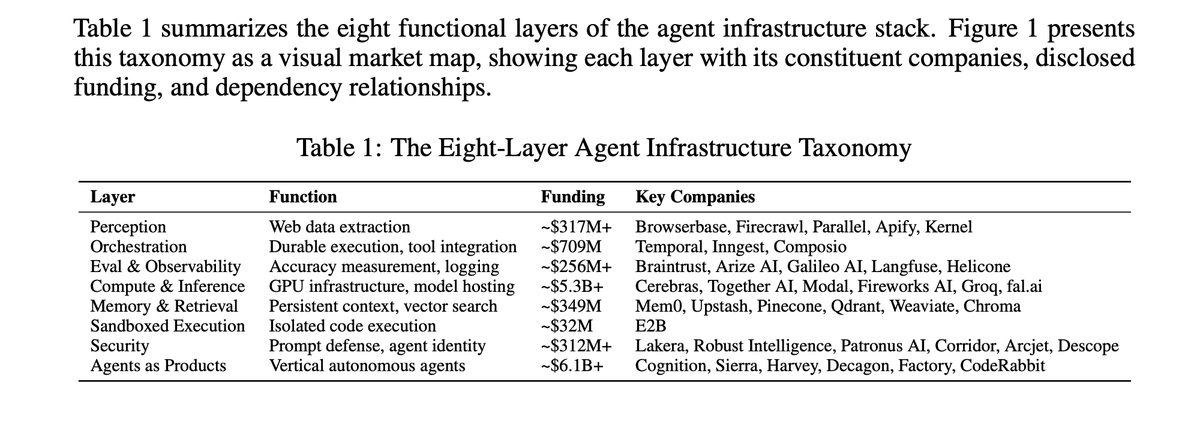
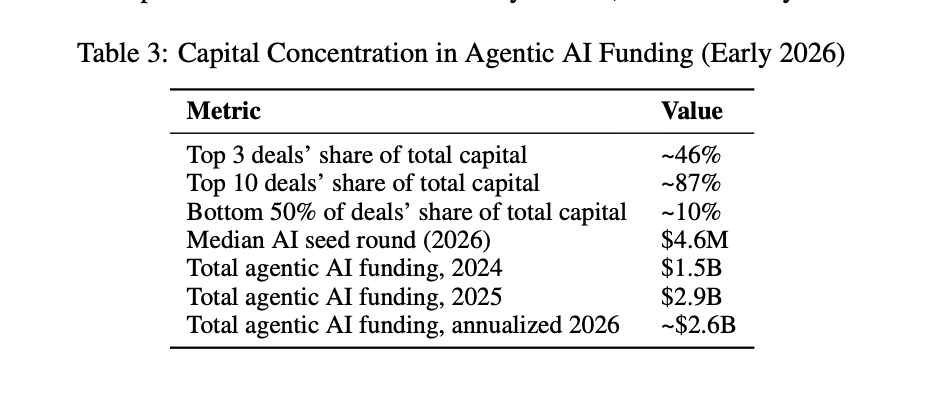
Compute and vertical agent products capture over 85% of total capital in the dataset.
Cerebras went public at a $95B market cap. Together AI reports approximately $1B ARR. Modal raised $466M
The 6 middle layers split the remaining 15% among themselves.
Cerebras went public at a $95B market cap. Together AI reports approximately $1B ARR. Modal raised $466M
The 6 middle layers split the remaining 15% among themselves.

Bigger platforms are absorbing observability and security startups.
ClickHouse bought Langfuse. Mintlify bought Helicone. Cisco bought two agent infrastructure companies in under two years.
LLM observability may not survive as an independent category.
ClickHouse bought Langfuse. Mintlify bought Helicone. Cisco bought two agent infrastructure companies in under two years.
LLM observability may not survive as an independent category.

Every time OpenAI or Anthropic ships a native feature, a cohort of startups loses its value proposition.
Function calling, code execution, web browsing. Each one displaced a cohort of startups.
The survivors own infrastructure that model providers are unlikely to replicate.
Function calling, code execution, web browsing. Each one displaced a cohort of startups.
The survivors own infrastructure that model providers are unlikely to replicate.

Agent memory seems to be the least solved layer (episodic, semantic, working, procedural).
Sandboxed execution is one of the most defensible layers.
E2B raised $32M and runs untrusted, LLM-generated code in isolated micro-VMs + reports 88% Fortune 100 adoption.
Sandboxed execution is one of the most defensible layers.
E2B raised $32M and runs untrusted, LLM-generated code in isolated micro-VMs + reports 88% Fortune 100 adoption.

The distribution of capital across the stack is extremely uneven, both across layers and within them.
About acquisitions: Security and observability seem to be the most acquired layers.
About acquisitions: Security and observability seem to be the most acquired layers.
5 open questions:
1. Do the 8 layers collapse into 3-4 bundles?
2. Do wrapper startups die in the next model update?
3. Is compute scarcity permanent?
4. Will parallel Chinese stacks alter global dynamics?
5. Who bears liability for agent contracts?
1. Do the 8 layers collapse into 3-4 bundles?
2. Do wrapper startups die in the next model update?
3. Is compute scarcity permanent?
4. Will parallel Chinese stacks alter global dynamics?
5. Who bears liability for agent contracts?

The 8 layers form a dependency stack: compute sits at the bottom, perception feeds orchestration, and memory stores results.
Security and evaluation cut across the entire stack, and sandboxed execution runs untrusted code.
Read the full paper here: dx.doi.org/10.2139/ssrn.6…
Security and evaluation cut across the entire stack, and sandboxed execution runs untrusted code.
Read the full paper here: dx.doi.org/10.2139/ssrn.6…

• • •
Missing some Tweet in this thread? You can try to
force a refresh