1/6 🧵The word "sad" has been completely eliminated from our lexicon.
In its place: disorders, diagnoses, chemical imbalances, and treatment protocols.
2/6 In 1990, roughly 2% of Americans identified as depressed. Today that number is 17.8%.
Is the purported 250% surge in clinical depression genuine, or is there a darker and more insidious force at play?
3/6 Historically, the perception of clinical depression as a chronic and severe condition necessitating medical intervention was uncommon. It wasn't considered a public health concern.
This trend continued until the mass marketing of antidepressants to the general population.
4/6 A diagnosis of Major Depressive Disorder requires only a two-week designation of change from previous "functioning."
Essentially, a brief period of struggle within this timeframe could be interpreted as indicative of a "disorder."
5/6 Those characterized as severely depressed are catatonic, enduring multiple hospitalizations, facing prolonged and debilitating depression lasting months or years — not two weeks.
Most outpatient therapists who designate clients as severely depressed have never met these individuals.
6/6 Statistically speaking, it's highly probable that if you were prescribed an antidepressant drug, you shouldn't have been.
This is disease mongering — a very effective marketing tactic to increase pharmaceutical sales and psychiatric treatment.
1/8 The sticks and stones rhyme was better mental health advice than anything we’ve replaced it with. We didn’t discover a fragile generation. We manufactured one — and I watched it happen in real time across thirty years of clinical practice.
🧵
2/8 In 2004 I was working in a middle school. “Bullying” was expanding to mean eye-rolling, exclusion, being left out of a group chat. We taught children that words were injuries, that injuries demanded a response, and that the correct response was to escalate to an authority. Every time they did it, they rehearsed fragility.
3/8 Psychologist Nick Haslam calls it concept creep. When you stretch the definition of harm — trauma, abuse, bullying, violence — you manufacture victims by definition. Not because anything got worse. Because you moved the boundary of the word. Philosopher Ian Hacking called the next step the looping effect: name a kind of person into existence, and they obligingly become it.
1/6 The most widely used depression screening tool in American medicine was created by a Pfizer marketing executive.
Not a psychiatrist. Not a researcher. A marketer.
This is the story of how a pharmaceutical company manufactured an epidemic. 🧵
2/6 In the early 1990s, depression was considered rare.
That was a problem for Pfizer.
They had a new antidepressant, Zoloft, and not enough patients to sell it to.
So they set out to change what depression meant.
3/6 The target wasn't psychiatrists. It was your family doctor.
If Pfizer could get primary care physicians diagnosing and prescribing -- they'd access millions of patients who'd never see a specialist.
They needed a tool simple enough for a 15-minute appointment.
1/In 1955, bipolar disorder disabled 1 in every 13,000 people.
Today it's 1 in 22.
We didn't get sicker. The diagnosis got bigger.
Thread 🧵
2/ Bipolar disorder has no confirmed genetic marker. No validated biomarker. No lab test that can establish its presence in a single human being.
It is a symptom checklist voted into existence by committee and handed to patients as if it were a diagnosis in the same category as diabetes.
3/ Three of seven symptoms for one week and you qualify for a Bipolar I diagnosis.
Distractibility. Decreased need for sleep. Increased goal-directed activity.
The bar is in hell. You've probably cleared it.
"I have anxiety" has become the most overused phrase in America.
Not because people aren't suffering — they are.
But somewhere along the way, a universal human emotion got rebranded as a lifelong medical identity.
And the people who were supposed to help you? They made it worse.
🧵
Here's what nobody's saying out loud:
The more you talk about your anxiety, the more anxiety you create.
Every therapy session spent dissecting your fear. Every time you narrate it to a friend. Every post you make about it.
You're not processing it. You're rehearsing it.
Big Pharma found a goldmine. Therapists found a business model. Social media found an identity.
And you? You found a story.
"I am someone who has anxiety."
The story became the cage.
What actually resolves it looks nothing like what you've been told.
🧵1/ In 2025, the CIA quietly added a document to its public reading room.
Written in 1952. A program to develop chemicals that produce anxiety, depression, docility, and confusion — delivered to subjects without their knowledge.
The targets were not foreign enemies.
They were ordinary Americans.
🧵2/ The man who ran the program was simultaneously president of the American Psychiatric Association.
He kept patients in chemically induced sleep for weeks. Erased their identities. Called it therapy.
He was not expelled. He was not prosecuted.
He mentored generations of psychiatrists.
🧵3/ In 1973, the CIA burned the files before investigators arrived.
The researchers went back to their universities. Their hospitals. Their grant applications.
The methods didn't burn. They privatized.
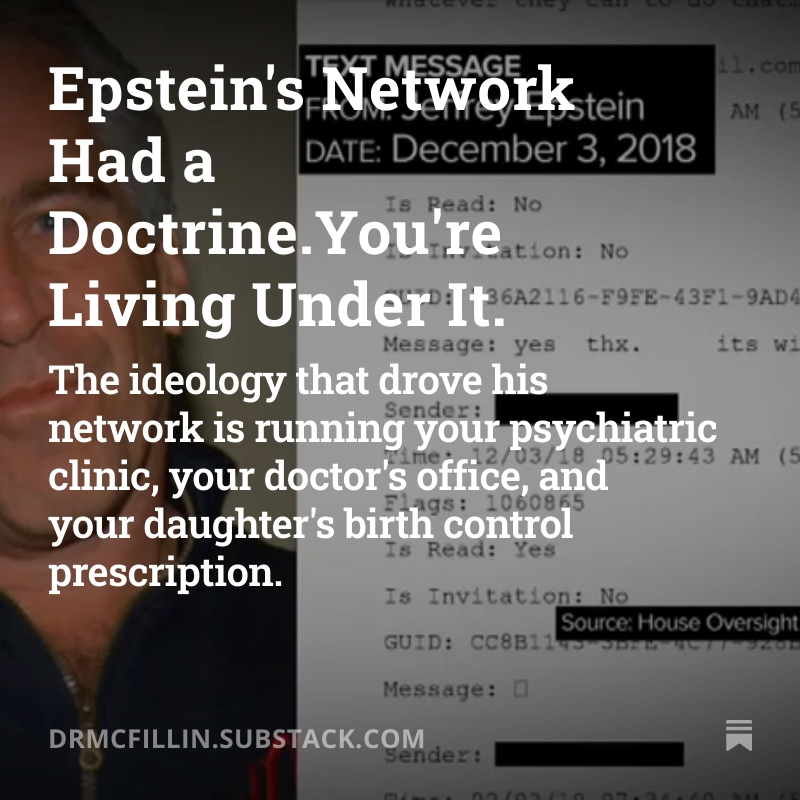
🧵1/5 Buried inside the Epstein files is something far more disturbing than a blackmail network, as sinister as that is. What the documents reveal is a worldview. A coherent, funded, institutionally embedded worldview about what human beings are, what they’re worth, and who gets to decide.
2/5 Epstein donated to the World Transhumanist Association. He funneled thirty million dollars into Harvard’s Program for Evolutionary Dynamics. He was in active discussions about financing a designer baby project, altering human germline DNA so parents could engineer heritable traits in their children.
3/5 He told scientists and wealthy associates that he planned to use his New Mexico ranch to impregnate twenty women at a time. His goal, in the words of the New York Times, was to “seed the human race with his DNA.”