I see index rebal is in the news again. One question we've covered both sides of over the years:
Do the profits come at the expense of index investors?
Thread 🧵👇
Do the profits come at the expense of index investors?
Thread 🧵👇
https://twitter.com/nishantkumar07/status/2074157551373980093
1/ The 'yes' side is pretty obvious. In 2022, we wrote about a paper that shows index additions on avg rise 67 bps in the 5 days before rebal date, then drift downward.
The conclusion here is passive should *not* be trading on rebal day and the only reason to do so is to keep tracking error low
papers.ssrn.com/sol3/papers.cf…
The conclusion here is passive should *not* be trading on rebal day and the only reason to do so is to keep tracking error low
papers.ssrn.com/sol3/papers.cf…
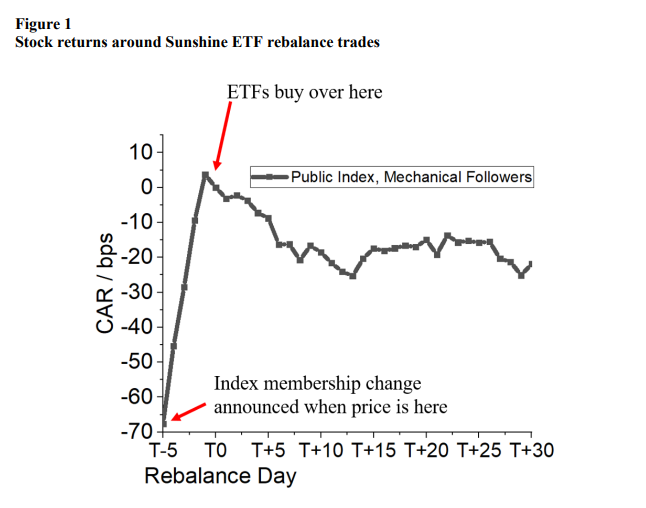
2/ The author also argues it's good to be opaque about when you rebalance.
A classic divergence: Even for the same index tracked, BlackRock rebalances on known dates, Vanguard spreads out the trades and doesn't disclose holdings every day
A classic divergence: Even for the same index tracked, BlackRock rebalances on known dates, Vanguard spreads out the trades and doesn't disclose holdings every day
3/ But if that's the case, why is it that even closet index trackers (incl institutions with internal passive portfolios) rebal on rebal day?
This famous paper by Chinco-Sammon says rebal day volumes are *3x* what the known size of index funds should be
papers.ssrn.com/sol3/papers.cf…
This famous paper by Chinco-Sammon says rebal day volumes are *3x* what the known size of index funds should be
papers.ssrn.com/sol3/papers.cf…

4/ Sammon et al follows up on this with a new paper: it's actually better to trade on rebal days coz rebal desks are there to provide liquidity
(The problem is when you fast-track IPOs and there isn't that much time to pre-position, *ahem* SPCX)
papers.ssrn.com/sol3/papers.cf…
(The problem is when you fast-track IPOs and there isn't that much time to pre-position, *ahem* SPCX)
papers.ssrn.com/sol3/papers.cf…
5/ So how has the index effect changed over time?
Greenwood-Sammon says it's weakened (for SPX at least) papers.ssrn.com/sol3/papers.cf…
DFA says it's still there dimensional.com/lu-en/insights…
Greenwood-Sammon says it's weakened (for SPX at least) papers.ssrn.com/sol3/papers.cf…
DFA says it's still there dimensional.com/lu-en/insights…
6/ What's prob true is as index rebal trades spread, the effect has weakened and also started earlier, which for the desks mean you have to weather more vol in the stocks
There's also a natural ebb and flow. As the strat got crowded after SPX's TSLA addition, returns worsened, some teams got cut etc, as @nishantkumar07 and I wrote about in 2023
bloomberg.com/news/articles/…
There's also a natural ebb and flow. As the strat got crowded after SPX's TSLA addition, returns worsened, some teams got cut etc, as @nishantkumar07 and I wrote about in 2023
bloomberg.com/news/articles/…
7/ But clearly it's back again!
• • •
Missing some Tweet in this thread? You can try to
force a refresh