
1/10
Dallas-Fort Worth added no net engineering jobs for a DECADE.
There were 40,000 engineering jobs in 2012. And roughly 40,000 in 2022.
Meanwhile, OPT guest workers in those same jobs doubled.
The "shortage" story doesn't survive contact with the data. 🧵
Dallas-Fort Worth added no net engineering jobs for a DECADE.
There were 40,000 engineering jobs in 2012. And roughly 40,000 in 2022.
Meanwhile, OPT guest workers in those same jobs doubled.
The "shortage" story doesn't survive contact with the data. 🧵
2/10
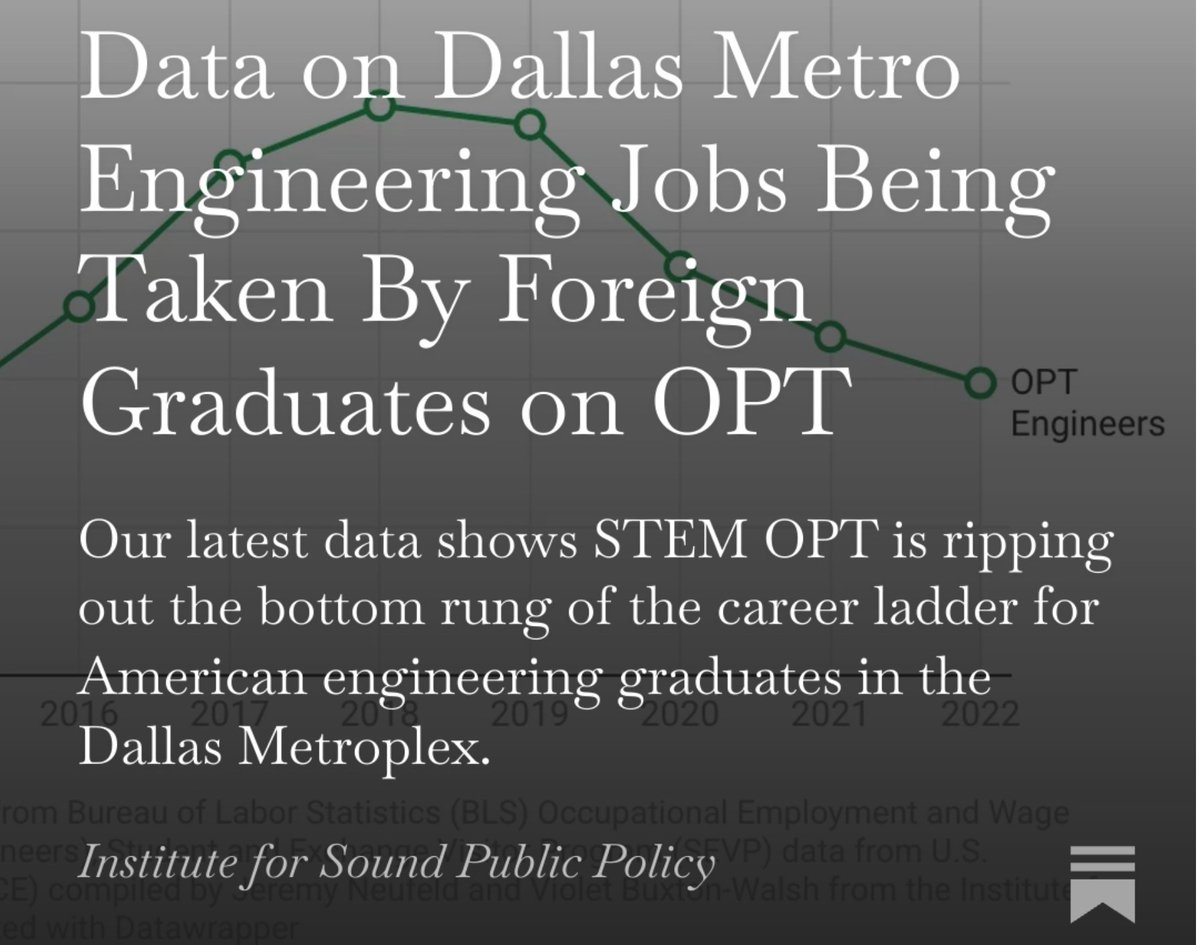
In 2022, OPT workers held 3,913 of DFW's engineering jobs, nearly 10% of the entire sector.
In 2012, it was 5%.
Same number of jobs. Twice the guest worker share.
In 2022, OPT workers held 3,913 of DFW's engineering jobs, nearly 10% of the entire sector.
In 2012, it was 5%.
Same number of jobs. Twice the guest worker share.
3/10
It gets more dramatic. Between 2014-2018, OPT's share of DFW engineering jobs nearly QUADRUPLED from 5% to 19%.
That's not organic growth. That's a policy-driven surge.
It gets more dramatic. Between 2014-2018, OPT's share of DFW engineering jobs nearly QUADRUPLED from 5% to 19%.
That's not organic growth. That's a policy-driven surge.

4/10
Here's why: the STEM OPT extension wasn't always this generous.
Bush set it at 29 months.
Obama expanded it to 36 months in 2016.
Both moves made unilaterally by the executive branch. No vote. No cap. No requirement to try hiring an American first.
Here's why: the STEM OPT extension wasn't always this generous.
Bush set it at 29 months.
Obama expanded it to 36 months in 2016.
Both moves made unilaterally by the executive branch. No vote. No cap. No requirement to try hiring an American first.

5/10
The year after Obama's expansion kicked in, OPT's share of DFW engineers jumped from 12.5% to 17% in a single year.
This is a government directed labor subsidy to corporations and universities.
The year after Obama's expansion kicked in, OPT's share of DFW engineers jumped from 12.5% to 17% in a single year.
This is a government directed labor subsidy to corporations and universities.
6/10
The powers that be want us to think "these are PhDs filling gaps nobody else can fill. . . "
WRONG! Only 11% of OPT engineers in Dallas held or were pursuing a U.S. PhD.
The other 89% (3,487 workers) were bachelor's and master's grads. Same credentials as American applicants.
The powers that be want us to think "these are PhDs filling gaps nobody else can fill. . . "
WRONG! Only 11% of OPT engineers in Dallas held or were pursuing a U.S. PhD.
The other 89% (3,487 workers) were bachelor's and master's grads. Same credentials as American applicants.
7/10
21% of these workers, over 800 in 2022 alone, came from ONE school: UT Arlington.
Add UT Dallas (the #2 largest STEM OPT campus in the country in 2018), and this stops looking like a labor shortage and starts looking like an institutionalized pipeline.
21% of these workers, over 800 in 2022 alone, came from ONE school: UT Arlington.
Add UT Dallas (the #2 largest STEM OPT campus in the country in 2018), and this stops looking like a labor shortage and starts looking like an institutionalized pipeline.

8/10
The part nobody mentions: OPT workers are exempt from Social Security and Medicare payroll taxes.
That's a built-in 15% discount for employers who hire a guest worker over an American grad.
It's not a loophole. It's the incentive structure working exactly as designed.
The part nobody mentions: OPT workers are exempt from Social Security and Medicare payroll taxes.
That's a built-in 15% discount for employers who hire a guest worker over an American grad.
It's not a loophole. It's the incentive structure working exactly as designed.
9/10
Every year, American engineering grads are told the field is booming and jobs are plentiful.
In Dallas, 1 in 10 entry-to-mid-level engineering jobs now goes to a worker whose hire costs the employer less in taxes than hiring them would.
Every year, American engineering grads are told the field is booming and jobs are plentiful.
In Dallas, 1 in 10 entry-to-mid-level engineering jobs now goes to a worker whose hire costs the employer less in taxes than hiring them would.
10/10
Dallas isn't an outlier — it's one of the fastest-growing, most engineering-dense metros in the country.
If the "shortage" story doesn't hold up here, it doesn't hold up anywhere.
For a full breakdown, check out our latest Substack: open.substack.com/pub/ifspp/p/da…
Dallas isn't an outlier — it's one of the fastest-growing, most engineering-dense metros in the country.
If the "shortage" story doesn't hold up here, it doesn't hold up anywhere.
For a full breakdown, check out our latest Substack: open.substack.com/pub/ifspp/p/da…
• • •
Missing some Tweet in this thread? You can try to
force a refresh





