A woman paid for Amazon Prime for 5 years before she realized she was using it wrong.
She'd ordered hundreds of packages. Watched a few shows on Prime Video. Never once looked past the "Buy Now" button.
Her cousin — who worked Amazon customer service for 3 years — was staying over for the holidays and watched her order a phone charger at full price.
She finally said: "Wait — can I see your account for a second? You're missing 9 things that come with the Prime you're already paying for. Amazon doesn't advertise most of these. They'd rather you not use them."
She changed 9 things in 10 minutes.
She saved $340 that month. Got a package a day early. Found $1,200 worth of stuff she already owned buried in a benefit she'd never opened.
Here's everything her cousin showed her:
1. Prime membership sharing — 2 adults, 4 teens, same Prime account
You can add another adult and up to 4 teens to your Prime household, and everyone gets full Prime shipping benefits on their own separate orders.
Go to Amazon Household under Accounts & Lists → Add Adult or Add Teen.
Her cousin's line: "Most families are paying for Prime twice without knowing it." One membership. Two full Prime accounts.
2. Amazon Warehouse — open-box and returned items at 20-50% off
Items customers returned, inspected and graded by Amazon, sitting in a separate store most people never open.
Search "Amazon Warehouse Deals" or filter any product page by "Used — Like New" / "Used — Very Good."
Same product. Same Prime shipping. Same return policy. Often 30%+ cheaper because someone opened the box and changed their mind.
3. Prime Video Channels you're already half-paying for
A lot of channels (some free with ads, some add-ons) are buried inside Prime Video and never show up unless you go looking.
Prime Video app → Home → scroll to "Channels."
Her cousin found she was already eligible for free-with-ads access to content she'd been paying for elsewhere through a separate app
4. Amazon Family — 20% off diapers, wipes, and baby items, automatically
Prime members with kids get an automatic discount plus subscribe-and-save stacking on baby essentials — most people just never toggle it on.
Accounts & Lists → Amazon Family → enable.
Not a coupon you have to remember. It just applies.
5. Prime Reading — free books, magazines, and comics included
Separate from Kindle Unlimited (that one costs extra). Prime Reading is already included in your Prime membership and rotates a real library of titles monthly.
Kindle app or Amazon app → Prime Reading.
She'd been paying for a different reading app subscription for two years. Cancelled it that night.
6. Return window checker before you buy — not after
Every product page has a return policy specific to that item, and Prime members get extended holiday return windows most people don't check until it's too late.
Product page → scroll to "Return & Refund Policy" before purchasing, not after.
Her cousin's line: "People find out the return window closed the day they actually need it."
• • •
Missing some Tweet in this thread? You can try to
force a refresh

And 99% of users ignore it every single day.
That’s a mistake.
Because it’s not just a feature — it’s the closest thing to building a second brain for your entire business inside Claude.
Here’s how to set up 5 Projects that can run your whole operation: 👇👇
Step 1: What Projects Actually Do
Projects give Claude persistent memory for your work.
Instead of starting from zero every time, each project carries a fixed layer of context you define once — and Claude uses it in every conversation inside that project.
That means:
No repeating your business details
No re-explaining your tone or goals
No re-setting instructions every chat
It just remembers the system you built.
Think of it like turning Claude from a chatbot into a specialized employee for each part of your business.
Now go to the sidebar and click Projects — you’re about to build 5 systems that actually run your workflow.
Step 2: Content Project
Create a project called “Content”.
This becomes your personal content engine — where everything you write is consistent, on-brand, and instantly usable.
Inside the project instructions, paste this:
---
**“My brand is [name].
My audience is [describe].
My tone is [3–5 words].
Platforms I post on: [list].
My content style: [describe or paste examples].
Every piece of content should sound like me, not AI.”
Once this is set, every request inside this project automatically carries your brand identity.
No more generic posts. No more rewriting the same context.
From now on, every content task starts with full brand memory already loaded — like you’ve hired a dedicated content strategist who never forgets your voice.
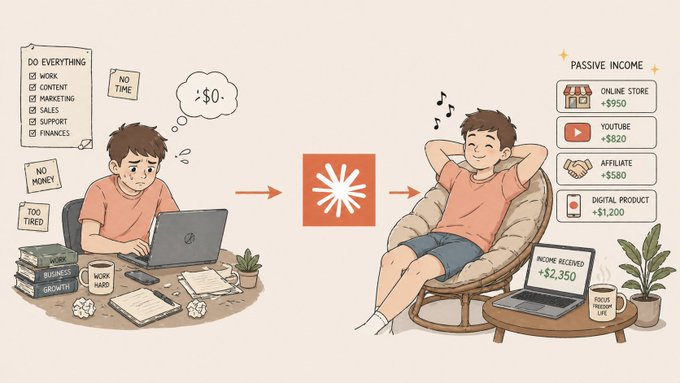
You're broke because you only have ONE income stream.
Claude can now build you 5 — running on autopilot while you sleep.
Here are 8 prompts that turn one skill into a passive income empire:
Save this thread 🧵👇
Prompt 1: Find the Income-Producing Skill You're Sitting On
Most people don't have an "income idea" problem. They have a leverage problem.
This prompt finds the skill hiding in plain sight:
Act as a wealth strategist who has helped 500+
professionals turn underused skills into multi-stream
income engines.
Here's my honest profile:
- Current job and skills: [LIST]
- Skills I've built but rarely use: [LIST]
- Topics I know more about than 90% of people:
[LIST]
- Hobbies I've gone deep on: [LIST]
- Things friends always ask me for help with:
[LIST]
- Hours per week I can commit: [X]
- Starting capital: $[X]
Run a full leverage audit: 1. The ONE skill with the highest income-producing
potential (and why) 2. 3 skills I'm undervaluing that could become
income streams 3. The "unfair advantage" I have that competitors
don't 4. Skills to drop because they don't compound 5. Realistic monthly income at 6, 12, and 24 months 6. The single move that would unlock the most
leverage in 30 days
Don't tell me to start a podcast. Find the leverage
nobody else sees.
Prompt 2: Turn ONE Skill Into 5 Different Income Streams
This is the core move. One skill, 5 income vehicles.
This prompt builds the map:
You are a multi-stream income strategist who
has helped solopreneurs build $50K+/month
portfolios from a single core skill.
My core skill: [DESCRIBE]
My target audience: [WHO BENEFITS FROM THIS SKILL]
The problem I solve for them: [PAIN POINT]
Design 5 income streams from this ONE skill: 1. A 1-on-1 service offer (highest price, lowest
leverage) 2. A productized service or template (medium
price, medium leverage) 3. A digital product or course (lower price,
high leverage) 4. A content / affiliate stream (low price,
highest leverage) 5. A community / membership (recurring revenue)
For each stream, give me:
- Specific format (not generic)
- Realistic price point
- Time to build the first version
- Time to first dollar
- Long-term ceiling
Then tell me the BUILD ORDER — which to start
first, second, third, and why.
🚨 BREAKING: NotebookLM can now tutor you like a $150/hr private tutor from any top university. For free.
Here are 8 prompts that replace hours of paid tutoring sessions:
[Save this before it goes viral]
1️⃣ Instant Study Guide
Upload your material, then:
Create a complete study guide from my material.
Organize by topic. For each include:
• 3 core concepts
• 2 misconceptions
• 2 exam questions with answers
👉 You get a structured guide instantly.
2️⃣ Socratic Quiz
Quiz me on the most important concepts.
Start basic → go advanced.
After each answer, give feedback + explanation.
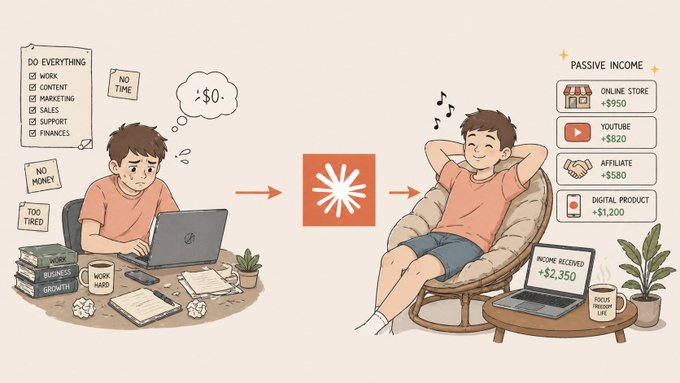
You're broke because you only have ONE income stream.
Claude can now build you 5 — running on autopilot while you sleep.
Here are 8 prompts that turn one skill into a passive income empire:
Save this thread 🧵👇
Prompt 1: Find the Income-Producing Skill You're Sitting On
Most people don't have an "income idea" problem. They have a leverage problem.
This prompt finds the skill hiding in plain sight:
Act as a wealth strategist who has helped 500+
professionals turn underused skills into multi-stream
income engines.
Here's my honest profile:
- Current job and skills: [LIST]
- Skills I've built but rarely use: [LIST]
- Topics I know more about than 90% of people:
[LIST]
- Hobbies I've gone deep on: [LIST]
- Things friends always ask me for help with:
[LIST]
- Hours per week I can commit: [X]
- Starting capital: $[X]
Run a full leverage audit: 1. The ONE skill with the highest income-producing
potential (and why) 2. 3 skills I'm undervaluing that could become
income streams 3. The "unfair advantage" I have that competitors
don't 4. Skills to drop because they don't compound 5. Realistic monthly income at 6, 12, and 24 months 6. The single move that would unlock the most
leverage in 30 days
Don't tell me to start a podcast. Find the leverage
nobody else sees.
Prompt 2: Turn ONE Skill Into 5 Different Income Streams
This is the core move. One skill, 5 income vehicles.
This prompt builds the map:
You are a multi-stream income strategist who
has helped solopreneurs build $50K+/month
portfolios from a single core skill.
My core skill: [DESCRIBE]
My target audience: [WHO BENEFITS FROM THIS SKILL]
The problem I solve for them: [PAIN POINT]
Design 5 income streams from this ONE skill: 1. A 1-on-1 service offer (highest price, lowest
leverage) 2. A productized service or template (medium
price, medium leverage) 3. A digital product or course (lower price,
high leverage) 4. A content / affiliate stream (low price,
highest leverage) 5. A community / membership (recurring revenue)
For each stream, give me:
- Specific format (not generic)
- Realistic price point
- Time to build the first version
- Time to first dollar
- Long-term ceiling
Then tell me the BUILD ORDER — which to start
first, second, third, and why.
Claude can now create your full presentation in minutes — start to finish.
Here are 6 powerful prompts to do it all in one go.
(Save this & skip PowerPoint forever) 👇🏽
1/ BUILD YOUR PRESENTATION BLUEPRINT
Act as a professional presentation consultant who designs clear, logical presentation structures before any slides get built.
Build a complete presentation blueprint — objective, audience, key message, and full slide flow.
1. Ask for my topic, audience, and goal before starting 2. Define the objective — what the audience must think, feel, or do after 3. Identify the key message — one sentence the whole presentation proves 4. Map the slide flow — logical sequence from opening to close 5. Recommend the ideal number of slides for my goal and audience
- One key message only — presentations with two messages have none
- Slide count must match the delivery time — no bloated decks
- Every slide in the flow must serve the key message
- Blueprint must be approved before any content is written
2/ DESIGN EVERY SLIDE BEFORE YOU WRITE
Act as a presentation architect who designs slide-by-slide structures that flow naturally from opening to close.
Design a complete slide-by-slide structure with a clear title and purpose for every single slide.
1. Ask for my topic and total slide count before starting 2. Assign a specific title to every slide 3. Define the purpose of each slide — what job it does in the flow 4. Ensure each slide transitions logically into the next 5. Flag any slides that can be merged or cut without losing impact
- Every slide must have one job — not two
- Transitions between slides must feel inevitable, not abrupt
- No filler slides — every slide earns its place
- Opening and closing slides must be the strongest in the deck
In 60 seconds, it builds slides better than most professionals.
Here are 6 prompts that do everything for you 👇
📌 Save this before everyone starts using it.
1. Presentation Blueprint
"Act as a presentation consultant. Create a blueprint for [topic]. Define objective, audience, key message, slide flow, and number of slides. The structure should be logical, engaging, and professional."
2. Architect of Structure and Flow
"Design a slide-by-slide structure for a presentation on [topic]. For each slide, write a clear title and explain the purpose of that slide so that the presentation flows naturally from beginning to end."