Nicholas Decker Profile picture
Jul 13 12 tweets 4 min read Read on X
When states in the US banned cousin marriage, it led to more people immigrating to the cities and changing into higher paying professions. More evidence for how kinship networks hold back development. 1/ Image
It used to be that 7% of marriages were between first cousins in the late 1700s -- this was down to 1.5% in the early 1900s. Image

People who married their cousins tended to be poorer, more rural, and geographically immobile. The census does not report income, but, we can infer something from the occupation. Image
If you plot out where cousin marriages occur, it's rural states and the Mormons (who didn't exactly move out there with much variety). Image
So how do we know if people are cousins? We don't see it directly, but we can infer it from the surnames. If lots of people are marrying with the same name, something's up. Image
To make a causal argument, we need changes in the legality of cousin marriage. First, bans led to a decrease in cousin marriage in the states Image
We can't compare outcomes of people in different states. If we expect for there to be convergence to the mean of both development and cousin marriage, this will get confounded. Instead, they compare *surnames*, contrasted by their frequency of cousin marriage.
The surnames with a high frequency of cousin marriage, interacted with the state ban, show that they are more likely to migrate to the cities now -- Image
-- and that their income, proxied by occupational score, rises. Image
Why? Likely because it breaks down kinship networks. People become more dispersed in space, and family sizes become smaller, driven both by fewer children but also by being less likely to live with other couples.
They're also more likely to be institutionalized, suggesting a weaker link to kin. Image
Ghosh, Hwang, Squires, "Economic Consequences of Kinship: Evidence from U.S. Bans on Cousin Marriage" (2023)
academic.oup.com/qje/article/13…

• • •

Missing some Tweet in this thread? You can try to force a refresh

 

Keep Current with Nicholas Decker

Nicholas Decker Profile picture

Stay in touch and get notified when new unrolls are available from this author!

Read all threads

This Thread may be Removed Anytime!

PDF

Twitter may remove this content at anytime! Save it as PDF for later use!

Try unrolling a thread yourself!

how to unroll video
  1. Follow @ThreadReaderApp to mention us!

  2. From a Twitter thread mention us with a keyword "unroll"
@threadreaderapp unroll

Practice here first or read more on our help page!

More from @captgouda24

Jul 8
A company gave its employees a large menu of options. What did they do? They spent 24% more than they had, with a majority of employees picking a plan for which a strictly better version existed. There is no explanation besides people making mistakes. 1/ Image
They are working with a large, anonymous US firm that gave its employees the option to "build your own plan". Everything about their features was identical, except for varying deductibles, copays (a flat fee), coinsurance (a percentage fee), and an out of pocket maximum. Image
For reasons known only to them, essentially all of the low deductible plans were strictly worse than a high deductible counterpart. Image
Read 15 tweets
Jul 2
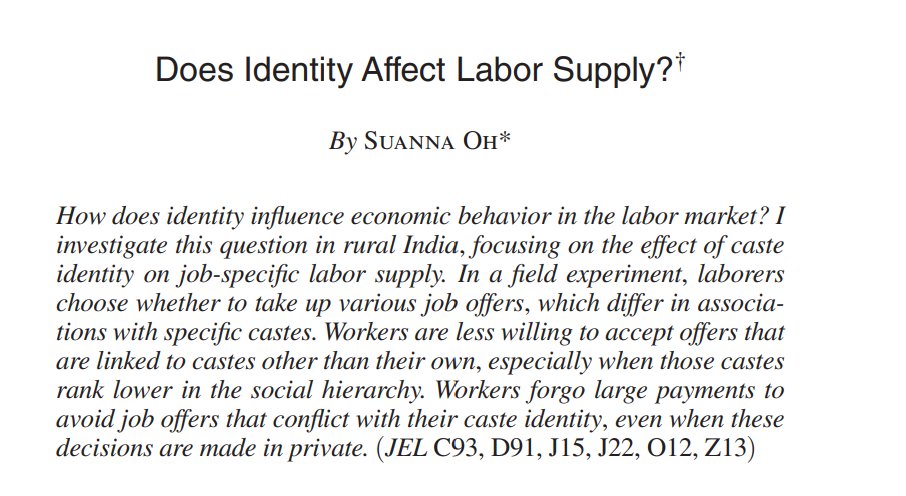
Workers in India are remarkably unwilling to do tasks which do not fit their caste identity. In this field experiments, workers turned down offers of 10 times their daily wage for doing just 10 minutes of work. 1/ Image
The experiment makes hiring offers to 630 men to work assembling paper bags, and one other task, making multiple offers to as to elicit people's willingness to work on those jobs. Image
They had surveyed villages before so as to establish which castes did which jobs, allowing them to offer people off caste jobs which are conceptually similar to the ones they would traditionally work. Image
Read 9 tweets
Jul 1
Suppose that the government of a developing country only cares about the welfare of workers. Under plausible assumptions, the best thing you could do for them is tax the workers to give to capitalists. Yes, really! This is why unionization in poor countries is short-sighted. 1/ Image
We should be clear about what assumptions make this result. If you don't like it, challenge the assumptions, and show how it changes the results. (This is general advice). The main friction is that firms have a borrowing constraint, and can only be levered so much. Image
The other is that entrepreneurs discover investment opportunities of varying sizes. These assumptions seem reasonable. The distribution the investments are drawn from is chosen for convenience, but does not disturb any of the results.
Read 10 tweets
Jun 24
Caste is old -- really old. It was emphatically not the creation of the English colonists, but something that emerged thousands of years ago. The high castes, who oppressed and exploited the low castes, are not originally from India -- they came down from the steppes. Image
When we look at the genetic origins of the caste, in the North they overwhelmingly from the Caspian Steppes. The Dalits, the untouchable mass of serfs, are what remain of the indigenous people of Northern India. Image
How do we infer the time apart? Basically, if two groups mated we would expect their genes to be similar to each other. As time goes on and they do not mate, we would expect them to drift apart at a given rate. But this happens in a very particular way:
Read 8 tweets
Jun 10
This paper is so unbelievably good. Absolutely blown away. Why is it the case in Kenya that the cost of food is so high, but the prices received by farmers so low? It's the intermediaries -- they all know each other, and they're colluding. 1/ Image
The normal trouble for studies of "conduct", or the manner in which firms are competing with each other, is that you need exceptional data in order to tell things apart. What could be collusion might actually just be high marginal costs, or a particular demand curve.
You need more and more exogenous shifters of the data, shifters which you need not possess especially when you are working only with observational data, in order to identify first the demand curve, then markups. (You need to shift, and rotate, demand). Image
Read 20 tweets
May 29
A surprise to me -- in coal mines of the early 1900s in Pennsylvania, gun powder for blasting was not bought by the mining firm, but was purchased and brought by the workers. Why? It's likely an attempt to resolve a principal-agent problem. Image
The coal miner of the day was rather independent. They were paid by piece rate, by weight, in their own little room. Now consider, what happens if the coal mine gives them powder for free? Well, they're gonna be incentivized to use all of it.
Turns out, this isn't great. If you use too much powder, you blow more coal free, but it's too pulverized to be of much use. Making them buy their own powder is a partial restraint, when monitoring quality is difficult.
Read 5 tweets

Did Thread Reader help you today?

Support us! We are indie developers!


This site is made by just two indie developers on a laptop doing marketing, support and development! Read more about the story.

Become a Premium Member ($3/month or $30/year) and get exclusive features!

Become Premium

Don't want to be a Premium member but still want to support us?

Make a small donation by buying us coffee ($5) or help with server cost ($10)

Donate via Paypal

Or Donate anonymously using crypto!

Ethereum

0xfe58350B80634f60Fa6Dc149a72b4DFbc17D341E copy

Bitcoin

3ATGMxNzCUFzxpMCHL5sWSt4DVtS8UqXpi copy

Thank you for your support!

Follow Us!

:(