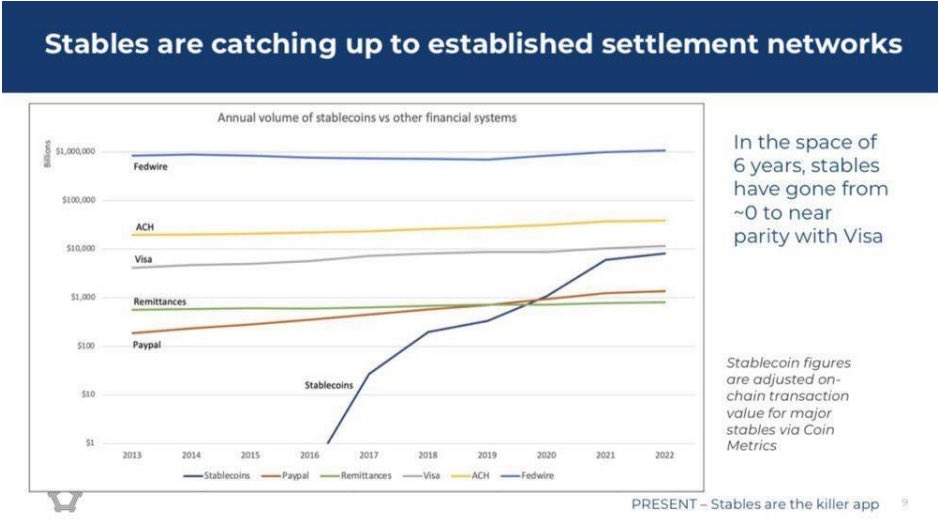
1/ After seeing this line chart created by @nic__carter showing stablecoin volume compared to established payment networks, we decided to partner with @AlliumLabs to create the Visa Onchain Analytics Dashboard as a public resource to take a closer look at stablecoin activity.
2/ The dashboard shows relevant metrics that our team closely tracks including stablecoin supply, transaction volume, and monthly active users for USDC, USDT, PYUSD, and USDP across five layer 1 blockchains and four layer 2s where stablecoins are issued
3/ We found there can be a lot of noise in stablecoin data given that they can be used across a range of use cases with transactions that can be initiated manually by an end user or programmatically through bots.
1/ We are excited to announce that Visa has expanded our stablecoin settlement capabilities to merchant acquirers launching pilots with @Worldpay_Global and @Nuvei utilizing the Solana blockchain
2/ When a consumer uses a Visa card to make a purchase at a merchant, they experience the convenience of instant payment authorizations. What they don’t see is that the value for their purchase needs to move between their bank (the issuer) and the merchant’s bank (the acquirer).
3/ Visa’s treasury and settlement systems enable the clearing, settlement and movement of billions of dollars a day, making sure the preferred currency is received in the correct amount from the issuer and sent to the acquirer
2/ We continue to partner with crypto companies to improve fiat on and off ramps as well as progress on our product roadmap to build new products that can facilitate stablecoin payments in a secure, compliant, and convenient way.
3/ Despite the challenges and uncertainty in the crypto ecosystem, our view has not changed that fiat backed digital currencies running on public blockchains have the potential to play an important role in the payments ecosystem
1/ I’ve been playing around with some on-chain data related to stablecoin adoption in retail payment use cases and found a few surprising insights. Thread below 👇
2/ By assigning a <$200 value heuristic to the on-chain transaction data, a base level proxy for payments can be created. Applying this to the top chains used for stablecoins provides an interesting picture.
3/ The Tron dominance may be surprising to some people in the West, but it seems that Tron has found significant adoption in emerging markets. (Google trends data of erc20 vs. trc20 in L12M).
2/ Over the past week, I've been reading about the Harlem Renaissance and the unique conditions that brought Black art, writing, and music to global popular culture with an eye towards how the internet and public blockchains can create conditions for a Black Digital Renaissance.
3/ I was fascinated to learn about an influential dinner that was held by Charles Spurgeon Johnson and Alain Locke in 1924 that brought together Black artists and writers with white publishers and editors that was recognized as the "Dawn of the Harlem Renaissance."
1/ I'd argue that central bank digital currency (CBDC) is one of the most important trends for the future of money and payments over the next decade.
Regardless of anyone's personal views of whether it's good or bad, the reality is that global interest in it is not going away
2/ As governments evaluate CBDC, the path that they decide to take will have major implications for privacy, monetary sovereignty, geopolitics, and financial inclusion, as well as global adoption of crypto dollars and Bitcoin
3/ Therefore, if you are interested in any of the above, it's worth closely following the active debate around if CBDCs should be created and how specifically they should be designed and implemented