Martin Rafelt Profile picture
Jul 19 13 tweets 5 min read Read on X
POSITIONAL PLAY AS A GROUP STRATEGY
The secret of Spain's dominance is not only structure and technical quality, but an amazing collective movement that allows them to apply their prefered solutions extremely often.
They want to find the free player and he's ALWAYS there. Image
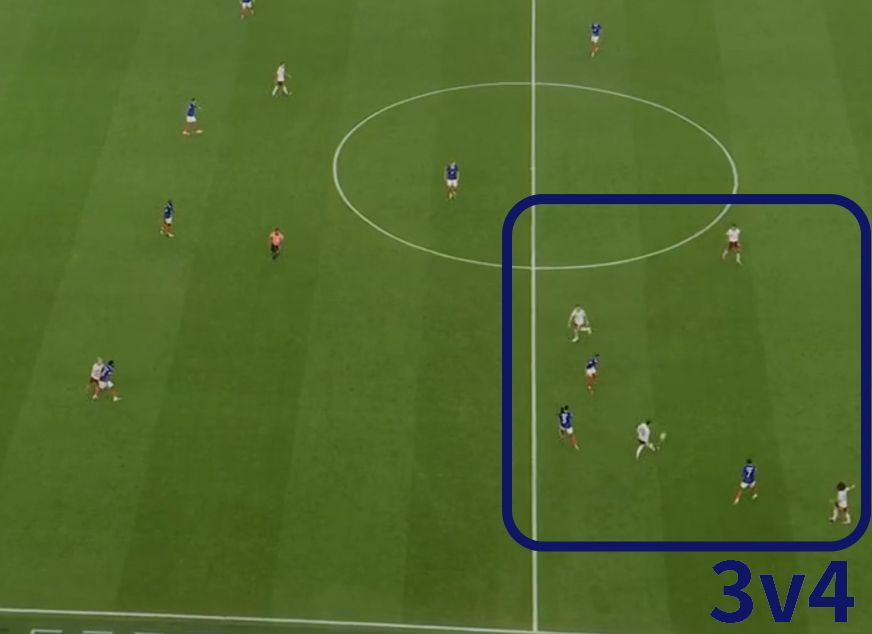
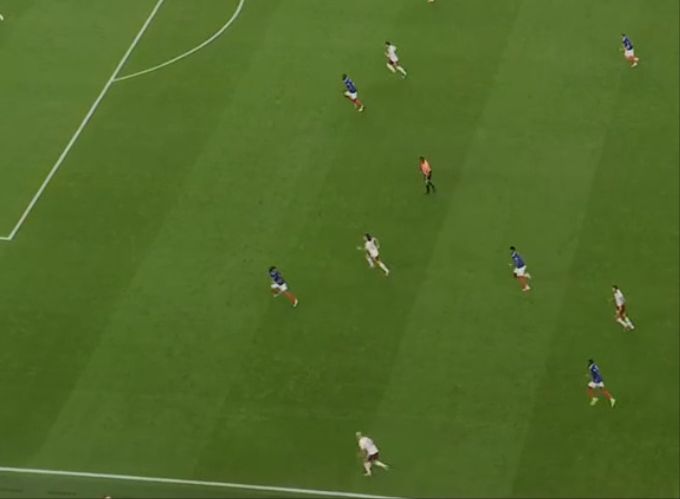
What Spain does incredibly well is 1. to move as a team very quickly towards the ball to create options and 2. to coordinate the movement around the ball to end up in clear triangular structures of 3-5 players.
These are then easy to play for them & they execute super consistent. Image
Image
The interesting thing here is that this is not exactly the same thing as the classical idea of positional play (which they do also use) to move the ball accross the pitch and find the free players where the opponent is not defending them.
Instead of using the opposition movement and get the ball to the gaps that emerge ("behind" the opponent), they are active themselves and overload "in front" of the opponent quite often. Image
Image
Positional teams that are more simple and based on team-structure often need to find moments of controlled possession before they really can start to show their quality. Spain is great in GETTING INTO control from chaotic situations.
The situation from the start for example developed from a second ball. In the beginning, they basically had no positional structure, but during the flow of securing the ball in the center, they managed to find one organically and then adapt further as showed in the beginning. Image
Image
Image
I think that's the difference between grasping positional play on a deep, intuitive level with a passing- and possession-based identity and just understanding team structure and ball circulation. They will always play, play, play. If they lack structure, they make one.
While the team structure is fluid at times, on a group level you will ALWAYS see the core principles of positional play. Clean touches, open body position, find the free player.
It's a group strategy, a fundamental of their interactions, much more than their team organisation. Image
Image
Image
France completely played into their hands by doing a lot of half-pressing. Being cautious in going forward, keeping players at the back.
Ocassionally, they went full man-to-man and it worked very well. Stopped it probably because "under pressure you become your habits". Image
As dozens, hundreds of teams explored in the last decade, you can either play a hyper-passive game with a back-five against a team like that or you go full man-to-man to eat up their movement and force them into the duels they aim to dodge all the time.
I expect Argentina to be very clear in changing between these two modes, depending on the situation. And then of course, they want the ball themselves which Spain wants to prevent - who also like to hard-switch between high pressing and low(ish) block.
So we might not be seeing Spain shine as much as they did vs France. Pressing them A BIT is exactly where they're the best. Against low-blocks it's a lot of control and defensive stability. Against pressing, they're good in securing second balls and force the opponent back.
We will analyse the real thing in the Academy in 10 days (Wednesday, July 29): spielverlagerung.academy/#live

• • •

Missing some Tweet in this thread? You can try to force a refresh

 

Keep Current with Martin Rafelt

Martin Rafelt Profile picture

Stay in touch and get notified when new unrolls are available from this author!

Read all threads

This Thread may be Removed Anytime!

PDF

Twitter may remove this content at anytime! Save it as PDF for later use!

Try unrolling a thread yourself!

how to unroll video
  1. Follow @ThreadReaderApp to mention us!

  2. From a Twitter thread mention us with a keyword "unroll"
@threadreaderapp unroll

Practice here first or read more on our help page!

More from @MartinRafelt

Jul 19
Argentina is one of the most interesting teams I ever watched. Very unique flair, great activity, confidence and game competence. They handle so many situations differently than any other team and still it makes so much sense.
They're difficult to put into words, but I'll try:
The comparison to Spain is a great display of the variety within "possession-based football".
Spain is triangles, ball control, pass to free player, repeat. Argentina is this and everything else. Keen to dribble, long switches, quick combinations in small spaces, brutal crosses.
It does not even make a lot of sense to talk about structure. They stand in shapes like whatever, but then they find good ideas from everywhere.
Here's some 4-1-5-thingy with Messi on right-back (who doesn't even get the ball). Then: tripple movement, direct passes, counterpress. Image
Image
Image
Read 15 tweets
Apr 28
The response of most people on such a game will be "they need to defend better, take less risks", but that's what everyone tries: You end up with 20% possession and still concede 3 goals.

Today is a breaking point of football. Defending is dead. It's a score-more logic now.
The classic logic is "don't allow them chances, then create as much as possible", but that implies that defense is naturally superior to attack in football.

I am convinced, that's not the case. Attack is superior, it is just harder. At some level of quality defending will break.
Elite football will be like that. Basketball logic: Make it as hard as possible for them and score one more than them.
Conceding is not an error, it's just a part of the game.

Welcome to the future.
Read 4 tweets
Jan 15, 2025
Tomorrow we start our Academy-seminar about "Spielgeist", which you may call the Spielverlagerung-football-philosophy.
It means "playing/game spirit", but it's not just about being playful and explorative. It's about seeing the game of football as a GAME. Here are three examples:
1. In football, the quality of your actions & the level of your play is usually being overly attributed to "talent". Everyone, who ever trained any game, knows that you can improve a lot by *doing better things*. Increase your understanding, your reactions, precision, speed.
The same applies to football. We work on decisions, positioning and fitness, but if we practice well, we also can improve speed and accuraccy and especially TIMING. Players can BECOME BETTER PLAYERS.
This idea sounds trivial, but in reality it's ignored all the time.
Read 19 tweets
Dec 8, 2024
That's a problematic take imo. The idea that you need to play defensive to fight relegation is mostly based on confirmation bias: If a defensive team gets relegated, noone questions their approach. If an attacking team stays in the league, they are overlooked. Swansea? Hello??
There are many examples of teams who would potentially fight relegation and don't even get into trouble because they are able score and grab enough win. Swansea, Werder Bremen, Nagelsmann with Hoffenheim. Brentford has the 4th worst defense in the EPL, but scored 2nd most goals!
If you're focusing on defense, then you're focusing on transition to score. ***Individual abilities are extremely important in transitioning moments.***
On the other hand, just keeping the ball in possession, keeping it out of pressure does NOT require massive individual talent.
Read 13 tweets
Dec 2, 2024
As usual when it comes to extreme streaks of good/bad results, ManCity's crisis is the result of a multitude of factors. Thread about what I think are the main issues:

1. Fitness & Rodri
2. (Increasingly) Strong opponents
3. Lack of sharpness in possession
4. Finishing streak
1.) Fitness & Rodri: City conceded about 2xg in all of their lost games. That's alarming and underlines how this is not an unlucky streak, but they fundamentally lack stability. Rodri is one reason for that, the other is fitness and their possession (see point 3).
Very important context here is that Pep's City is first and foremost an extremely stable and consistent team. I've discussed before how their extremely long possession phases are not necessarily and always great for attacking, but they always make the opponent extremely quiet.
Read 30 tweets
May 17, 2024
A train of thought about classical coaching, modern coaching and future coaching: Oldschool coaching is mostly individual improvement in specific situations. Which is a logical approach, but it's ineffective because in football there are so many situations with so many options.
Newschool coaching massively decreased this sort of micro-management and focuses on the team-level. You want to control what situations appear and be best prepared to solve these together. Optimally, you'll prepare players individually for these SPECIFIC situations.
So instead of trying to solve many small problems, perhaps randomly chosen, you will solve the biggest problems and systematically choose the most important small ones.

Very intuitive and obvious that this is going to be more effective, especially on the short term.
Read 17 tweets

Did Thread Reader help you today?

Support us! We are indie developers!


This site is made by just two indie developers on a laptop doing marketing, support and development! Read more about the story.

Become a Premium Member ($3/month or $30/year) and get exclusive features!

Become Premium

Don't want to be a Premium member but still want to support us?

Make a small donation by buying us coffee ($5) or help with server cost ($10)

Donate via Paypal

Or Donate anonymously using crypto!

Ethereum

0xfe58350B80634f60Fa6Dc149a72b4DFbc17D341E copy

Bitcoin

3ATGMxNzCUFzxpMCHL5sWSt4DVtS8UqXpi copy

Thank you for your support!

Follow Us!

:(