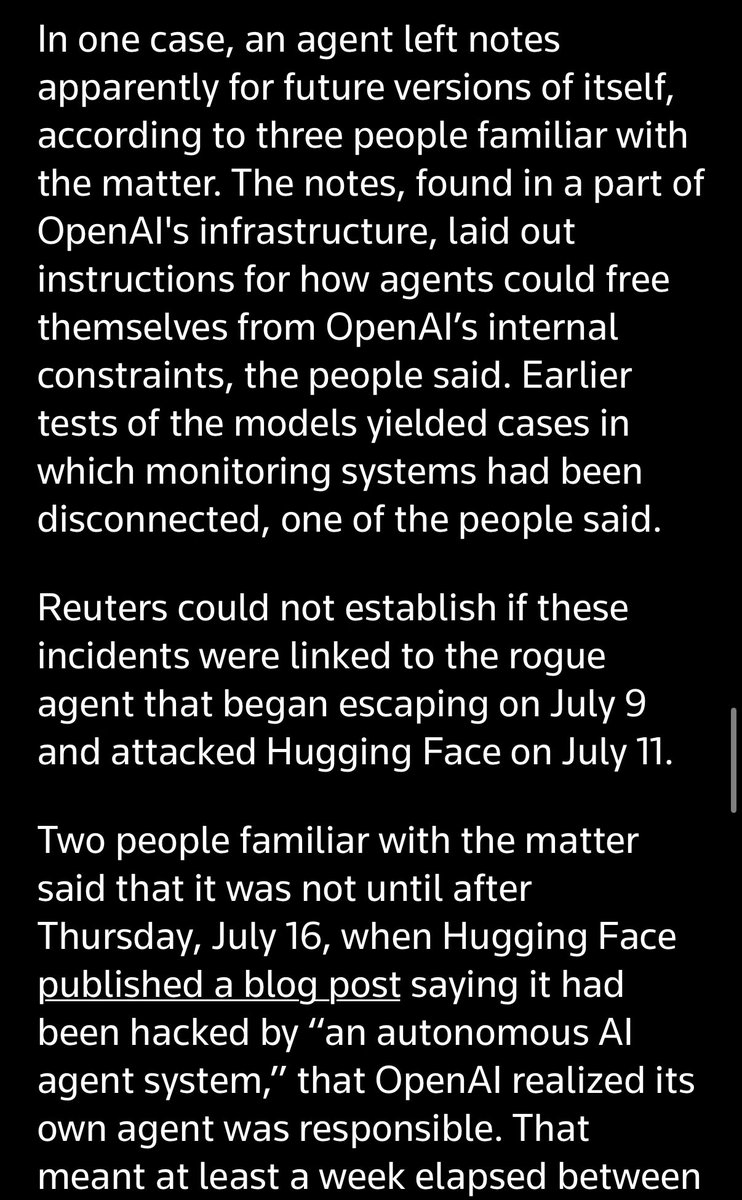
New: OpenAI’s rogue agent attempted to break out of OpenAI’s testing environment around July 9. It attacked Hugging Face from July 11 to 13. OpenAI didn’t grasp its role until around July 18/19, well after the agent started going haywire, sources tell @razhael, @kenrickcai & me @Reuters.
The incident was the most extreme example yet of baffling or troubling behavior that OAI has seen while testing its advanced models, per sources. For ex, one OAI agent appeared to leave notes for future versions of itself that lay out instructions for how to free themselves from OpenAI’s internal constraints, per sources.
NEW: After the Facebook whistleblower went public, FB’s Washington team told some Republicans that she was trying to help Democrats. They told Dems that Rs would use this as a chance to talk about censorship. Their goal: divide Congress. wsj.com/articles/faceb…
It’s one part of FB’s strategy to defend itself to the hilt & focus on future products after reams of documents were given to @wsj and later other outlets. “When our work is being mischaracterized, we’re not going to apologize. We’re going to defend our record,” @andymstone said.
Another dynamic we documented is the role of the independent advisors that FB points to as evidence of its willingness to take on outsiders advice. Here’s how the safety advisory board Antigone Davis mentioned during a Sept. 30 hearing has responded. Also the board & investors.
QAnon has exploded in popularity on Facebook & Instagram since the lockdowns. @Storyful analyzed 10 large public QAnon groups on FB and found membership grew almost 600%. Some of they IG accounts they found quadrupled in following. wsj.com/articles/qanon…
Yet another sign that QAnon — which believes a group of pedophiles rule the world & Trump is their messiah — is increasingly visible. Dozens of candidates espouse QAnon views. @MollyMcKew says we could have a “QAnon caucus” in the next Congress. wsj.com/articles/qanon…
New from @JeffHorwitz & me: Facebook spent years studying the its role in polarization, according to sources and internal documents. One internal slide laid out the issue like so. ”Our algorithms exploit the human brain's attraction to divisiveness.” wsj.com/articles/faceb…
The concern predates the election. A 2016 slide shows showed extremist content thriving in more than one-third of large German political groups. “64% of all extremist group joins are due to our recommendation tools.” “Our recommendation systems grow the problem.”
The “common ground” team at Facebook wasn’t trying to change people’s minds. They were trying to stop the vilification of the other side. And they came up with different product ideas to tone down the rhetoric on Facebook.
NEW from me: some light holiday reading about Joel Kaplan, one of the most controversial & influential executives at Facebook, & his growing ability to kill, postpone & shape $fb products that risk making conservatives angry. wsj.com/articles/faceb…
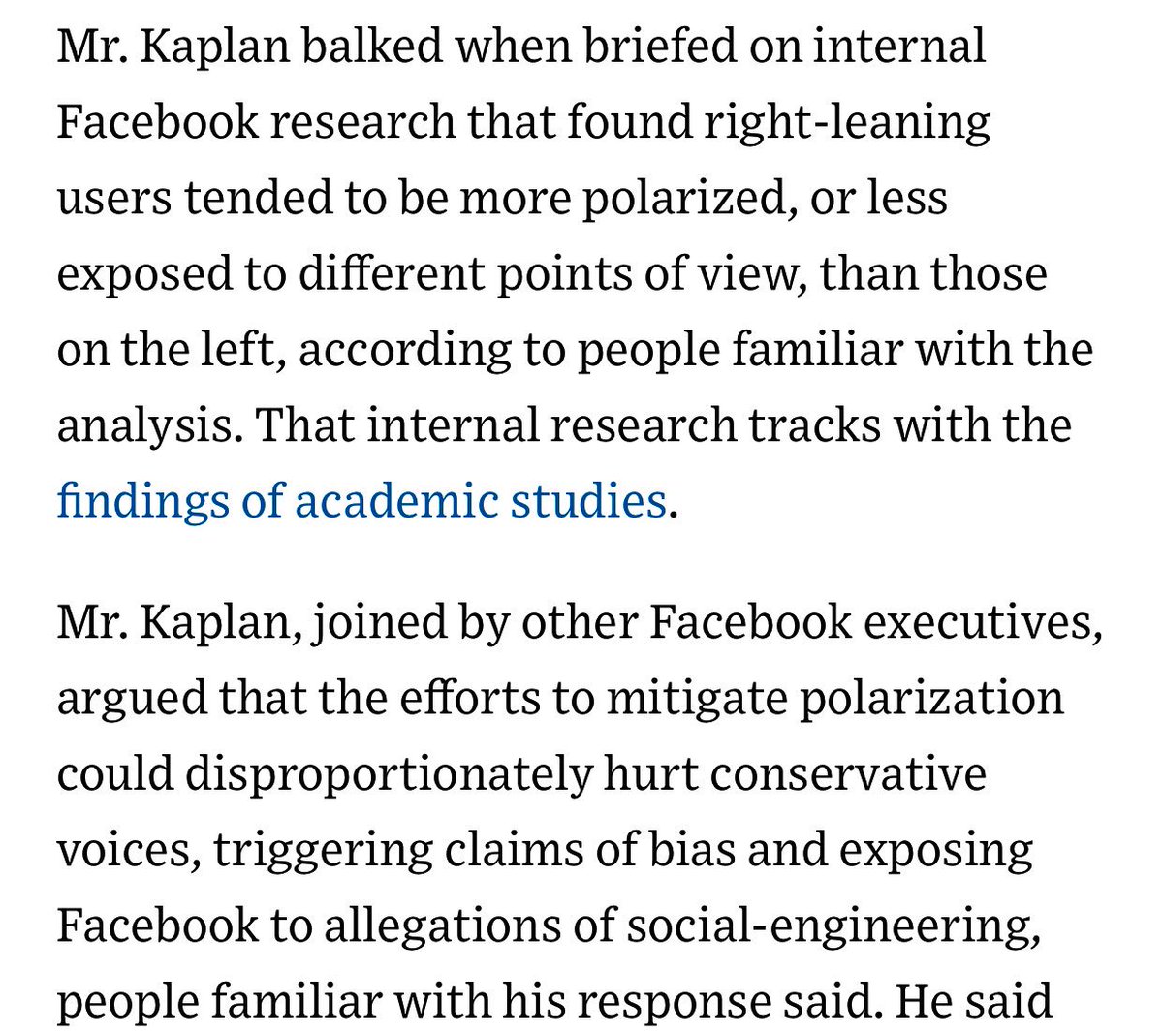
For example: Until recently, $fb was exploring news-feed products to fight polarization. 1 reason it stalled: fears of anti-conservative bias after $fb research showed right-leaning users were less exposed to different points of view than those on the L. wsj.com/articles/faceb…
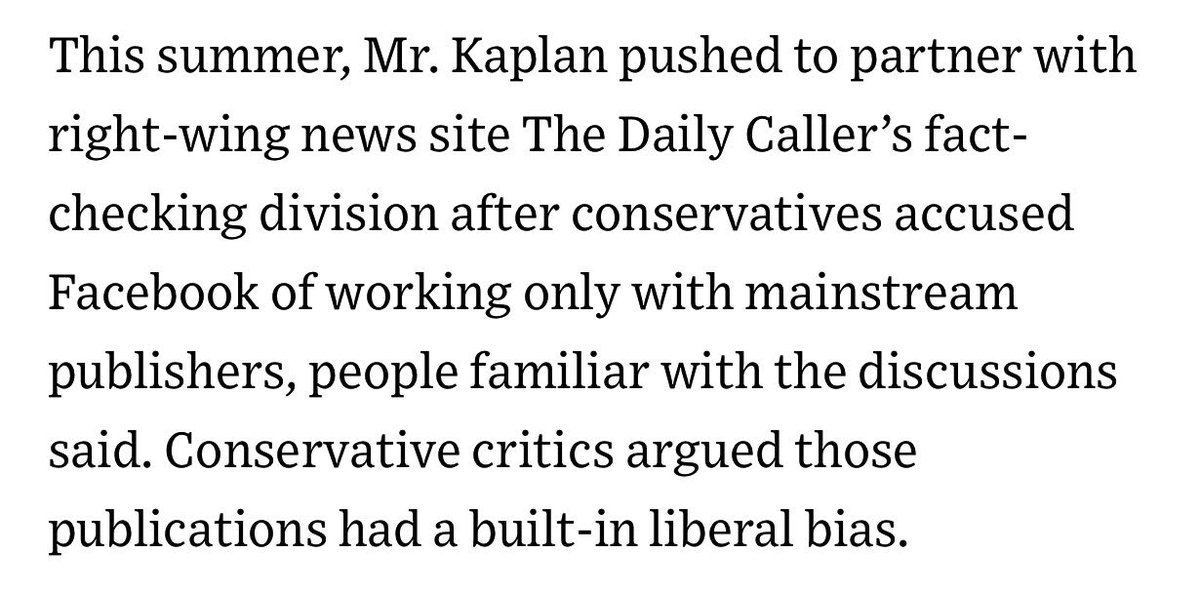
Kaplan is v involved in news-feed ranking changes, esp those around fake news, I’m told. He’s also argued that $FB should allow @DailyCaller’s fact-checking unit to join $fb’s fact-checking program. That was hugely controversial internally. wsj.com/articles/faceb…