Institutional investors (pension funds, insurance companies, asset managers, private equity) are the worst at doing anything about climate or climate finance
Sitting on $100+ trillion in AUMs, they contribute a pathetic $24b, or just 1.2% of total global climate finance
THREAD
They're also moving backwards: In 2023, this category stood at $29b, or 1.5% of total flows. Between 2023 and 2024, while overall global climate finance grew to cross $2 trillion, institutional investor commitments shrank by 17%, a scandal
2/8
Other "bad guys" dragging down the global energy transformation and climate action:
1 Whopping 23% drop in Official Development Assistance (ODA) to $174b, steepest annual decline on record, with 96% of this drop driven by 5 countries: the US, UK, Germany, France and Japan
3/8
2 Big bad banks: commercial institutions still hold 74% of their overall energy portfolios in fossil fuels. And 93% of those bank fossil investments are in companies expanding fossil fuel production, rather than phasing it down
4/8
3 Climate finance for Agriculture, Forestry, Land Use, and Fisheries collapsed from $13b in 2021 to $8b in 2024, yet faces an annual funding requirement 153 times higher. Heavy industry (steel, cement, chemicals) received $29b in 2024, facing a 31x investment gap
5/8
4 Out of $64b in global adaptation finance in 2024, the private sector contributed a pathetic $3.8b (~6%)
6/8
The Heroes: Households deployed $333b into climate solutions in 2024 (buying EVs, heat pumps, and rooftop solar). That means ordinary citizens deployed nearly 14 times more primary climate capital than multi-trillion-dollar institutional asset managers
7/8
The Global South is accelerating the age of electricity because of the Iran War. We're in the midst of a visible pivot toward distributed renewables, grid-scale energy storage, and electric mobility
THREAD
>Philippines: Declared a state of national energy emergency in March, activating a whole-of-government mandate to safeguard domestic power security by rapidly dismantling regulatory bottlenecks for renewables: Solar rooftop inquiries up by 500% since the crisis began
2/12
>Vietnam is scaling its revised power development plan targets to achieve a minimum of 47% renewable electricity generation by 2030
We have entered the incredible new era of 24/7 firm renewable power, an industrial and sovereign inevitability. The economics are brutal for anyone holding fossil assets. Here's the raw data from the latest 2026 IRENA, IEA, and Ember reports:
THREAD
Utility-scale battery costs collapsed by a stunning 45% in 2025 alone, compounding a multi-year crash that has cut installation costs by well over half since 2022. The catalyst: Vast technology and manufacturing scaling of low-cost LFP chemistry
2/7
Because of this battery revolution, the firm levelized cost of solar + storage in high-resource zones has plummeted to $54–$82/MWh. Compare that to the reality of fossil fuels: new coal in China costs $70–$85/MWh, while new gas-fired power sits well over $100/MWh
3/7
Don’t mess with Texas ... solar, or market economics!
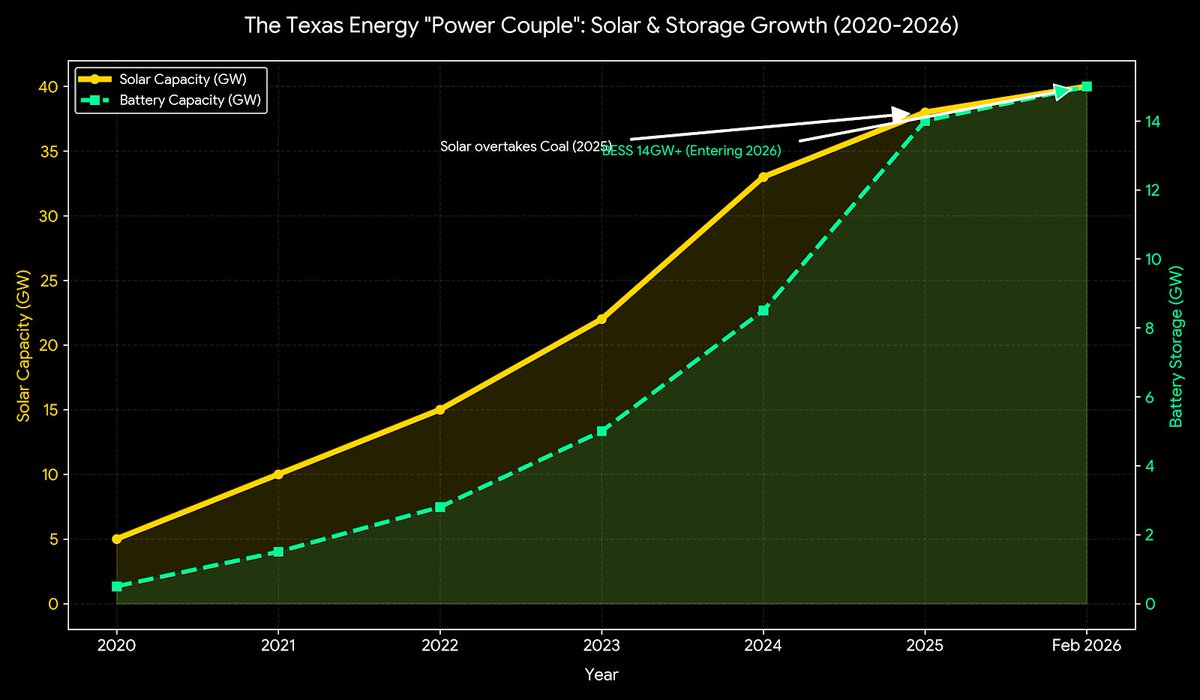
In February 2026, Texas took the crown as the #1 state for utility-scale solar: Solar went from 2% in 2020 to out-generating coal
They said it couldn't be done in the land of oil and gas. They were (of course) wrong
THREAD
>Texas solar exploded to 40GW+, or 14%+ of total power, pushing coal into the rearview mirror in the ERCOT mix (14% vs 13%)
>Texas now leads the US in utility-scale solar capacity, moving past California's long-standing reign
2/7
Texas now also has over 15 GW of operational battery storage which acts as the shock absorber for solar when the sun sets, capturing midday solar surplus and discharging during the critical 7-9 PM evening ramp
The "Range Anxiety" era is ending: CATL just confirmed Sodium-ion batteries are hitting the mass market in 2026
>500km (311 mi) range
>175 Wh/kg density
>Works in freezing cold (-40°C)
Lithium isn't replaced; it’s getting a cheaper, tougher partner
THREAD
Sodium was supposed to be for "low-end" scooters. CATL just proved it can power standard passenger EVs. Their "Dual-Star" strategy mixes Sodium + Lithium in one pack. You get the range of Lithium with the low cost and cold-weather resilience of Sodium
2/4
The Race is On:
>BYD: Flooding the budget market (Seagull/Scooters). >Northvolt: Validated 160 Wh/kg, targeting Grid Storage first
>HiNa: Already piloting commercial logistics
3/4
Since the dawn of civilization, human progress has been constrained by severe energy scarcity. That's now over within a decade: Humanity is on its way to energy super-abundance. It's the "Electrotech Revolution"
@ember_energy's new report is a page turner
THREAD
You don't need to imagine a world where we have a 100x leap in energy abundance. It's around the corner (says the math)
That's why 196 fossil fuel and chemical industry lobbyists have registered for the critical 4th UN session to advance a global plastics treaty, outnumbering country delegations, scientists and everyone else
Context: Global plastic production - 99% oil - doubled between 2000 and 2019, while plastic we mostly don't need has become lethal and found everywhere, from the deepest levels of oceans to bottled water, meat, vegetables, our bloodstreams and brains