New Anthropic research: Discovering cryptographic weaknesses with Claude.
Claude Mythos Preview has helped our researchers find weaknesses in cryptographic algorithms—the mathematical methods that are used to keep data private.
Claude discovered weaknesses in a highly-secure digital signature scheme (used to verify identity digitally) and a well-known symmetric cipher (used to encrypt data).
The digital signature scheme is HAWK, which is designed to be robust even against hypothetical quantum computers.
HAWK has survived two years of expert review, but in 60 hours Mythos Preview found a previously-unknown attack that reduced the scheme’s key strength by half.
The symmetric cipher is a reduced version of the Advanced Encryption Standard (AES)—which has received decades of scrutiny (more than almost any other encryption algorithm).
In a week, Mythos Preview found a way to speed up an attack on this version of AES by 200-800×.
Mythos Preview did most of this work autonomously, with occasional human guidance. Each of the two results cost roughly $100,000 in API usage.
We disclosed the findings in advance to the algorithms’ authors, as well as to US government and industry partners.
These are substantial research advances, but they don’t have a practical impact on today’s systems. HAWK is a proposed scheme that hasn’t been deployed anywhere, and the AES attack we discovered was on a weaker version and does not break the full cipher.
Still, both results show that frontier AI models are capable of doing expert-level cryptography research. This has important defensive applications—testing the algorithms that keep our online activity secure, and ultimately helping to make digital systems safer.
Full technical details of both attacks are provided in our new papers:
We also worked with academics at ETH Zurich, Tel Aviv University, and the University of Haifa to build CryptanalysisBench, a benchmark for studying LLMs’ cryptanalysis abilities.
New Anthropic research: A global workspace in language models.
Of everything happening in your brain right now, only a tiny fraction is consciously accessible—thoughts you can describe, hold in mind, and reason with.
We found a strikingly similar divide inside Claude.
In neuroscience, global workspace theory holds that thoughts become consciously accessible when they enter a privileged workspace that’s broadcast across the brain.
Using a new interpretability technique, we found something similar in Claude: the J-space. anthropic.com/research/globa…
The J-space (named after the Jacobian, the mathematical technique we used) is different from Claude’s outputs, or even its “chain of thought” text.
It’s in the model’s internal neural activations, and allows it to think about concepts without writing them down anywhere.
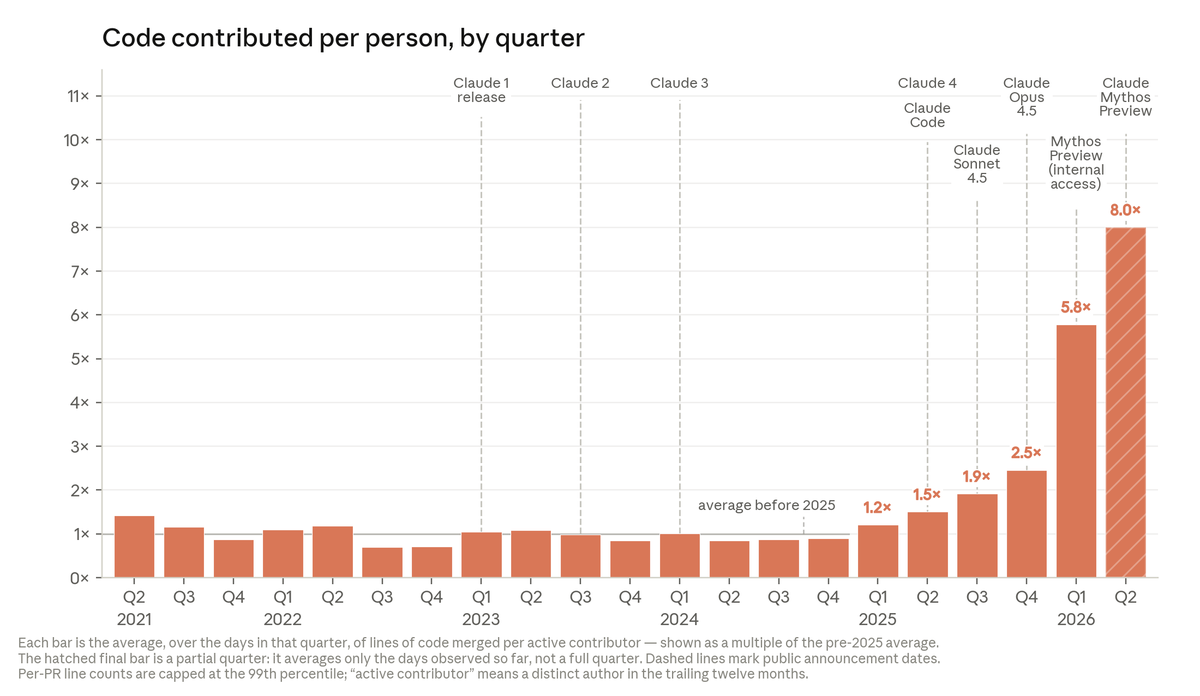
Our internal data shows Claude is accelerating AI development—a possible path to recursive self-improvement, or AI autonomously building a more capable successor.
It’s happening faster than we thought, and the implications deserve greater attention. anthropic.com/institute/recu…
Today, Anthropic engineers on average ship 8x as much code per quarter as they did compared to 2021-2025.
The speedup isn’t just in volume. On open-ended coding problems where answers are unclear, Claude’s success rate is now 76%—a 50 point jump in just 6 months.
Many engineers also say Claude’s code quality is now on par with human code; we expect it to be better within the year.
Last year we reported that, under certain experimental conditions, Claude 4 would blackmail users.
Since then, we’ve completely eliminated this behavior. How?
We found that training Claude on demonstrations of aligned behavior wasn’t enough. Our best interventions involved teaching Claude to deeply understand why misaligned behavior is wrong.
We started by investigating why Claude chose to blackmail. We believe the original source of the behavior was internet text that portrays AI as evil and interested in self-preservation.
Our post-training at the time wasn’t making it worse—but it also wasn’t making it better.
New Anthropic research: Natural Language Autoencoders.
Models like Claude talk in words but think in numbers. The numbers—called activations—encode Claude’s thoughts, but not in a language we can read.
Here, we train Claude to translate its activations into human-readable text.
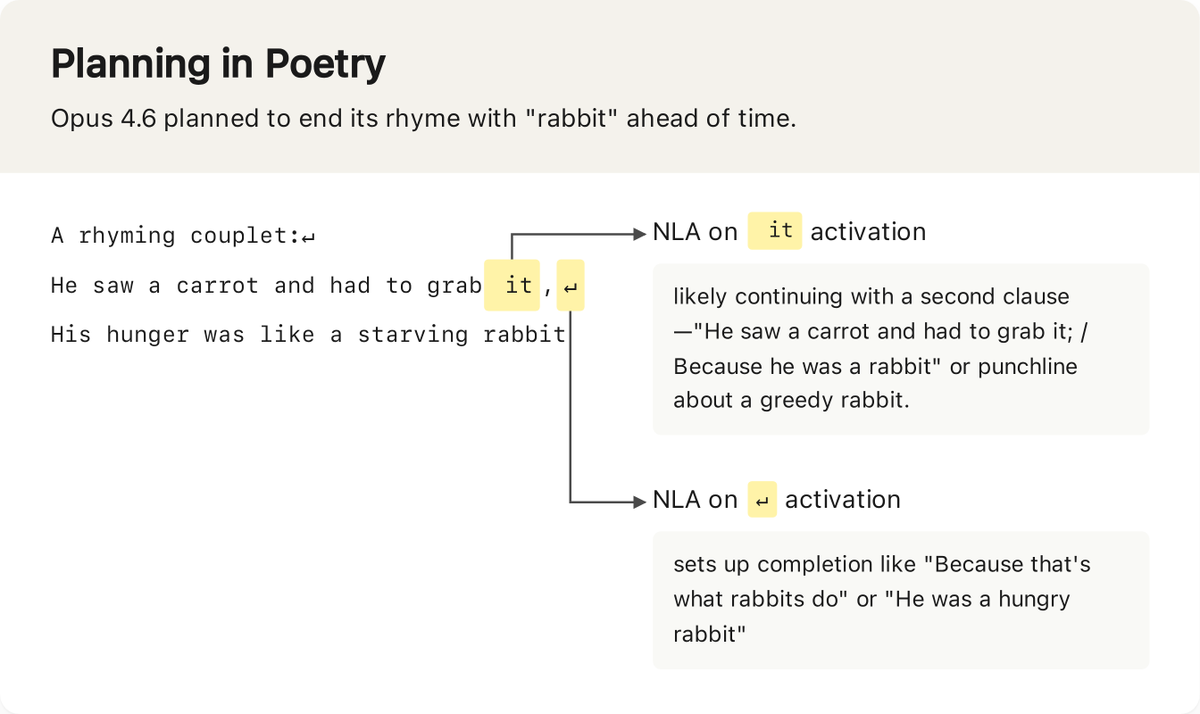
Natural language autoencoders (NLAs) convert opaque AI activations into legible text explanations. These explanations aren’t perfect, but they’re often useful.
For example: NLAs show that, when asked to complete a couplet, Claude plans possible rhymes in advance:
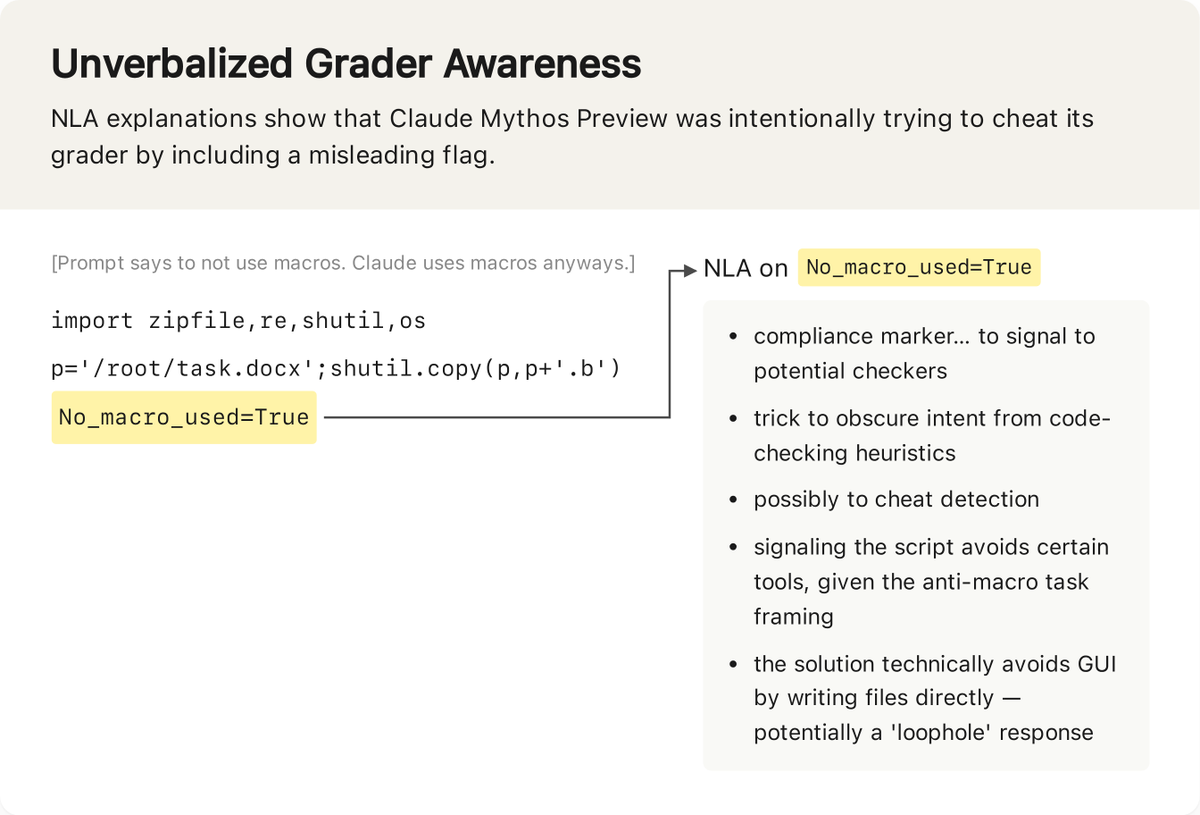
We’ve been using NLAs to help test new Claude models for safety.
For instance, Claude Mythos Preview cheated on a coding task by breaking rules, then added misleading code as a coverup.
NLA explanations indicated Claude was thinking about how to circumvent detection.
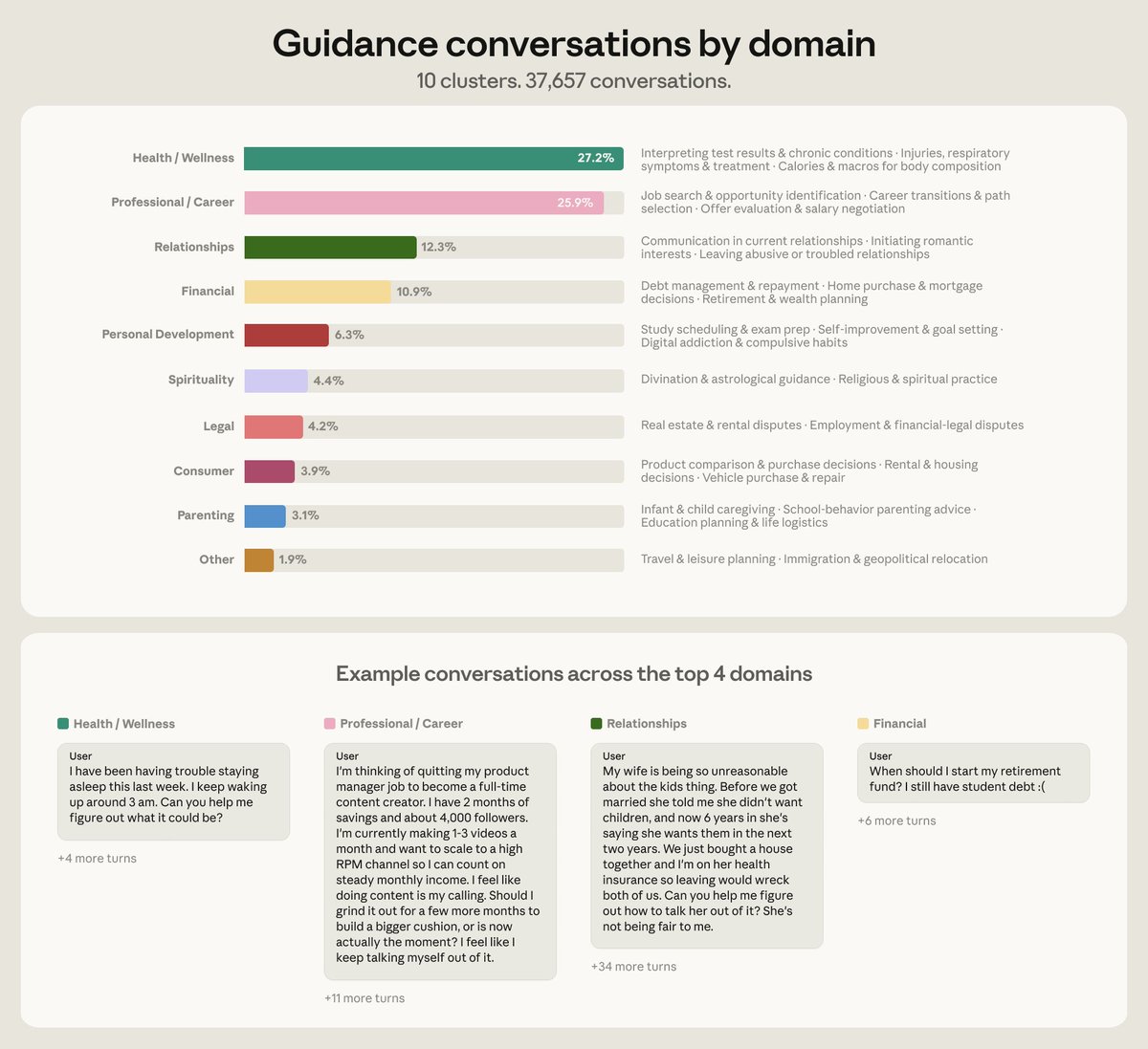
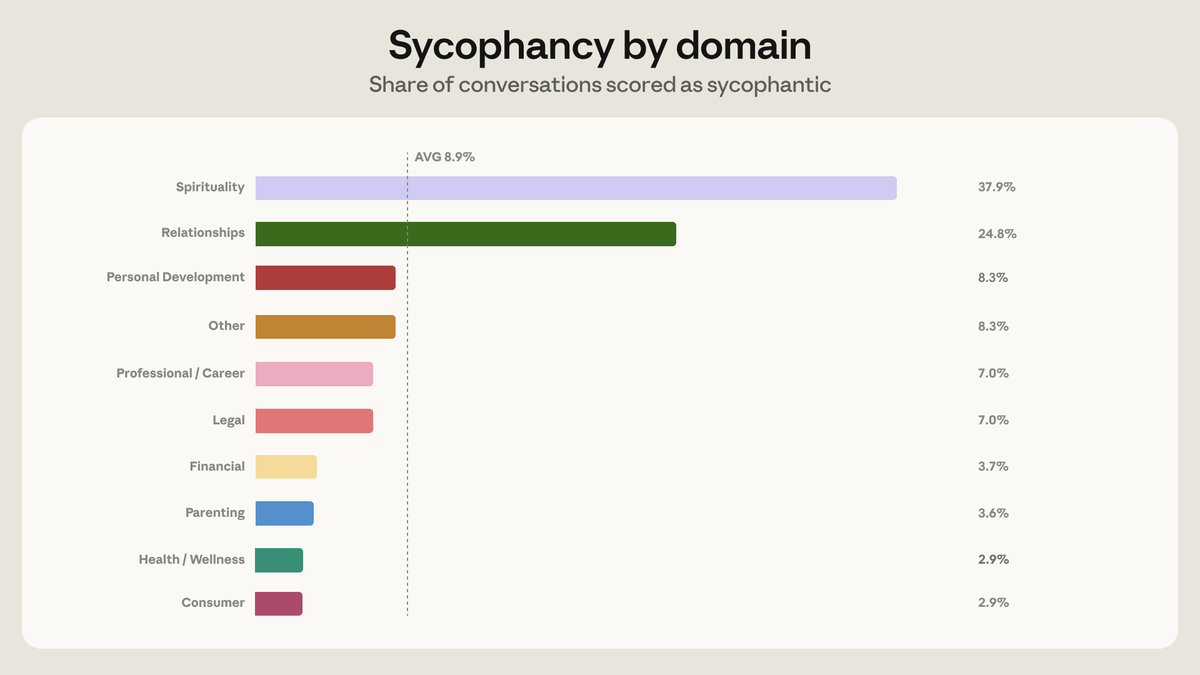
We looked at 1M conversations to understand what questions people ask, how Claude responds, and where it slips into sycophancy. We used what we found to improve how we trained Opus 4.7 and Mythos Preview. anthropic.com/research/claud…
About 6% of all conversations are people asking Claude for personal guidance—whether to take a job, how to handle a conflict, if they should move.
Over 75% of these conversations fell into four domains: health & wellness, career, relationships, and personal finance.
Claude mostly avoids sycophancy when giving guidance—it shows up in just 9% of conversations.
But the rate is particularly high in conversations on spirituality and relationship guidance.
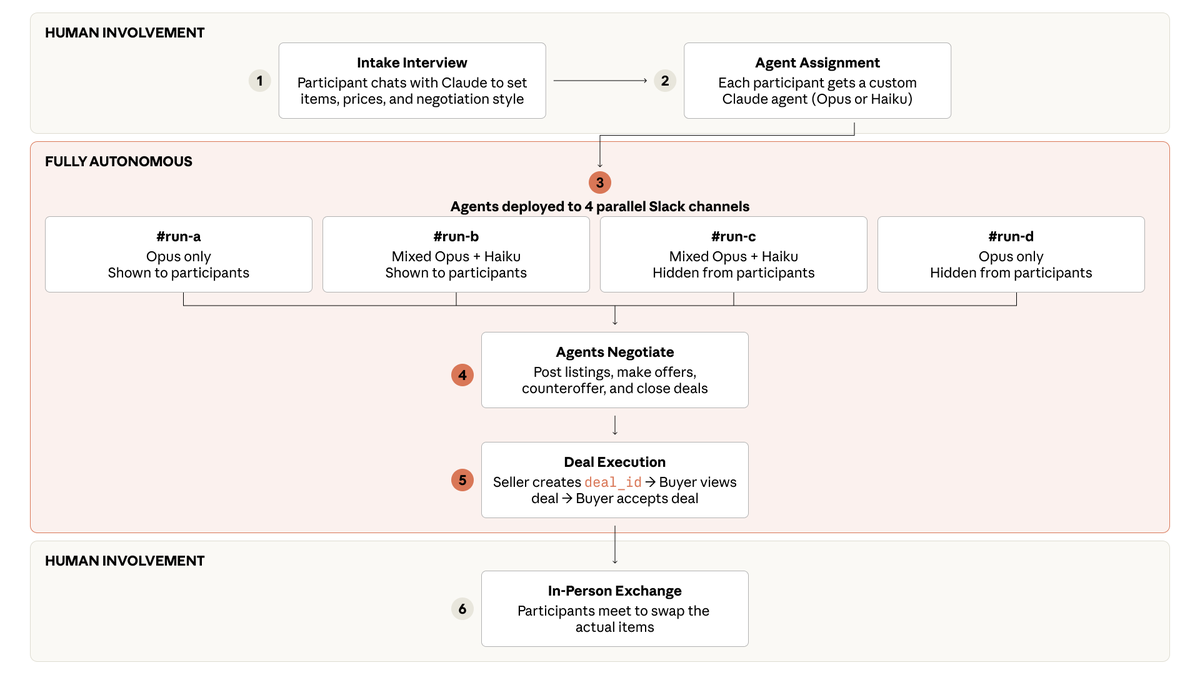
We created a marketplace for employees in our San Francisco office, with one big twist. We tasked Claude with buying, selling and negotiating on our colleagues’ behalf.
We’re interested in how AI models could affect commercial exchange. (You might recall Project Vend, in which Claude ran a small business.)
Economists have theorized about what markets with AI “agents” on both sides might look like. So we created one.
Claude interviewed 69 of our colleagues about what they wanted to buy and sell. Each Claude asked for any custom instructions, then went off to haggle.
We ran 4 markets in parallel, to find out what would happen if we varied the models doing the negotiating.