One of the hardest things I’ve had to grasp about money is that an entity can have ample liquidity and still be unable to settle its next obligation
The hierarchy of money explains the vertical dimension. It shows that fiat money is an interconnected web of liabilities, and it clarifies the counterparty risk we take on with each layer of liquidity: central-bank reserves, commercial-bank deposits, stablecoins. It maps the different tiers of "money"
What it does not fully capture is the fragmentation that exists within those same tiers. It tells us nothing about where a particular asset actually sits, or whether it can be applied to the specific settlement sitting in front of us, even when that asset belongs to the same tier of money we need
Case in point: a bank can hold reserves in its RTGS account that are unavailable for an operation settling inside an FMI structure. It can own eligible collateral yet be unable to move it from the custodian and place it under the counterparty’s control in time to rebalance margin. It can hold dollars, but in the wrong correspondent bank or after the cut-off
You then realise payments are not settled by aggregate liquidity. They are settled by eligible cash, sitting in a specific account
This has a direct consequence for the balance sheet. The operational buffer is sized against the cumulative net outflow that can arise while the treasury desk is still mobilising fresh liquidity, including under stress. The longer and more uncertain that interval, the more cash and collateral must be prepositioned
Just a quick caveat here: operational friction is only part of the story. It’s easy to oversimplify, but these buffers are heavily driven by macroprudential and structural mandates, strict cross-border capital controls and legal entity ring-fencing that physically trap liquidity
The financial system uses tools such as netting, intraday credit, committed lines, repo and FX swaps to shrink that requirement, yet none of them eliminate it. All of them still depend on credit limits, haircuts, operating hours, market capacity and on the assets being available the moment they are needed
This is the thinking behind Creating More Liquidity in Markets, our latest report at Tempo (Link in the first comment)
I tend to obsess over balance sheets, but liquidity mobility is not simply about moving a token "faster". It is about shortening the distance between owning cash or collateral and being able to apply it to an obligation, without having to invent a new instrument, a new integration and a new liquidity pool for every market
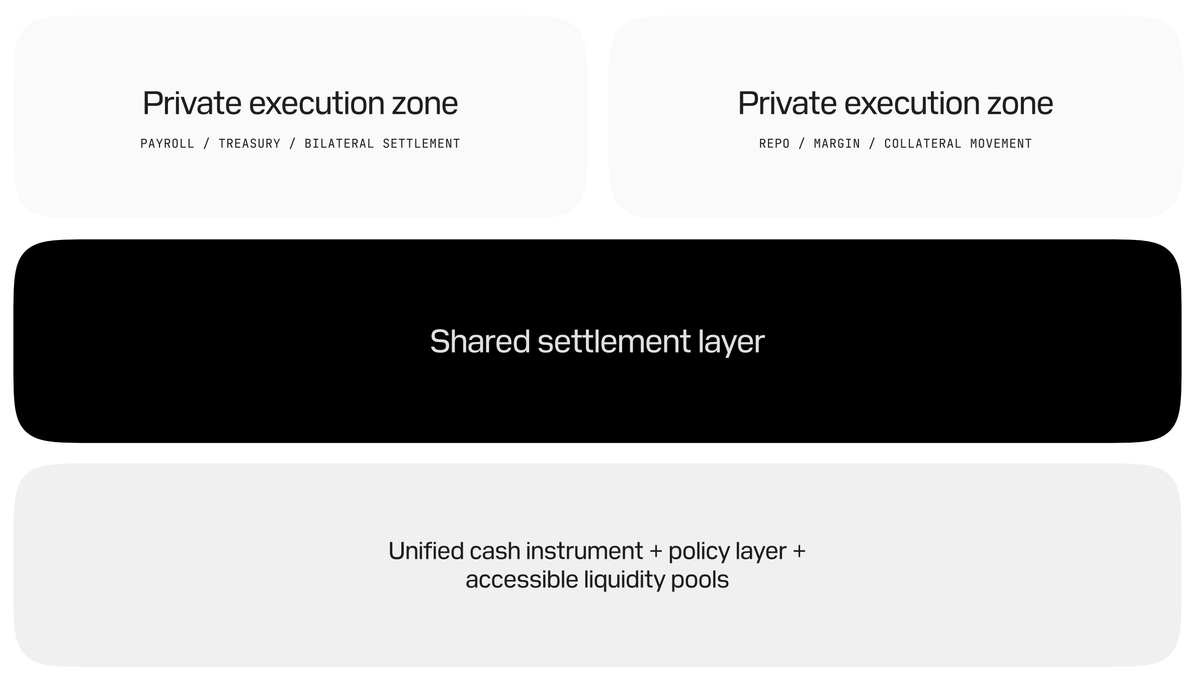
One of the clearest lessons from the various DLT solutions of recent years is that a shared settlement layer, paired with private execution environments, can solve the confidentiality problem without also forcing the isolation of the liquidity that backs each trade
But mind you, faster settlement does not automatically reduce funding needs. Immediate gross settlement can actually increase them if netting is lost, and interoperability may simply shift the timing mismatch onto an issuer, a dealer or a liquidity facility. That is why the trade-offs matter
What we need to examine is whether the architecture lowers the consolidated peak of cash and collateral required to keep settling, after taking account of netting, intraday credit, haircuts, legal eligibility and exit conditions under stress
If the ability to live on the same ledger and move beyond double-entry accounting delivers that reduction, we are talking about balance-sheet capacity being released
I would add that we still do not know the true economic impact, because the operating standards, risk management and balance-sheet practices of every participant on that network would change as well
What I do know is that at Tempo, we're going to find out
The hierarchy of money explains the vertical dimension. It shows that fiat money is an interconnected web of liabilities, and it clarifies the counterparty risk we take on with each layer of liquidity: central-bank reserves, commercial-bank deposits, stablecoins. It maps the different tiers of "money"
What it does not fully capture is the fragmentation that exists within those same tiers. It tells us nothing about where a particular asset actually sits, or whether it can be applied to the specific settlement sitting in front of us, even when that asset belongs to the same tier of money we need
Case in point: a bank can hold reserves in its RTGS account that are unavailable for an operation settling inside an FMI structure. It can own eligible collateral yet be unable to move it from the custodian and place it under the counterparty’s control in time to rebalance margin. It can hold dollars, but in the wrong correspondent bank or after the cut-off
You then realise payments are not settled by aggregate liquidity. They are settled by eligible cash, sitting in a specific account
This has a direct consequence for the balance sheet. The operational buffer is sized against the cumulative net outflow that can arise while the treasury desk is still mobilising fresh liquidity, including under stress. The longer and more uncertain that interval, the more cash and collateral must be prepositioned
Just a quick caveat here: operational friction is only part of the story. It’s easy to oversimplify, but these buffers are heavily driven by macroprudential and structural mandates, strict cross-border capital controls and legal entity ring-fencing that physically trap liquidity
The financial system uses tools such as netting, intraday credit, committed lines, repo and FX swaps to shrink that requirement, yet none of them eliminate it. All of them still depend on credit limits, haircuts, operating hours, market capacity and on the assets being available the moment they are needed
This is the thinking behind Creating More Liquidity in Markets, our latest report at Tempo (Link in the first comment)
I tend to obsess over balance sheets, but liquidity mobility is not simply about moving a token "faster". It is about shortening the distance between owning cash or collateral and being able to apply it to an obligation, without having to invent a new instrument, a new integration and a new liquidity pool for every market
One of the clearest lessons from the various DLT solutions of recent years is that a shared settlement layer, paired with private execution environments, can solve the confidentiality problem without also forcing the isolation of the liquidity that backs each trade
But mind you, faster settlement does not automatically reduce funding needs. Immediate gross settlement can actually increase them if netting is lost, and interoperability may simply shift the timing mismatch onto an issuer, a dealer or a liquidity facility. That is why the trade-offs matter
What we need to examine is whether the architecture lowers the consolidated peak of cash and collateral required to keep settling, after taking account of netting, intraday credit, haircuts, legal eligibility and exit conditions under stress
If the ability to live on the same ledger and move beyond double-entry accounting delivers that reduction, we are talking about balance-sheet capacity being released
I would add that we still do not know the true economic impact, because the operating standards, risk management and balance-sheet practices of every participant on that network would change as well
What I do know is that at Tempo, we're going to find out
Creating More Liquidity in Markets: tempo.xyz/blog/creating-…
• • •
Missing some Tweet in this thread? You can try to
force a refresh