
1/18》Here's NOAA's graph of ocean heat content (OHC), in the upper 700 meters of seawater (where most added heat is).
ncei.noaa.gov/data/oceans/wo…
Graph source:
ncei.noaa.gov/access/global-…
There are a couple of odd things about that graph. Can you spot them?
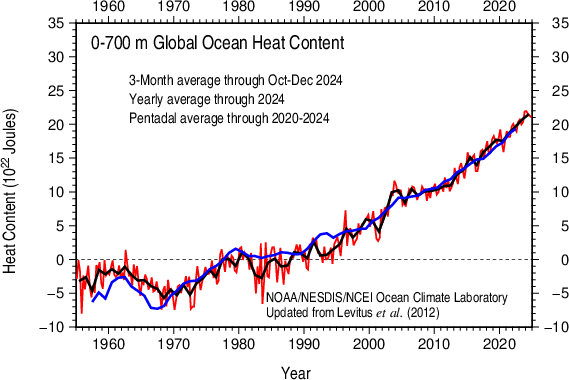
2/18》Most obviously, note the horizontal axis. They graph OHC all the way back to 1955!
Don't believe it. OHC is estimated by models, informed by temperature measurements, made by Argo Floats. The first Argo Float was deployed in 2000. They didn't reach 3000 units until 2007.
3/18》The part of their graph prior to about 2005 is 100% codswallop. The kindest thing you can say about it is that it's a plausible extrapolation, consistent with (but you can't say based upon!) convenience samples of sea surface temperatures.
4/18》But let's assume, for the sake of discussion, that their guesses about OHC prior to 2005 are miraculously correct. Can you spot the other odd thing about their graph?
ncei.noaa.gov/data/oceans/wo…
5/18》Doesn't it seem odd to you that graphs, articles & web pages about ocean 'warming' almost never mention temperatures? If you don't smell something fishy, your BS detector is seriously defective!
6/18》That's the other odd thing: the units on the vertical axis. The topic is ocean warming, yet the units are 10²² Joules ≡ 10s of zettajoules (ZJ).
They say ≈200 ZJ of energy were added to the top 700 meters over the last 35 years.
Q1: Why not show it as temperature?
7/18》Why didn't they use a vertical axis marked with units that people can understand, like °C average water temperature change?
On both right & left sides they used units of 10²²J, not °C. Why?
The answer will be obvious, once we've answered a related question:
8/18》Q2: What does 200 ZJ mean, in terms we can understand, like temperature?
Let's figure it out.
sealevel.info/How_much_would…
9/18》Total volume of water in the oceans:
1,338,000,000 cubic-km = 1.338 × 10^9 km³ = 1.338E9 km³
Volume of water in the upper 700 meters of the oceans:
360,000,000 km² × 0.7 km = 2.52 × 10^8 km³ = 2.52E8 km³ = 18.83% of total ocean volume
11/18》So, let's calculate how much energy it takes to warm that much water by 1°C.
Everyone knows 1 cal of energy will raise one gram of fresh water by 1°C, and 1 kcal (1000 cal) warms 1 kg of water by 1°C. 1 cal = 4.184 J, so 4.184E3 J warms 1 kg of pure, fresh water 1°C.
12/18》Seawater has an 8% lower specific heat of 3.850E3 J / (kg °C). So:
It takes 2.588E20 kg × 3.850E3 J/kg = 9.964E23 Joules to raise the average temperature of the top 700m of the oceans by 1°C.
13/18》So 200 ZJ (= 2.0E23 J) warms the top 700m of seawater by an average of (2.0E23 / 9.964E23) = 0.2007 °C, or about 1/5-th of a degree.
That's right, one-fifth of a degree, in 35 years.
Is that supposed to be frightening? 🤣
14/18》So now you know the answer:
Q1: Why not use a vertical axis marked in units of temperature?
A: So people will be less likely to laugh when we claim it's an "emergency."
15/18》But, if you have a properly skeptical scientific mind, that should cause you to wonder about another question:
Q3: How can they know the average ocean temperatures to within <0.2 °C, even now?
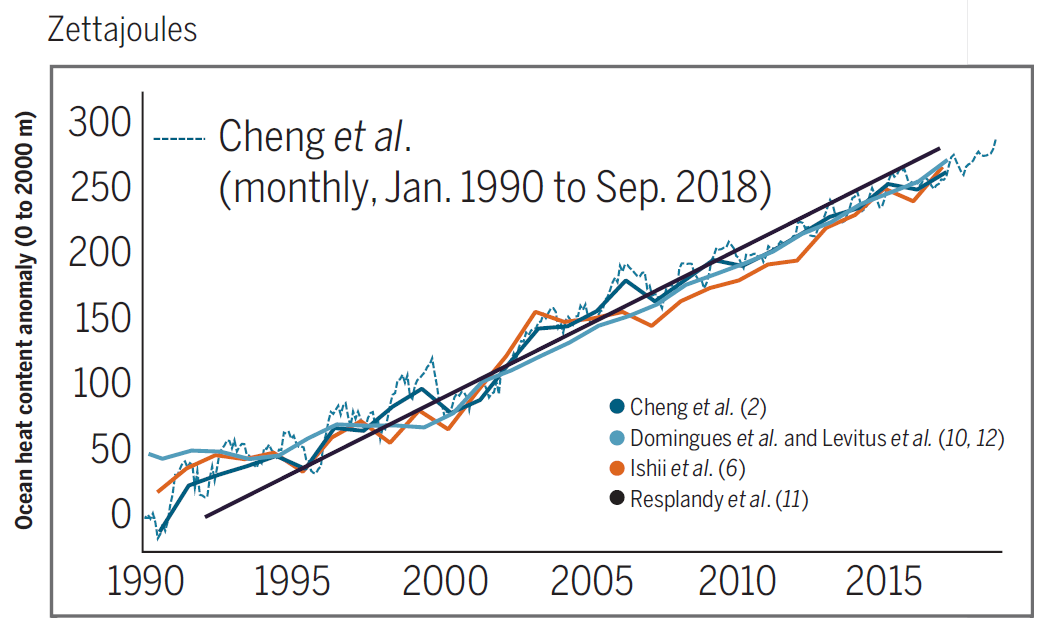
16/18》Here's a hint, from which you might guess the answer. This recent paper revised the estimate of ocean heat content anomaly upward by 40%:
science.sciencemag.org/content/363/64…
Graph:
sealevel.info/how_fast_are_t…
@SciAm article:
scientificamerican.com/article/oceans…
@sciam 17/18》Q3: How can they know the global average ocean temperature to within <0.2 °C, even now?
That 40% revision is a hint. A revision that large means the quantity being measured was difficult to measure accurately.
A3: They DON't really know.
Share this Scrolly Tale with your friends.
A Scrolly Tale is a new way to read Twitter threads with a more visually immersive experience.
Discover more beautiful Scrolly Tales like this.