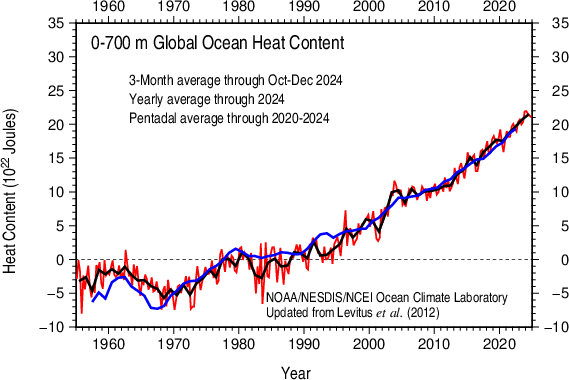
1/18》Here's NOAA's graph of ocean heat content (OHC), in the upper 700 meters of seawater (where most added heat is).
ncei.noaa.gov/data/oceans/wo…
Graph source:
ncei.noaa.gov/access/global-…

There are a couple of odd things about that graph. Can you spot them?
2/18》Most obviously, note the horizontal axis. They graph OHC all the way back to 1955!

Don't believe it. OHC is estimated by models, informed by temperature measurements, made by Argo Floats. The first Argo Float was deployed in 2000. They didn't reach 3000 units until 2007.
3/18》The part of their graph prior to about 2005 is 100% codswallop. The kindest thing you can say about it is that it's a plausible extrapolation, consistent with (but you can't say based upon!) convenience samples of sea surface temperatures.
4/18》But let's assume, for the sake of discussion, that their guesses about OHC prior to 2005 are miraculously correct. Can you spot the other odd thing about their graph?
ncei.noaa.gov/data/oceans/wo…
5/18》Doesn't it seem odd to you that graphs, articles & web pages about ocean 'warming' almost never mention temperatures? If you don't smell something fishy, your BS detector is seriously defective!
6/18》That's the other odd thing: the units on the vertical axis. The topic is ocean warming, yet the units are 10²² Joules ≡ 10s of zettajoules (ZJ).

They say ≈200 ZJ of energy were added to the top 700 meters over the last 35 years.

Q1: Why not show it as temperature?
7/18》Why didn't they use a vertical axis marked with units that people can understand, like °C average water temperature change?

On both right & left sides they used units of 10²²J, not °C. Why?

The answer will be obvious, once we've answered a related question:
8/18》Q2: What does 200 ZJ mean, in terms we can understand, like temperature?

Let's figure it out.

sealevel.info/How_much_would…
9/18》Total volume of water in the oceans:
1,338,000,000 cubic-km = 1.338 × 10^9 km³ = 1.338E9 km³

Volume of water in the upper 700 meters of the oceans:
360,000,000 km² × 0.7 km = 2.52 × 10^8 km³ = 2.52E8 km³ = 18.83% of total ocean volume
11/18》So, let's calculate how much energy it takes to warm that much water by 1°C.

Everyone knows 1 cal of energy will raise one gram of fresh water by 1°C, and 1 kcal (1000 cal) warms 1 kg of water by 1°C. 1 cal = 4.184 J, so 4.184E3 J warms 1 kg of pure, fresh water 1°C.
12/18》Seawater has an 8% lower specific heat of 3.850E3 J / (kg °C). So:

It takes 2.588E20 kg × 3.850E3 J/kg = 9.964E23 Joules to raise the average temperature of the top 700m of the oceans by 1°C.
13/18》So 200 ZJ (= 2.0E23 J) warms the top 700m of seawater by an average of (2.0E23 / 9.964E23) = 0.2007 °C, or about 1/5-th of a degree.

That's right, one-fifth of a degree, in 35 years.

Is that supposed to be frightening? 🤣
14/18》So now you know the answer:

Q1: Why not use a vertical axis marked in units of temperature?

A: So people will be less likely to laugh when we claim it's an "emergency."
15/18》But, if you have a properly skeptical scientific mind, that should cause you to wonder about another question:

Q3: How can they know the average ocean temperatures to within <0.2 °C, even now?
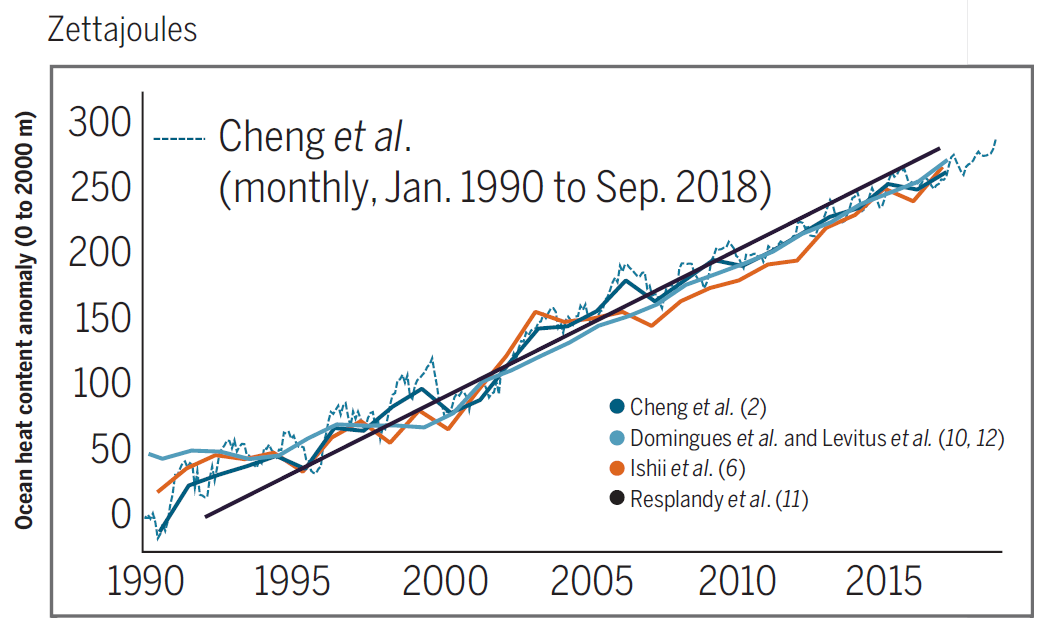
16/18》Here's a hint, from which you might guess the answer. This recent paper revised the estimate of ocean heat content anomaly upward by 40%:
science.sciencemag.org/content/363/64…

Graph:
sealevel.info/how_fast_are_t…

@SciAm article:
scientificamerican.com/article/oceans…
@sciam 17/18》Q3: How can they know the global average ocean temperature to within <0.2 °C, even now?

That 40% revision is a hint. A revision that large means the quantity being measured was difficult to measure accurately.

A3: They DON't really know.
@sciam 18/18》There're only about 4000 Argo floats sampling ocean temps from about 360 million km² of ocean. The Argo-based OHC estimates (since 2007) are questionable; OHC estimates before that are pure codswallop.

Learn more:
sealevel.info/learnmore.html…

@ThreadReaderApp @Rattibha unroll
@sciam @threadreaderapp @rattibha The full 18-part tweetstorm is compiled here:
threadreaderapp.com/thread/1533248…

And here:
rattibha.com/thread/1533248…

###

• • •

Missing some Tweet in this thread? You can try to force a refresh

 

Keep Current with ✝️ 🇺🇸 🇺🇦 Dave Burton

✝️ 🇺🇸 🇺🇦 Dave Burton Profile picture

Stay in touch and get notified when new unrolls are available from this author!

Read all threads

This Thread may be Removed Anytime!

PDF

Twitter may remove this content at anytime! Save it as PDF for later use!

Try unrolling a thread yourself!

how to unroll video
  1. Follow @ThreadReaderApp to mention us!

  2. From a Twitter thread mention us with a keyword "unroll"
@threadreaderapp unroll

Practice here first or read more on our help page!

More from @ncdave4life

Jan 23, 2025
1/4. Rising CO2 levels improve plants' water use efficiency and drought resilience, through reduced stomatal conductance. Simply put, plants need to process less air to get the carbon they need for growth, and thus they lose less water to transpiration.
x.com/ncdave4life/st…

That's one of the reasons that catastrophic famines no longer happen. For all of of human history, until recently, famine was one of the great scourges of mankind: the "Third Horseman of the Apocalypse." But widespread famines are fading from living memory, and rising atmospheric CO2 concentration is one of the reasons for that.

That's a very, very Big Deal. For comparison:

● COVID-19 killed about 0.1% of the world's population
● The catastrophic 1918 flu pandemic killed about 2%
● WWII killed 2.7% of the world's population
● But the nearly-worldwide drought and famine of 1876-78 killed about 3.7% of the world's population.
@Panta_Rhei06 @simonmaechling --

2/4. Improved water use efficiency and drought resilience are especially beneficial in arid regions, like the Sahel, which is one of the reasons that region of Africa is "greening" even faster than most other places.
Image
3/4. I asked ChatGPT about that benefit of CO2 emissions and rising CO2 levels:

"With reference to the agronomy literature, quantify how elevated CO2 helps plants use water more efficiently, and increases crops' drought resilience, by reducing stomatal conductance and water loss through transpiration."

ChatGPT replied with a very good answer:

In agronomy, the effects of elevated CO2 on plant water use efficiency and drought resilience are extensively studied. One of the key mechanisms through which elevated CO2 levels improve water use efficiency is by reducing stomatal conductance and, consequently, water loss through transpiration.

Stomata are small pores on the surface of plant leaves that regulate gas exchange, including the uptake of CO2 for photosynthesis and the release of water vapor through transpiration. When CO2 levels are elevated, plants can maintain the same or higher rate of photosynthesis while reducing stomatal conductance. This reduction in stomatal conductance leads to a decrease in water loss through transpiration without significantly affecting CO2 uptake, resulting in improved water use efficiency.

Several studies have quantified the effect of elevated CO2 on stomatal conductance and transpiration. For example, a meta-analysis published in 2013 (Kimball et al., 2013) found that under elevated CO2 levels, stomatal conductance decreased by an average of 22%, while transpiration decreased by only 17%. This indicates that plants under elevated CO2 levels were able to reduce water loss more efficiently than they reduced CO2 uptake, leading to an overall improvement in water use efficiency.

Improvements in water use efficiency due to elevated CO2 levels can increase plants' drought resilience by allowing them to maintain adequate hydration during periods of water scarcity. This can be particularly beneficial in arid and semi-arid regions where water availability is limited.

Overall, the literature suggests that elevated CO2 levels can improve water use efficiency in plants by reducing stomatal conductance and water loss through transpiration, which can enhance their resilience to drought conditions.
Read 5 tweets
Jan 12, 2025
1/6》 Marcus, please tell me that you're not fooled by a fake "study" of a three-day-old event, from a climate industry propaganda outlet. Do you know how long real studies take?

This is the real global trend:
sealevel.info/learnmore.html…
@Marcusgibson @WeatherProf 2/6》 NASA measures it from MODIS satellites. They show a decreasing trend in fires.
earthobservatory.nasa.gov/images/145421/…
archive.ph/WfDJh
earthobservatory.nasa.gov/images/90493/r…
@Marcusgibson @WeatherProf 3/6》 The main factors affecting fires are land management and forestry practices.
phys.org/news/2022-11-1…
forestpolicypub.com/2021/07/30/gri…
Global warming has negligible impact on wildfires.
Read 7 tweets
Jan 11, 2025
1/8. Gov. Newsom's press release falsely blames "a hotter, drier world." In fact, the world is warming only very slightly & slowly, and it hasn't gotten at all drier. Here're the facts:
sealevel.info/learnmore.html…
As you can see from the graph, the fraction of the globe in drought has decreased slightly, not increased.

Oh, and BTW, NCA4 (circa 2018) estimated that global average temperatures have risen only 1.14 ±0.13°C since the 1800s, and the warming is disproportionately at chilly high latitudes.Image
2/8. Also, higher CO2 levels greatly reduce drought impacts, by making plants more drought-resistant and water-efficient, through reduced stomatal conductance. That's very beneficial in arid regions, like the Sahel & much of California. Here's an article.
web.archive.org/web/2017061915…
That's is one of the reasons that region of Africa is "greening" even faster than most other places.

@NewScientist reported the "remarkable environmental turnaround," including a “quite spectacular regeneration of vegetation,” and "a 70 per cent increase in yields of local cereals such as sorghum and millet in one province in recent years."
@WeatherProf 3/8. National Geographic @NatGeo also wrote about it.
web.archive.org/web/2009080201…

sealevel.info/Owen2009_Sahar…
Read 9 tweets
Oct 10, 2024
1/8》Doc wrote, "You’re not going to change my mind."

Please do not be impervious to evidence, like trillionofcells. That would make me sad.Image
2/8》Doc wrote, "Wasn’t Gleick cleared of any wrongdoing?"

No, he was not cleared. That was disinformation from The Grauniad:
x.com/ncdave4life/st…

In fact, Gleick eventually admitted the identity theft, and disseminating the forgery & the stolen documents (though only after he was caught & publicly identified).

I can see that you didn't read my article about it. You should:
sealevel.info/Peter_Gleick_D…
3/8》Gleick never admitted being the forger, but there can be no doubt of that, either.

It was the incongruous appearance of his name in the document, with the strangely flattering description of him as a "high-profile climate scientist," in a document which said NOTHING positive about ANY other climate activists, which first drew Steve Mosher's attention to Gleick. But it was the idiosyncrasies of Gleick's own writing style, found in the forged document, which Mosher mostly discussed, when explaining why he believed Gleick wrote it.

Mosher explained it, at length, in a series of blog comments, beginning here:
rankexploits.com/musings/2012/t…

Note that that was all BEFORE Gleick confessed to being the person who had impersonated the Heartland Board Member to steal the other documents. THAT iced it: there's no question that Gleick was the forger.

(BTW, Mosher used to be with Berkeley Earth.)
Read 9 tweets
Oct 2, 2024
1/8. The IPCC authors expect  a worsening trend. No such trend is actually detectable, so far.

In fact, here's a paper about the downward  trend in hurricane destructiveness, tho I suspect the decrease might be a fluctuation rather than a durable trend.
nature.com/articles/ncomm…
2/8. The IPCC authors are sly. They know hurricanes & other tropical cyclones aren't worse, but they dodge & weave to avoid admitting it. Here's a tricky quote from AR6:

"It is likely that the global proportion of Category 3–5 tropical cyclone instances has increased over the past four decades."

ref: ipcc.ch/report/ar6/wg1…
3/8. That's a textbook illustration of Chesterton's point:

"Falsehood is never so false as when it is very nearly true."

It's "spin." It is calculated deception without QUITE lying.

Look at that graph again:

(Updated version: )climatlas.com/tropical/globa…Image
Read 9 tweets
Aug 14, 2024
@JamesFaris_ & @BusinessInsider, here's reality:

Hurricanes and other tropical cyclones:


tl;dr: Hurricanes are not worsening.

sealevel.info/learnmore.html…
climatlas.com/tropical/globa…Image
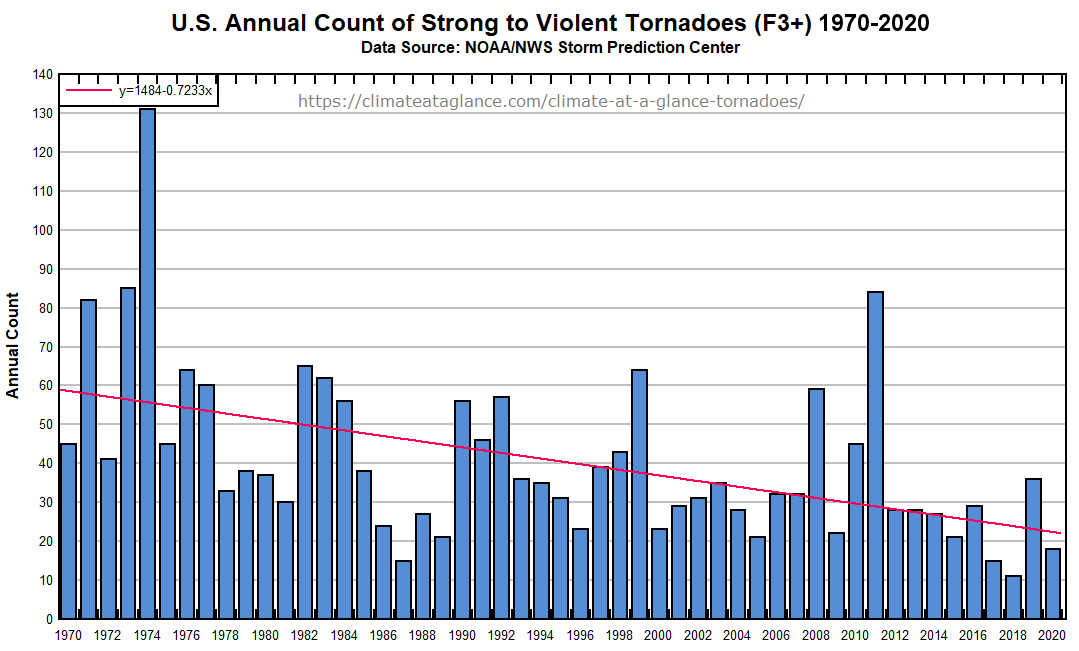
Tornadoes:


tl;dr: Tornadoes are not worsening.

sealevel.info/learnmore.html…
climateataglance.com/wp-content/upl…Image
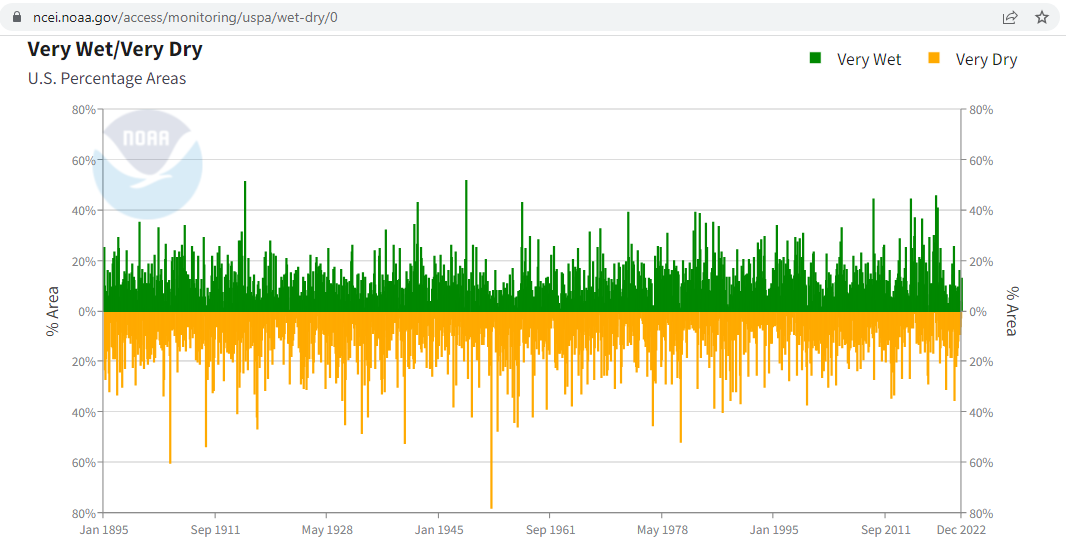
Droughts & floods:


tl;dr: Droughts & floods are not worsening.


sealevel.info/learnmore.html…
ncei.noaa.gov/access/monitor…
sealevel.info/US_percentage_…Image
Read 7 tweets

Did Thread Reader help you today?

Support us! We are indie developers!


This site is made by just two indie developers on a laptop doing marketing, support and development! Read more about the story.

Become a Premium Member ($3/month or $30/year) and get exclusive features!

Become Premium

Don't want to be a Premium member but still want to support us?

Make a small donation by buying us coffee ($5) or help with server cost ($10)

Donate via Paypal

Or Donate anonymously using crypto!

Ethereum

0xfe58350B80634f60Fa6Dc149a72b4DFbc17D341E copy

Bitcoin

3ATGMxNzCUFzxpMCHL5sWSt4DVtS8UqXpi copy

Thank you for your support!

Follow Us!

:(