
1/ As 🇷🇺 missiles rain down on civilian targets all over 🇺🇦, I get questions what to do now. Some thoughts as a former air defence officer on this. But beware, information about the attacks is limited, and I would not say it is over yet. Air alarms are still ongoing.
2/ I will 1⃣ look at the missiles/weapons presumably used, 2⃣ 🇺🇦 air defences, and 3⃣ ways if Western assistance. Again, all based on limited information.
3/ So let's start with 1⃣ the attacking weapons:
First, Kyiv and many other cities in Ukraine aer in the range of Short Range Ballistic Missiles (SRBM), particularly Iskander and Tochka-U. THese are hardest to intercept.
An Iskander comes in at a high angle (~70°)...
4/ ... and high speed (>2400m/s). Any intercepting missile needs to get a lead on the target, in this case going upwards very fast. If an Iskander maneuvres during decent, this gets even more difficult, as the interceptor needs to make large corrections very fast.
5/ This means that practical range of air defence missiles is highly reduced. A missile that can intercept a subsonic aircraft at 50km (used in catalogue range diagrammes) will only be able to defend sites against SRBM attacks a few kilometers around the firing position.
6/ Then cruise missiles, like the Kalibr. THey come in at much lower speed (~240m/s) and low altitude (depending on terrain, but usually 50 to 100m above ground).
As a target, they aer as easy to intercept as any other subsonic aircrafft, however their low RCS ...
7/ ... and infrared signature means they are often detected very late. Having multiple sensors supporting each other can midgigate this. Dedicated low-altitude radars like the good old flamingo help as well. upload.wikimedia.org/wikipedia/comm…
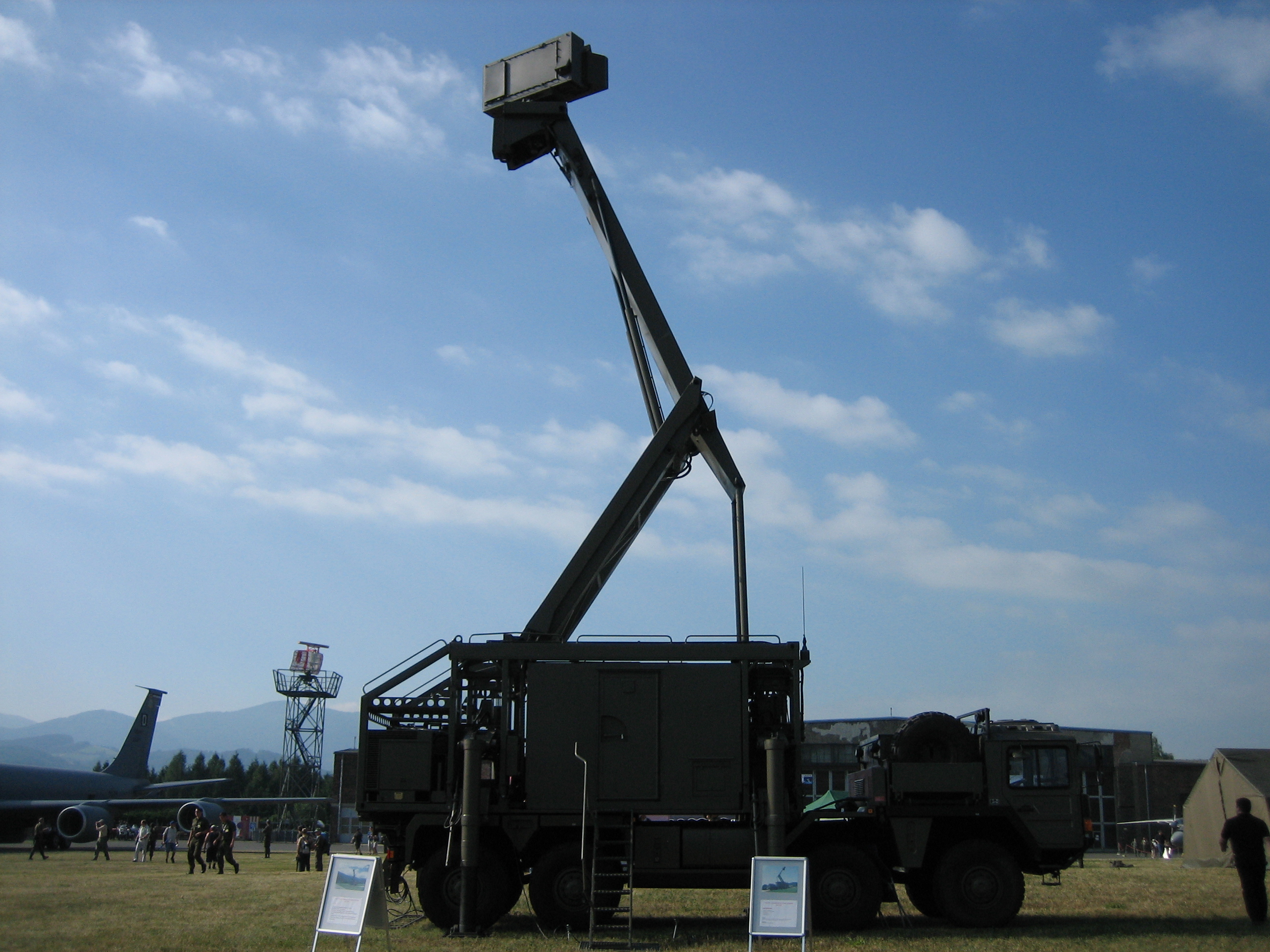
8/ Finally lointering munition, or "suicide drones" (although, guys, every sort of munition is suicidal...). They are the slowest target by far, a bit over 50m/s. But being slow, they can follow the terrain closer than a cruise missile, often fly below the radar's actual sight.
9/ They are also very cheap, costing roughly $20.000 a piece, much less than any missile, even much less than the smallest air defence missiles posed to intercept them.
Hence they also appear in larger numbers, and usually in staggered waves.
10/ The first wave providing information about the target's defences, to be circumvented by the second.
Because of shortages in ammunition, Russia had also resorted to use air-defence missiles and anti-ship missiles for ground attack roles. They are not very good at that.
11/ SAM do not have any land attack mode at all, so they can only roughly hit something somewhere in an aerea target like a city.
Anti ship missiles have a land-attack mode, but they need large buildings for their radar seekers to orient themselves.
12/ Striking in this attack, 🇷🇺 used high-end, high-cost SRBM and cruise missiles as instruments of terror against non-hardened targets.
From a purely military point of view, that is quite a waste of effort. But if you are desperate to show off...
13/ So on 2⃣, what can 🇺🇦 do to defend itself?
First, there is no "one fits it all" weapons system to defend, as the targets are fairly different in speed, course, altitude, and numbers.
Air defences need to be layered, and different weapons system supporting each other.
14/ Back in March and April, 🇺🇦 air defences around Kyiv were thik and layered. They intercepted several Tochka-Us and Kalibr missiles, although of course not all in one attack wave.
According to the UAF, 41 out of 75 missiles were intercepted in this attack.
15/ Problems for air defences particuarly in the West are deployments to the East where the bulk of the fighting happens, shortages of ammunition, and the surprise elements of air attacks.
So a few remarks about the missiles:
16/ The primary air defence system od the Ukrainian Air Force is the S-300 system, of which 🇺🇦 had 31 batteries before the war.
Particularly the S-300PMU is capable of interceoting SRBM, however the bulk of S-300 are PS/PM versions.
The 150-90km range against aircraft ...
17/ ... is reduced to below 30km (or below) against SRBM, for reasons mentioned above.
As it has been the backbone of 🇺🇦 air defence for 7 months, ammunition supply is an issue. 🇸🇰 has handed over its S-300 in April, but given the high consumptio of missiles, this won't do alone.
18/ The Buk-M1 supplements the S-300. 🇺🇦 had 10 batteries, range <30km. While unsuited against SRBM other than lucky point defence, the missile is much better against low flying targets like cruise missiles and drones, against which S-300PS/PM have issues with their seekers.
19/ Buk missiles are running out, and 🇺🇦 desperately trying to get more ammo.
Also, because they are needed to fend off Russian aircraft in the theatre of operations, many have been deployed East as fighting moved there.
20/ 🇺🇦 also uses short-range systems like the Igla/Stinger/Grom MANPADS and Gepard SPAAG against drones.
Gepards are very scarce and needed to accompany mechanised reserves into battle. They are rerely deployed around cities, last time to guard Lamprechts visit to Odessa.
21/ MANPADS operators can hardly see small drones, so they need q-ing in by radar or other sensors. Ukrainians are integrating these short range systems in air defence networks. However defending large cities with MANPADS would require lots of launchers, due to their short range.
22/ As with Gepards, most MANPADS are operated by the army, not air force, hence they are deployed where the fighting is.
Even without ammo shortages, defending Ukraine is no easy task. The country is large, multiple high-value targets: cities, power stations, communication hubs
23/ To a certain degree, fighters can close the gap between air defence zones against cruise missiles and drones, but depending on the direction of the attack, they need to be close and in the air.
24/ 🇺🇦 fighters had shot down Kalibr in the past. Now there is a diplomatic incident between 🇲🇩 and 🇷🇺 as some Kalibr flew across 🇲🇩 territory.
This is probably to re-route them to bypass central Ukrainian fighter patroles.
25/ So 3⃣ what we can do to support Ukraine? Unfortunately here we are less contrained by political issues than by material shortages.
Air-defence has been de-prioritised in the West for 30 years, as the Taliban and other foes had no impressive air force. And history had ended...
26/ Most air-defence systems in 🇪🇺 were developed on a commercial basis, because there was an export market, not because there was interest in them by our own armies and bureaucracy.
That had negative impact on production capabilites (low), costs (high), and availability (none).
27/ Germany has reacted fastest in May to announce delivery of IRIS-T SLM. Technically a potent system, good sensors, range of 40km against aircraft (only point defence against SRBM), mobile.
But it can only be delivered as produced, so one battery this year and 3 in 2023.
28/ 🇺🇸 joined the effort with NASMAS, a similar system. 2 batteries this year, up to 6 in total by the next. THis system too is an export oriented design. It comes as fast as it is produced.
But compared to 31 S-300 and 10 Buk batteries, you see the catch.
29/ Western systems are more modern than Soviet ones, but again, this is a large country. The few systems can hardly be used to complement/support each other. There are too many sites to be protected for too few batteries.
30/ What I should say: you can only protect one object per pattery, not per launcher!
The radar and fire control centre are the critical mass, there is one per battery, even if there are 2, they are meant to alternate in order to avoid strikes by anti-radiation missiles.
31/ Often in the press you read things like "10 units are being delivered, etc." which referes to launchers. But launchers can only be used in connection to their radar and fire control center.
32/ So more batteries are needed. In 🇪🇺 the 🇫🇷🇮🇹 SAMP/T or the 🇫🇷 MICA-VR would be other excellent systems, still in production.
🇪🇸 is pondering sending used ASPIDE systems. Older and shorter ranged, it would still be of use, particular against Kalibr and drones.
33/ However, quantity would still be low, as production of these systems occurs at a very slow peacetime rate. Ramping up production is expensive, and would require a long-term committment by 🇪🇺 countries to fund this and procure future systems beyond this war.
34/ As you can imagine, I would highly recommend this, as NATO is very short on air-defence systems on its own, and we would need such systems after this war (🇺🇦 needs them now).
35/ On shorter ranged and particularly gun-systems, the situation is even more dramatic.
Against drones, guns are the only cost-effective sollution, because shells are cheaper than drones.
However the main gun producer in 🇪🇺 is/was Oerlikon in 🇨🇭 and even if ...
36/ ... now owned by Rheinmetall, there will be political hickups trying to export either used GDF or modern Skyranger.
I have no idea if we still have old Bofors 40mm/L70 around, and yes, they are horribly old, but to protect ports etc. against 🇮🇷 drones they are fine.
37/ Whih brings me to an other horrible mistake 🇪🇺 often does in military affairs. To fetishise technology and discard the effectiveness of aging weapons.
If modernised with proper sensors (radar/IR), an old GDF-002 or Bofors L70 is a good point-defence weapon to protect ...
38/ ... critical infrastructure, etc. Adding new sensors and integrate them in modern C2 systems is easier than designing and testing new systems from scratch.
We have fetishised technological revolutions so much that we forgot a lot of evolutionary potential of our old stuff.
39/ END for now.
Share this Scrolly Tale with your friends.
A Scrolly Tale is a new way to read Twitter threads with a more visually immersive experience.
Discover more beautiful Scrolly Tales like this.