
Dear friends, Germany's Energiewende - the grand plan to go green - is NOT going well⚡️
How bad is it? Can the new government fix it?
Let’s dive into one of the most ambitious (and chaotic) energy transitions in the world. 🧵👇
First, a brief background.
The term Energiewende dates back to the 1980s concept launched by Öko-institute.
The goal?
Phase out oil & nuclear while still growing the economy. Clean energy without more consumption. 🚫⚛️🛢️📈
A bold vision. But what happened?
Fast-forward to today, Energiewende = build renewables, ditch nuclear.
Why? Mostly fallout from Chernobyl and Cold War nuclear fears.
So Germany chose a unique path: no nukes, go green, but... also still use some fossil fuels.
Combine this with a new brand and spirit of environmentalism, and you get Energiewende.
In 1998, German Social Democrats (SPD) under Gerhard Schröder win the election.
By 2000, a deal is made with the Greens: Germany will quit nuclear.
In 2002, it's law. The first reactors close soon after.
The nuclear phase-out is on. 🔌❌⚛️
10 days before the election on 8th september 2005, Schröder approves the construction of Nord Stream 1.
On October 10th, Merkel and the CDU stand victorious.
On november 9th, Schröder accepts the role as president of the Shareholder's committee of Nord Stream AG. Later he will also become the president of Russian oil company Rosneft.
In 2010, Merkel and the CDU delays the phase out - new target, early 2030s instead.
Consensus achieved, nukes will remain online (at least for now)
Then, Fukushima happens.
Election panic. Green sentiment surges in state elections of Baden-Württemberg.
Merkel U-turns hard. The original phase-out plan is back.
Fast forward to 2023:
Germany pulls the plug on its last 3 reactors (after a 3 month extension. ☢️💀
The nuclear era is officially over.
But with nukes gone... how's that whole "clean energy transition" going?
Spoiler: not great.
At its peak, German nuclear plans pumped out over 170 TWh/year.
That's gone now.
Gas use? Up from 54 TWh (2002) to 77 TWh (2024). But at least down from a peak of 95 TWh in 2020.
Gas power plant capacity is booming.
From 20.3 GW to 36.7 GW in 2024. 🔥
(Electricity production from gas is a bit difficult to track, as there is significant "behind the meter generation" in industry. There are also many historical sources, as you can see in the chart on nuclear energy production.)
Electricity consumption is now the lowest since before the Berlin Wall fell. 📉
Let that sink in.
This isn’t just about clean energy - it’s about using less energy overall.
2024 had the lowest fossil-free power production since 2017. Yikes.
Germany is now a net importer of electricity - for the first time since 2002.
2023: 9.2 TWh imports
2024: 24.4 TWh imports
From energy exporter to importer in 6 years.
Since 2017, Germany's total electricity production has dropped by 152 TWh.
That's more than Sweden’s entire consumption.
From 659.3 TWh ➡️ 497.3 TWh (2024)
Let that number sink in 🔌🇩🇪
At the same time, consumption dropped by 78.2 TWh - equal to Finland’s entire power use.
From 599.9 ➡️ 521.7 TWh (2024)
The drop from the 2007 peak (624.3 TWh) is even steeper - That's a decrease of 102.6 TWh 📉
2024 = lowest electricity use since at least 1990.
Exports:
2017 ➡️ +52.5 TWh
2024 ➡️ -24.4 TWh
That’s a swing of 76.9 TWh.
Energiewende was supposed to lead Europe. Instead, Germany is importing more power than ever. ⚡🧲
(Yes, I'm aware the chart says differently, but the source data doesn't match. Please check out for yourself below)
Chart source:
cleanenergywire.org/factsheets/ger…
Data source:
ag-energiebilanzen.de/daten-und-fakt…
Emissions? ✅ Down.
Partly due to renewables. But also? Because the country is using less energy overall.
That’s not exactly a win if it comes from deindustrialization or energy insecurity.
Manufacturing in energy-intensive industries is down ~20% since pre-covid levels, driven by high energy costs.
The manufacturing declines have been hidden by strong employment in other sectors.
ft.com/content/bdba0f…
The nuclear phase-out has hurt energy security of supply and resource adequacy⚠️
Coal plants were supposed to close. Many can’t now.
Germany is even discussing delaying the coal exit. 😬
👉bloomberg.com/news/articles/…
For about 20 years, Germany has been paying subsidies to bring new gas-fired CHP plants online.
A report from 2023 illustrates the mind blowing potential cost savings of keeping Germany's last reactors running! 🤯
🤑€37 billion in savings for European consumers
🔥60 TWh less fossil gas consumed
🌍35 million tonnes CO2 saved
linkedin.com/posts/afry-man…
In Germany alone the effects would be substantial:
- a reduction of 8-23% in power prices
- consumer savings of €13.4 billion
- reduced CO2 emissions of 15 million tCO2 per year. With one single decision.
In February 2025, Germany's power prices jumped to record levels - exceeding energy crisis levels.
At the same time, the share of renewables hit the lowest level since 2022 on low solar and wind.
bloomberg.com/news/articles/…
This is a very real issue, that will require massive resolve from the new German government to fix.
But what's even worse? Several EU countries are still phasing out nuclear prematurely. Belgium is closing 3 reactors this year, and Spain will do in 2027.
We have to take this extremely seriously.
Without energy, we have no industry. Without industry, we have no defense. And without defence, we have no sovereignty.
Please listen to the Swedish energy minister and deputy PM:
We can't continue with "more of the same, but faster".
We also have to be better, and build smarter.
Addendum:
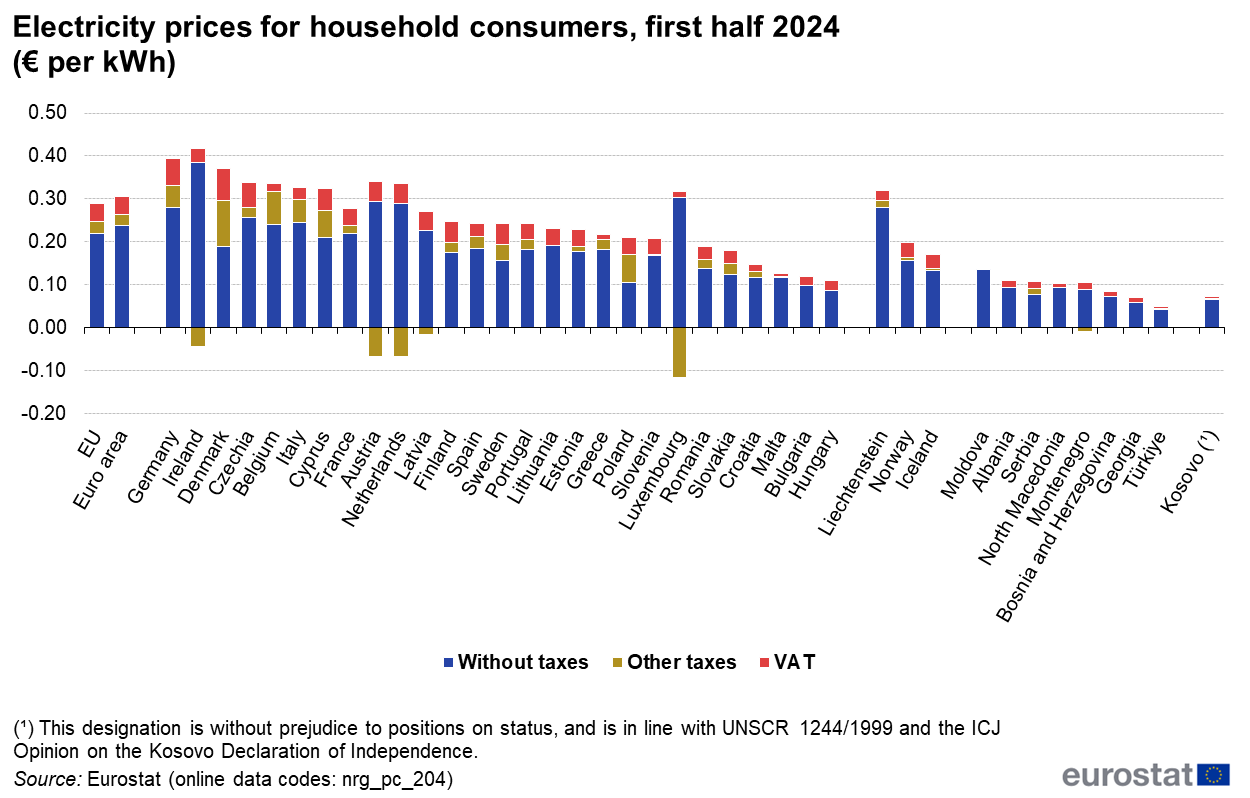
In 2024, Germans paid the highest electricity prices in the EU.
According to price comparison site Verivox, Germany has some of the highest electricity prices in the world. In 2023, they held the top spot for most expensive electricity globally (last image).
Starting 2024, grid fees rose sharply by 25% after the government failed to finance a €5.5 billion package on grid expansion.
This means an average consumer (4000 kWh consumption) will pay an extra €103 per year.
verivox.de/presse/analyse…
Other sources for power prices in Germany:
wiwo.de/unternehmen/st…
ec.europa.eu/eurostat/stati…
verivox.de/strom/verbrauc…
@bmonitor @KAH0852 Why would you connect 3-phase 36 kva for a consumption as low as the typical German household?
@bmonitor @KAH0852 Anyway, German power prices are some of the highest in the world and in the EU. End of story.
@N_Schmid And a dip one year in one year (of around 140 TWh) is not the same as permanently closing 170 TWh...
Also comparing to 2011, the year when Germany already closed 8 reactors, is maybe a little bit of cherry picking...
Share this Scrolly Tale with your friends.
A Scrolly Tale is a new way to read Twitter threads with a more visually immersive experience.
Discover more beautiful Scrolly Tales like this.