So, we're now trying to understand precisely what the Russians were working on at Nenoksa and what went wrong. We can, at least, confirm the outlines of the Russian account -- after an engine test, there was an explosion and fire on a barge that killed five nuclear scientists.
We can confirm the major aspects of the Russian version. Yes, there was an explosion -- the @ctbto_alerts detected it around 6:00 UTC or 9:00 am local time. It would be great if a seismologist worked out the precise event time.
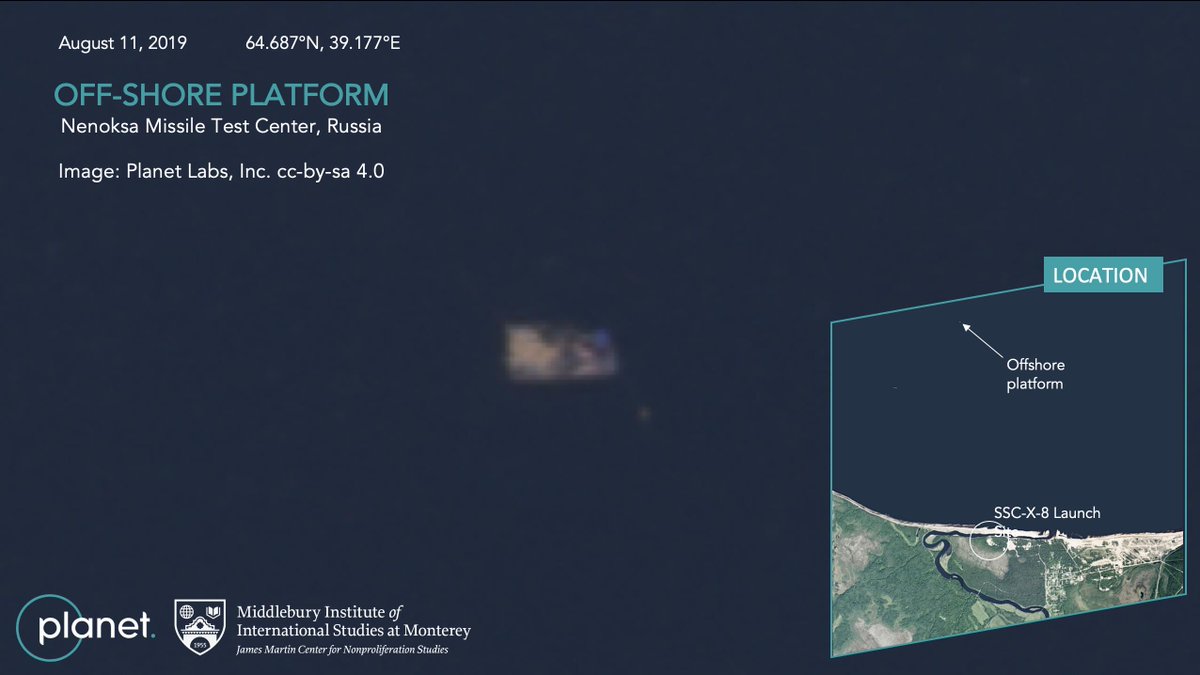
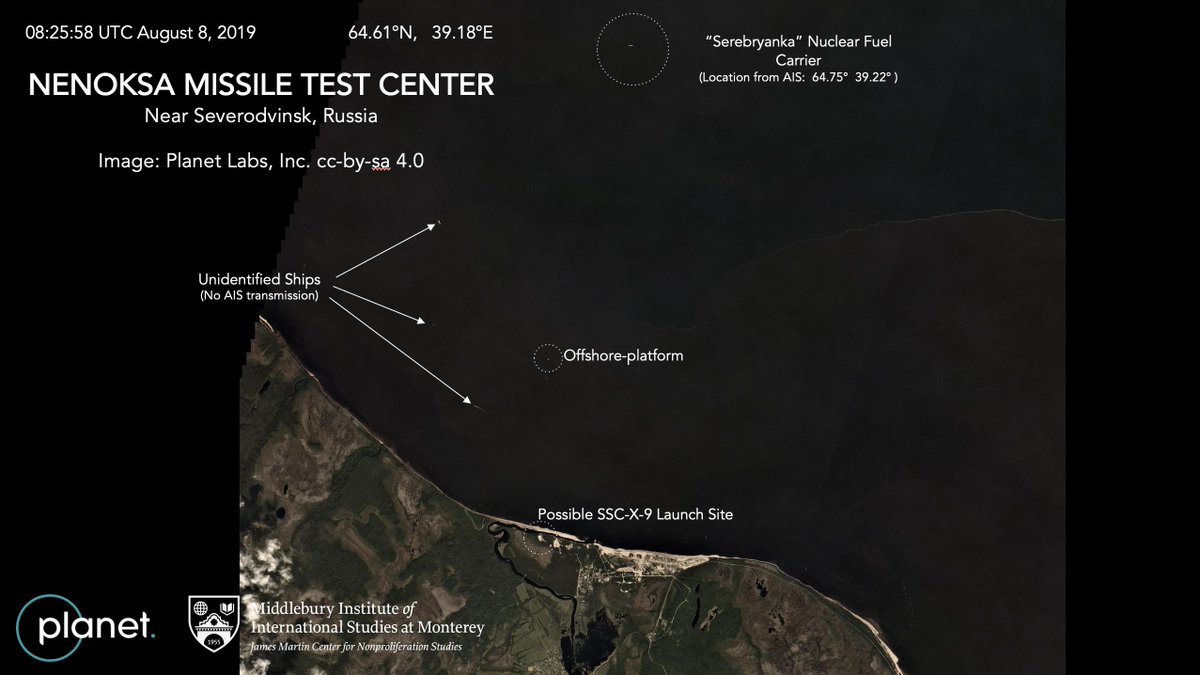
We can also see the damaged barge in satellite images. @planetlabs got a 70 cm image on August 11; @Maxar (via @ckoettl) got a 30 cm image on August 12.
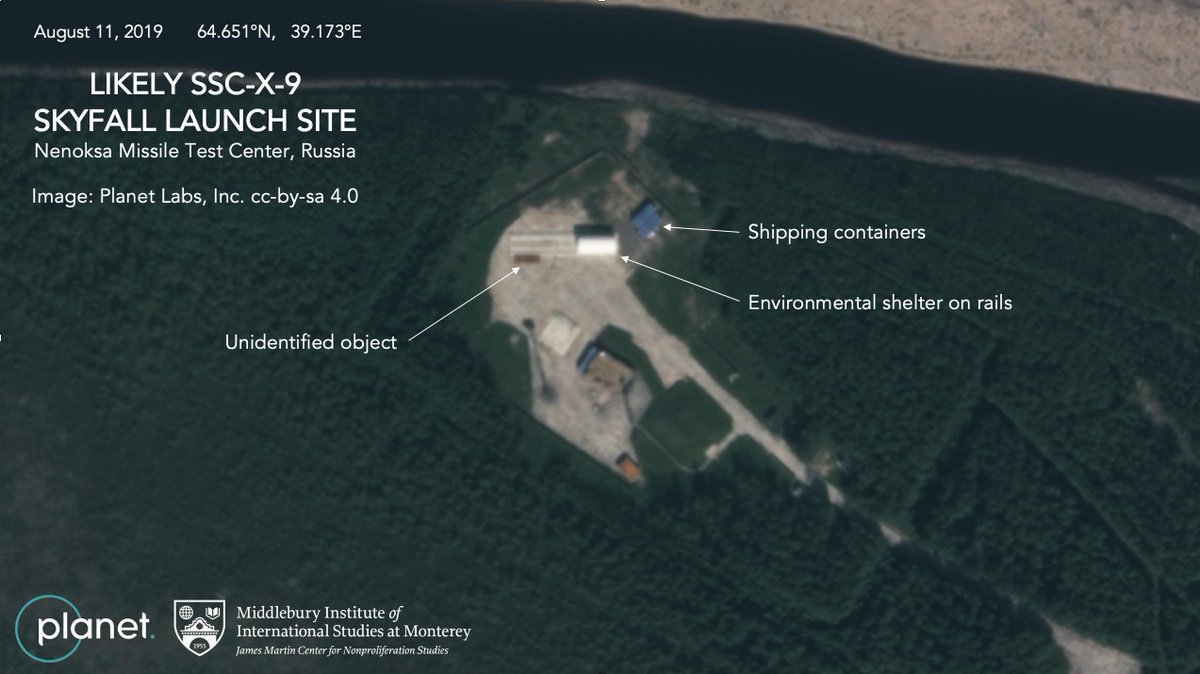
There are two reasons for thinking the explosion was related to a nuclear-powered cruise missile. The first is that some of the structures on the land suggest that Russia has moved testing of the SSC-X-9 to Nenoksa.
Second, AIS and satellite images demonstrate that Russia had the Serebryanka, a nuclear fuel carrier, sitting inside the exclusion zone PRIOR to the accident. In other words, it was waiting to carry away a highly radioactive cargoe like an SSC-X-9 propulsion unit.
Now, Russian officials have stated the five scientists killed were working on a small nuclear reactor, comparing it to @NASA's Kilopower reactor. That points to something like Skyfall, but the Russians don't seem to want to explain their design approach.
How does the nuclear reactor power the missile engine? The obvious reference is the direct-cycle US effort, Project Pluto. But there are also indirect-cycle concepts, including concepts that are closer to Kilopower. fas.org/nuke/space/anp…
A nuclear reactor to power a missile could be Skyfall (the program we know about) or a follow-on effort assuming that Skyfall, uh, fell short of its design goals. We really don't know. Boy, it would be great to still have some lab-to-lab contacts.
What went wrong? It's hard to guess unless we can understand how the nuclear reactor relates to the missile engine. But if we can tie together the backgrounds of the scientists and possible failure modes, we may be able to guess what the Russians don't want to tell us.
• • •
Missing some Tweet in this thread? You can try to
force a refresh

Why am I so unimpressed by these strikes? Israel and the US have failed to target significant elements of Iran's nuclear materials and production infrastructure. RISING LION and MIDNIGHT HAMMER are tactically brilliant, but may turn out to be strategic failures. 🧵 1/17
Netanyahu's justification for conducting this strike was that "Iran has produced enough highly enriched uranium for nine atom bombs -- nine." He refers to Iran's stockpile of ~400 kg of 60% U-235 which, if further enriched, would be enough for 9-10 weapons. Let's consider. 2/17
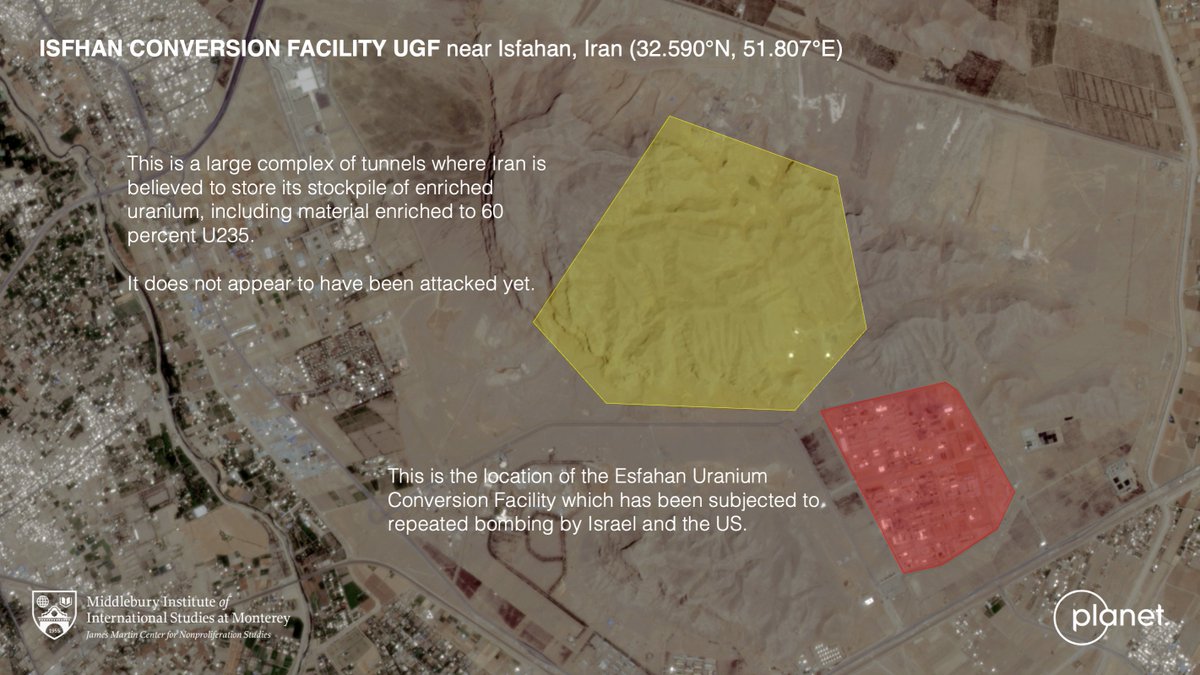
The 400 kg of HEU was largely stored in underground tunnels near the Isfahan Uranium Conversion Facility. Despite extensive Israeli and US attacks the facility, there does not seem to have been any effort to destroy these tunnels or the material that was in them. 3/17
References to "tactical" nuclear weapons in this otherwise great @guardian story by @hugolowell are misleading. The US would drop a strategic B61-11 nuclear earth penetrator with a yield of 300 or 400 kilotons. Hiroshima and Nagasaki were 15 and 21 kt. theguardian.com/world/2025/jun…
Here are the nuclear weapons in the US "enduring stockpile" from @ENERGY's stockpile management plant. Note that the B61-11 nuclear earth penetrator is labeled as a "strategic bomb" -- and for good reason. energy.gov/sites/default/…
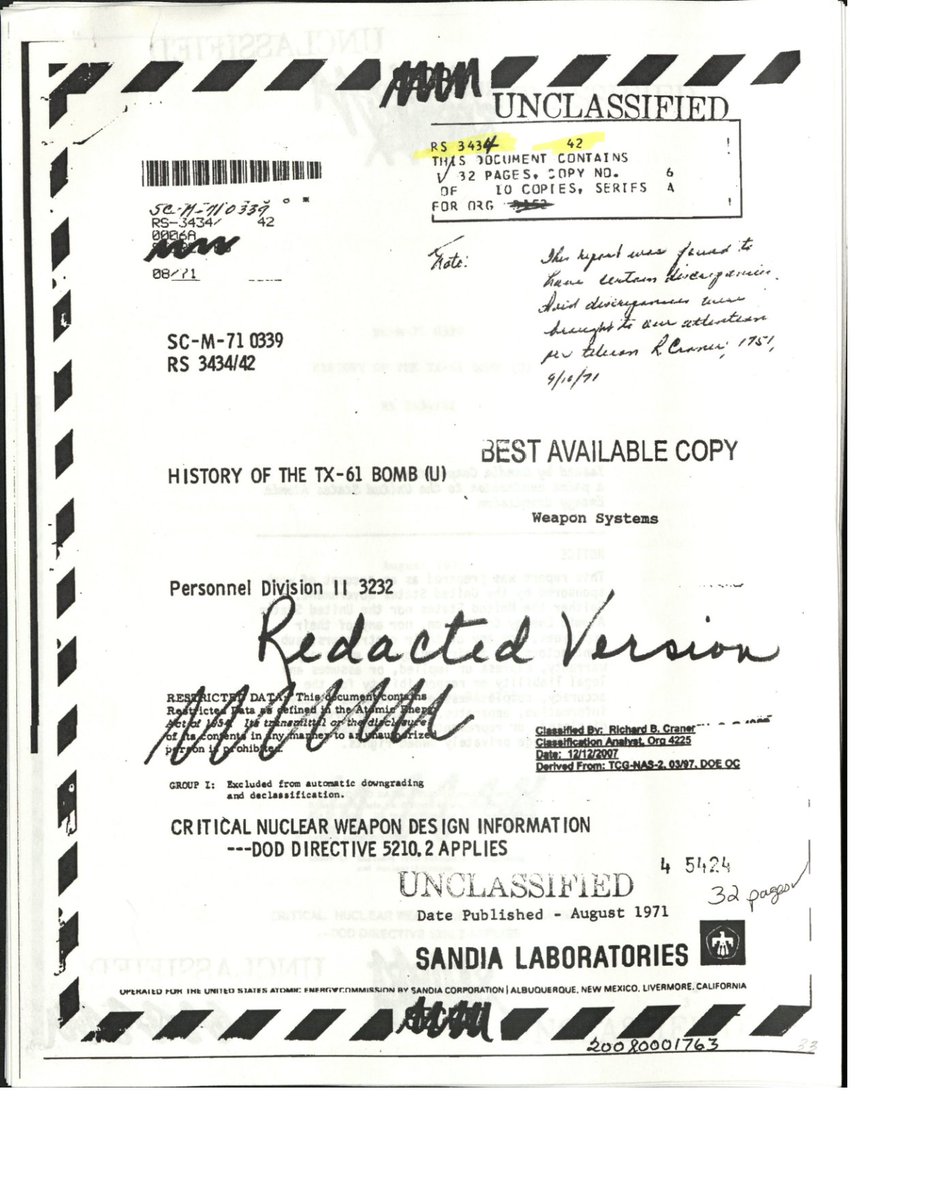
The yield of the B61-11 is classified, but it is a converted B61-7 bomb. The yield of the -7 and -11 are usually given as more than 300 kilotons. @nukestrat says the B61-11 was increased to 400 kt. Either way, this is a very powerful nuclear weapon.
I see @SangerNYT asked why Israel hasn't hit the stockpile of enriched uranium. My understanding is that the hex is stored in the tunnels at Isfahan and Israel hasn't been able to destroy the hard, deeply buried targets. Thread.
Isfahan UCF has some tunnels that are are about 100 m under a mountain that Israel has not yet tried to hit. The Iranians were pretty proud of these tunnels, which were constructed around the same time as Fordow by the same dwarves (aka the Passive Defense Organization).
This is pretty esoteric knowledge that is only covered in specialists journals like ... the @nytimes. 😉 (Sorry, I just appreciate Bill Broad and want to give him some love.)
This is probably the the new North Korean uranium enrichment facility that @iaeaorg DG @rafaelmgrossi briefed the Board of Governors about. @sam_lair and I have a summary on the blog. Nice shot by our friends at @planet. armscontrolwonk.com/archive/122048…
The dimensions, layout and other features do resemble the Kangson UEP when it was constructed. Here is a 2002 image of the Kangson under construction -- the central enrichment hall is about 93 m long, which is the right length for two 164-centifuge cascades end-to-end.
Trump's offer to Iran, as reported by @BarakRavid, is a dollar-store-JCPOA.
The JCPOA -- which Trump abandoned -- had all of these provisions, usually in ways that were stronger or more carefully constructed.
He's trying to put Humpty Dumpty back together again. A thread.
@BarakRavid Here is the original story. The proposal was "described to Axios by two sources with direct knowledge — one of whom provided a point-by-point breakdown." This is a paraphrase, so sometimes its hard to know what they are getting at. axios.com/2025/06/02/ira…
@BarakRavid Here is the text of the JCPOA. You don't have to take my word for it; you can look it up yourself. europarl.europa.eu/cmsdata/122460…
The claim of 25 missiles a month is falsely attributed to the @DI_Ukraine. What @DI_Ukraine says, according to other news outlets, is 25 IRBMs per YEAR, not per MONTH. babel.ua/news/113282-ro…
Oreshnik is the first two stages of the Yars missile. Oreshnik production rates should be similar to Yars production rates, which the Russians claim is "about 20 launchers and their supporting systems per year." web.archive.org/web/2021041112…