Anthony Bradley Profile picture
Aug 20, 2019 6 tweets 2 min read Read on X
Dear @DavidAFrench the answer to your question is quite simple. (1) The black church’s Christian identity is grounded in the Old Testament God who liberates the creation, evangelicals begin with Paul and *then* Jesus who’s trying to save people from creation. (2) Eschatology...
(2) Eschatology: evangelicals are still basically fundamentalist and premillennial. The black church’s eschatology is more amillennial (like the Lutherans). (3) Evangelicals are lamenting the loss of a cultural power/influence, esp. in the South, that the black church never had.
Evangelicals in America have never viewed themselves in exile. The Black church always identifies more with exilic Israel than individual Paul-ergo, the black church orients itself around a theology of suffering/hope. Evangelicals, a theology individual salvation/social power.
Finally, so, when you lose social power, you think the world is coming to an end and you start twisting the Bible to make 2 Chron 7:14 about America when it’s not. Spend a year in a black church and you’ll see the difference. Listen to @edeweysmith @pastoremase and @johnfaisonsr
Much, much more I could say.....I wish more evangelicals knew the theology of the black beyond King, Douglass, and Washington.
*black church

• • •

Missing some Tweet in this thread? You can try to force a refresh

 

Keep Current with Anthony Bradley

Anthony Bradley Profile picture

Stay in touch and get notified when new unrolls are available from this author!

Read all threads

This Thread may be Removed Anytime!

PDF

Twitter may remove this content at anytime! Save it as PDF for later use!

Try unrolling a thread yourself!

how to unroll video
  1. Follow @ThreadReaderApp to mention us!

  2. From a Twitter thread mention us with a keyword "unroll"
@threadreaderapp unroll

Practice here first or read more on our help page!

More from @drantbradley

Apr 30
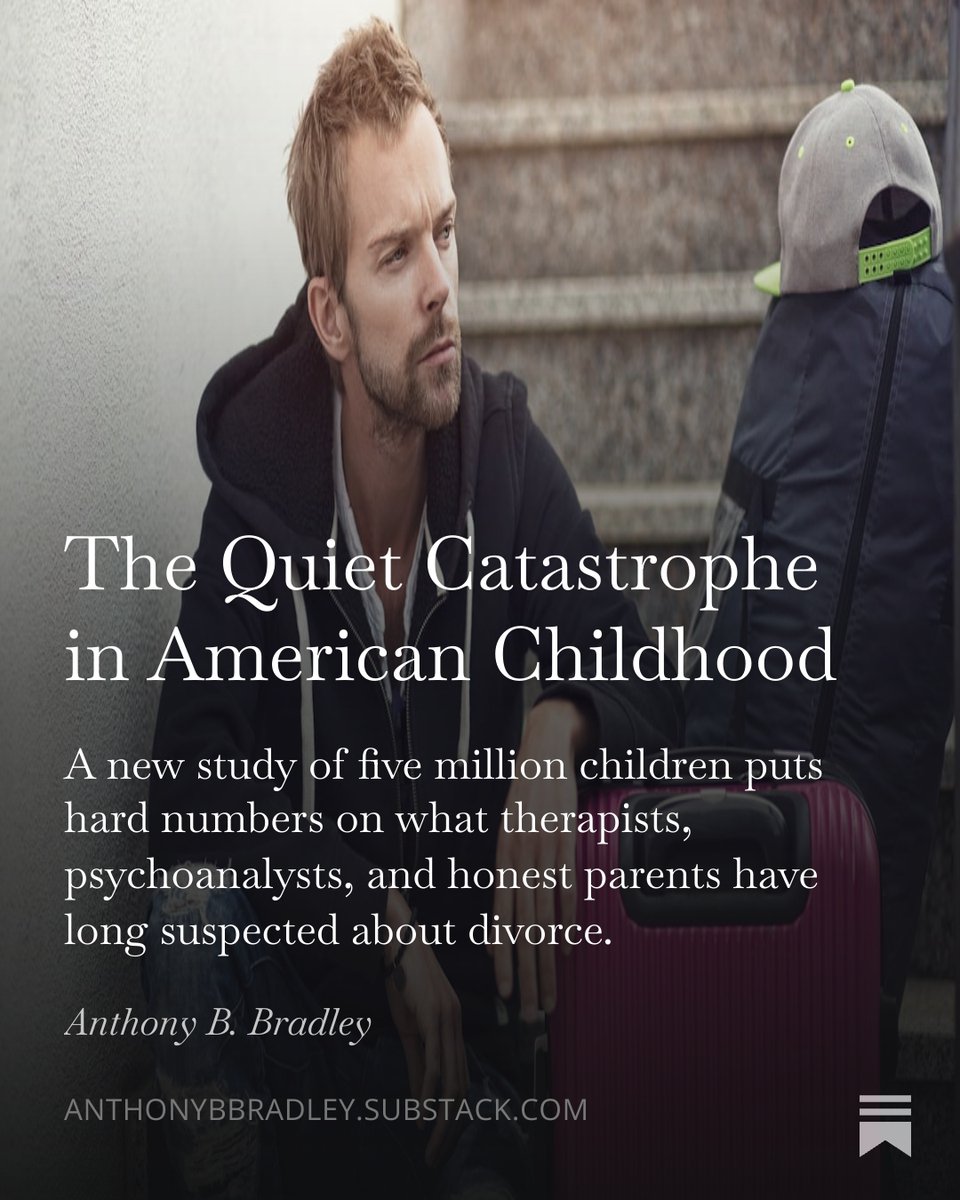
🧵My Latest: We’ve been told for decades that kids are “resilient” after divorce. A new study tracking millions of children suggests something very different. The real effects don’t show up when you think they do. And by the time they do… it’s too late. Image
What’s most unsettling isn’t what happens right after divorce. It’s what shows up years later, in places no report card or resume can measure. Careers look fine. Life looks stable. But something else quietly breaks.
This is one of the most important pieces I’ve written about. It connects hard data with what therapists have seen for decades but couldn’t prove at scale. Most people won’t like the conclusion. But you won’t be able to ignore it.
Read it here: anthonybbradley.substack.com/p/the-quiet-ca…
Read 5 tweets
Apr 11
Evangelicals don't have an elite problem. They have a formation problem. They raise bubble-wrapped cubicle boys and then complain about them later becoming passive men. Raised for passivity, destined for people-pleasing. Image
Aaron Renn (@aaron_renn) is right that evangelicals are missing from the commanding heights of American culture. No Big Tech, major finance, elite universities. But diagnosis misses this: The problem isn't weak institutions. It's what evangelical culture reliably produces.
Spend time in conservative Christian communities and a pattern emerges. Boys are raised to be responsible, polite, and safe. Failure is moralized. Ambition is redirected. Stability is celebrated. That's not formation for leadership. That's not formation for entreprenuers.
Read 11 tweets
Apr 4
🧵New research just dropped and it challenges almost everything the culture wants you to believe about boys who grow up with violent fathers. Image
The headline finding is the one nobody wants to say out loud: Most boys who watch their fathers be violent do NOT become violent themselves. The intergenerational transmission story is far more complicated than the experts admit.
Boys across four countries were interviewed. They were not passive victims absorbing dad's behavior. They were moral agents making real decisions under terrible pressure.
Read 11 tweets
Sep 8, 2025
We tell teenage boys: "Volunteer. Join that club. Lead that project. It'll look great on your college application." This is one of the most damaging pieces of advice we can give them. It's creating a generation of young men who are accomplished and adrift. Here's why: 🧵 Image
This advice instrumentalizes virtue. It turns service, leadership, and hard work into mere tools for personal gain (careerism). The goal is no longer the good work itself, but the line it adds to a resume. This creates a deep and hollow "purpose-void."
True masculine virtue isn't found in curating a perfect resume. It's found in becoming a man who confronts chaos and solves problems. The meaning comes from the work itself—the intrinsic good of bringing order and overcoming challenges, not the narcissistic validation it brings.
Read 6 tweets
Aug 10, 2025
Karen Horney has been my biggest influence in psychology.
She explained why “nice guys” burn out, why some become tyrants, and why others vanish into isolation. All of it comes from the same root. A quick guide 🧵 Image
Horney (1885–1952) was a German psychoanalyst who broke from Freud. Forget Oedipus complexes—she said the real driver of human misery is deeper: Basic Anxiety.
Once you get this, people’s behavior starts making scary sense.
Basic Anxiety = feeling small, alone, and unsafe in a hostile world. Usually formed in childhood when love feels conditional. You can have a PhD, six figures, a family… and still live with it every day.
Read 12 tweets
Aug 6, 2025
I’m old. At my church growing up, youth ministry was sex-segregated and led by the fathers (mostly in suits). Only the youth choir and Sunday School were co-ed. I didn’t see the wisdom in that—until I wrote my book on fatherhood. Here’s why, backed by research: Image
Black boys in America don’t just need mentors.
They thrive socially, economically, spiritually, etc. with deeply invested older Black men—especially fathers—who build trust with their family, speak into their identity, and walk with them as extended family.
A recent study found that Black youth don’t just benefit from one-on-one mentorship.
They thrive when mentors:
• bond with the boy’s family
• operate like extended family
• stay for the long haul
• and model what manhood looks like
Read 14 tweets

Did Thread Reader help you today?

Support us! We are indie developers!


This site is made by just two indie developers on a laptop doing marketing, support and development! Read more about the story.

Become a Premium Member ($3/month or $30/year) and get exclusive features!

Become Premium

Don't want to be a Premium member but still want to support us?

Make a small donation by buying us coffee ($5) or help with server cost ($10)

Donate via Paypal

Or Donate anonymously using crypto!

Ethereum

0xfe58350B80634f60Fa6Dc149a72b4DFbc17D341E copy

Bitcoin

3ATGMxNzCUFzxpMCHL5sWSt4DVtS8UqXpi copy

Thank you for your support!

Follow Us!

:(