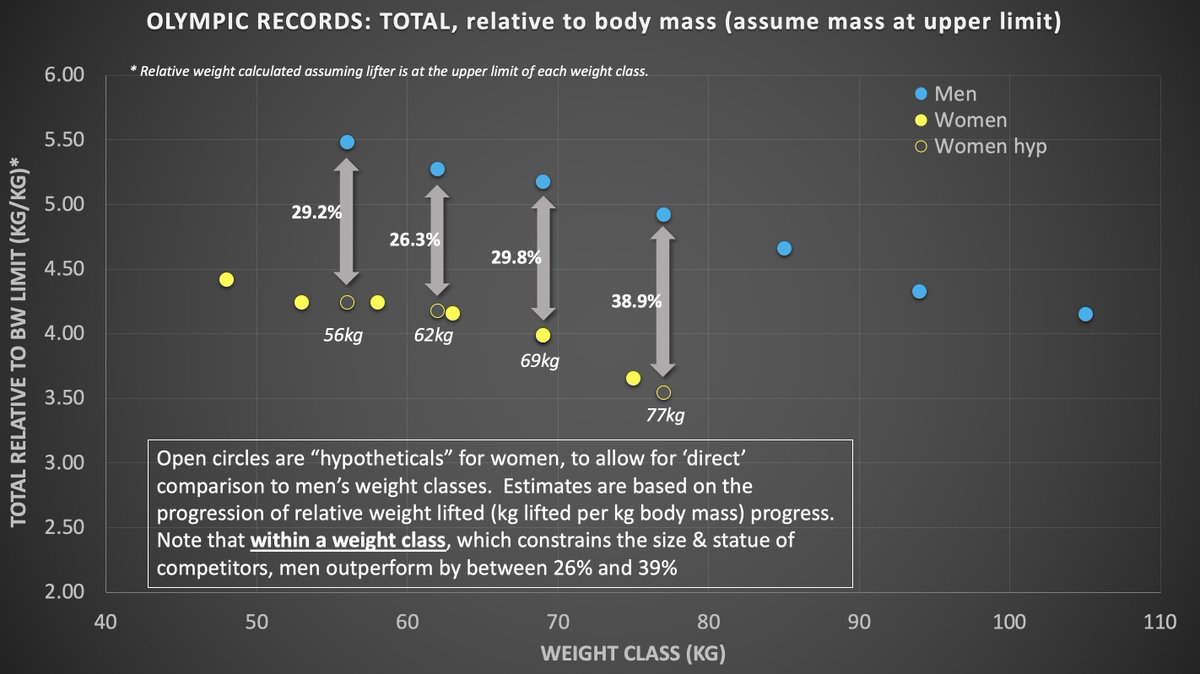
On male vs female performance differences: we often refer to a 10%-12% male advantage in running events. But what of power/strength sports? Inspired by @mar_vickers, I plotted weightlifting’s Olympic records for men & women. Men are 26% to 39% stronger EVEN CORRECTED FOR MASS
So to explain - the left graph shows total weight lifted (snatch + C&J), right is where I’ve expressed the OR as weight lifted per kg body mass. Open circles are estimates to allow “direct” comparisons at a given men’s weight class - gap is 26% to 39%, much larger than running
Implication is that if testosterone reduction is to “equalise” performance for the sake of the integrity of women’s sport (weightlifting in this instance, as a proxy for strength/power), it must “knock out” about 30% of any advantage as a result of “biological sex” (not mass)
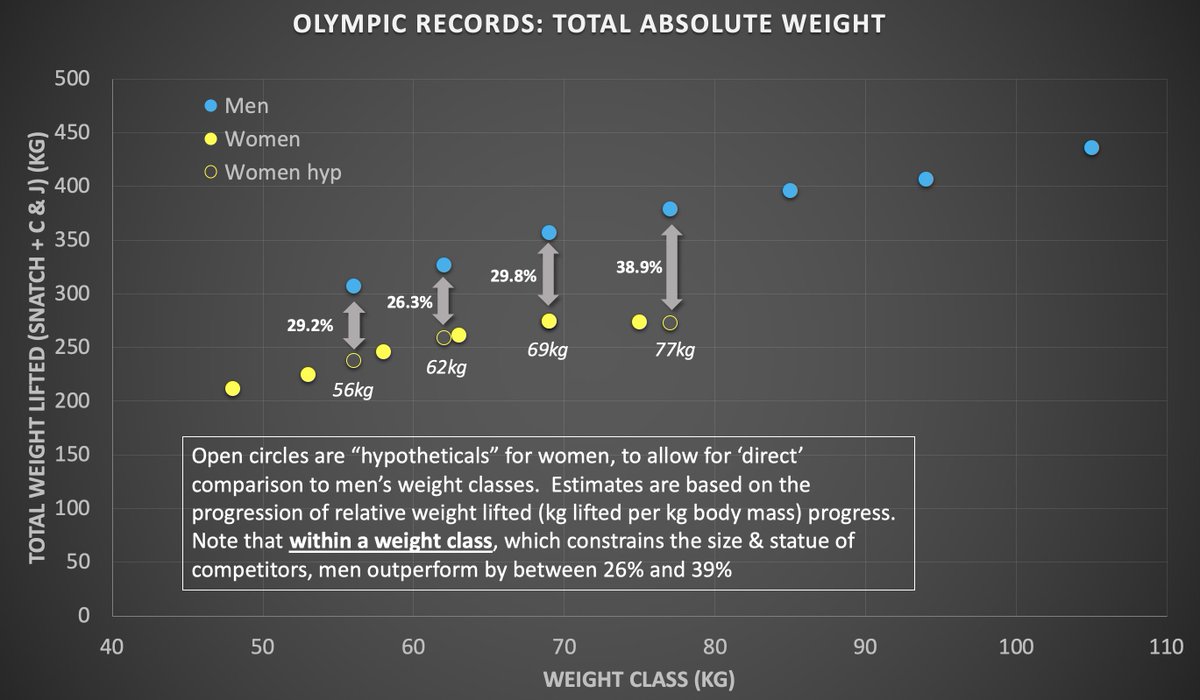
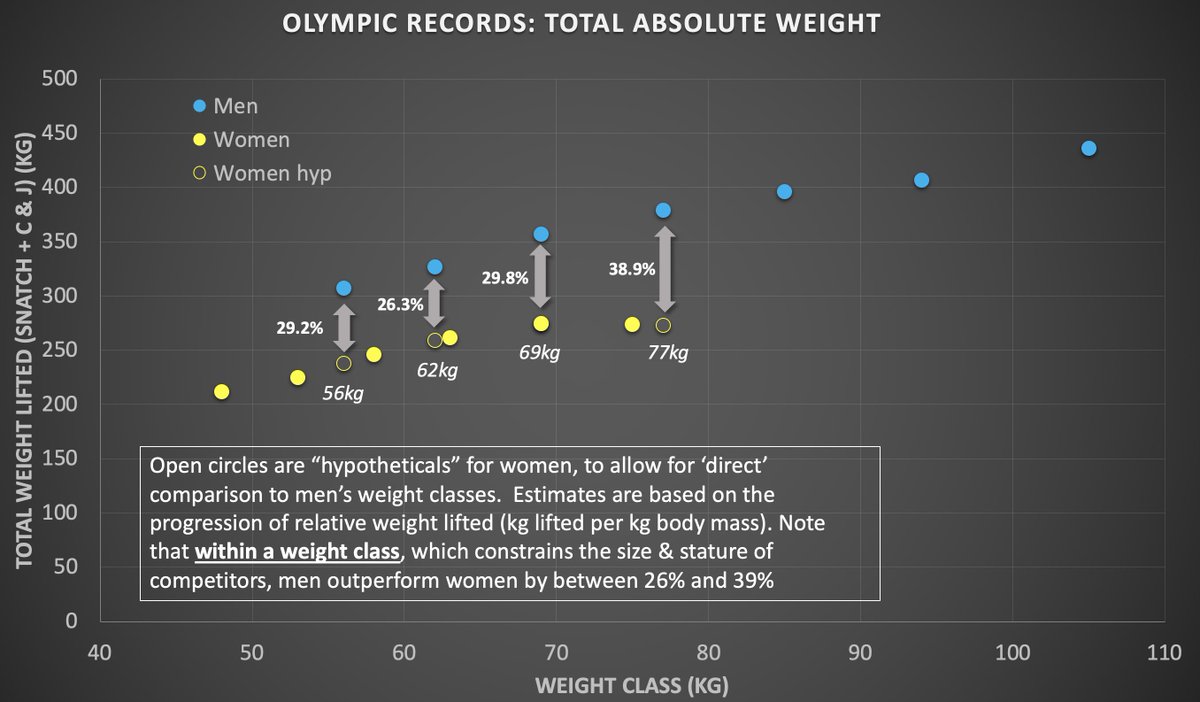
One last time, this time without spelling mistakes on the graphs (my bad): Men outperform women by 26% to 39% in weightlifting events, even when matched for weight class. Unless T reduction ‘weakens’ men by > 30%, an advantage will remain for Transgender women lifters
• • •
Missing some Tweet in this thread? You can try to
force a refresh

@Nakabuleluwa @drjamesdinic @ProfTimNoakes This desire for a bottom line is what creates a 'market' for the kind of reductionist, over-simplified & selective thinking espoused in that review. Physiology is complex - there are many ways to achieve some outcomes. But if the outcome is performance, low to zero CHO is not one
@Nakabuleluwa @drjamesdinic @ProfTimNoakes Also, very little that has been discussed here is actually new. You could've had lectures in 2002 and heard the same discussions and debates that are now being "debunked" by the paper. Only, the review leaves out dozens of papers that contradict its desired thesis. Can people...
@Nakabuleluwa @drjamesdinic @ProfTimNoakes ...exercise on low CHO intake? Of course? Does fatigue co-incide with EIH? Yes, of course. It's been known for years. Thus, does CHO ingestion prevent EIH and thus delay fatigue? Yes, obviously. None of this argues that high performing athletes can perform OPTIMALLY on low CHO
One thing about this, aside from it being typical academic circle-jerk insecurity (so needlessly, too), is that the integrated model proposed by @drjamesdinic doesn't actually make the same claims that many people (including Tim) proposed as far back as 2001. What James' model is
...explaining (correctly) is that both peripheral and central carbohydrate stores matter to exercise performance and fatigue. It's still a relatively narrow view on exercise, isolating one of many 'homeostats' that regulate or limit fatigue & performance, depending on context.
What Tim et al have argued (as per James initial tweet here ) is that "brain energy balance" matters, not peripheral glycogen levels, and so athletes can get away with very low CHO intake, 10g/hr levels. The bizarre irony is that to make this case,...
There's a whole interview with Malcolm Gladwell that I hope you'll listen to (it's great! link below), but part that is getting a lot of attention is this clip right near the start, and I thought I'd share some context & thoughts
So context, he's talking about a panel that happened in Boston at @SloanSportsConf a few years ago. I was a panelist, and he was the moderator/chair. I was significantly outnumbered on that panel, and my main recollection was that it was a bit of a car crash! speaking for myself!
I recall murmurs & dissent to just about everything I said (male advantage is real, enormous and should be excluded from women's sport, testosterone suppression doesn't take it away, no such thing as meaningful competition), and cheers when trans advocates spoke! I wasn't happy!
Two things these men (& very occasionally women) have in common when offering these 'insights' are: 1) Ignorance (perhaps chosen) of the policy leads them to criticize a straw man or fiction 2) They never offer a solution of any kind for women's benefit 🧵 theconversation.com/world-athletic…
For example, he writes the following. But the WA policy, from its origin, has been CLEAR that it's not simply the SRY gene, but the complete journey from that gene through to androgenization that is being excluded. That's why WA explicitly states the exception, as shown (blue)
He doubles down on his simplistic understanding of the process - SRY is step one, and then "further medical assessments" establish a diagnosis, which would very quickly identify the detail he asserts as if nobody has thought of it. He appears not to understand how 'screens' work
At some point in the future, I'll share a presentation that goes through male vs female physiological differences and the biological reality of sport, to explain what some have (wilfully) misunderstood. But for now, here's a pen review of this absurdity promoted by @BJSM_BMJ
Number 1 (summary conclusions only, mind)
Number 2. This might be the most egregious straw man ever erected. As if anyone really believes it is all muscle size and strength
The IOC appear unsure of why sport would test the sex of athletes. In a bonus (short 16min) podcast, I explain the reasons, how categories only work when excluding some people and why screening is not arbitrary but essential to fairness & safety for women: open.spotify.com/episode/0nhX9D…
It strikes me that the IOC response to the controversy is to ignore the test results, instead choosing to criticize the reason for testing. This enables them to deflect the implication of the test results. The reasons for testing, more generally, is what I cover in the podcast 1/
An organization that is sincere about the integrity of women's sport would deal with BOTH issues. By all means, criticize targeted testing & seek a better way to do it (also in the podcast), but recognize that those test results are telling you that males are fighting females 2/