I assessed what the macro data tells us about the Tax Cut & Jobs Act for @AEIdeas. My bottom line: "not much". Since passage GDP growth has slowed slightly as slowing consumption & investment growth only partly offset by faster govt spending. #TCJANowWhataei.org/publication/no…
The second sense in which the data tell us "not much" is that is the difficulty of extracting the signal (the effect of the tax cut) from the noise (the effect of the Fed, global economy, trade war, oil prices, fiscal stimulus, etc. etc. etc.)
A lot of sector-specific stories are important. This table tells some of them: (i) oil-related investment growth slowed dramatically as oil prices stopped their rapid rise; (2) software and R&D growth increased for reasons unrelated to the TCJA; and (3) everything else slowed.
At least three macro stories are also important but go in different directions: fiscal stimulus boosted the economy while the trade wars and interest rate increases went in the opposite direction.
Sorting all of this out the main conclusion is that the second sense of "not much" (hard to extract the signal from the noise) reinforces the first sense of "not much" (if the tax cut was so important relative to everything else we would see the signal much more clearly).
The best hope for a better understanding of the causal impact of the TCJA will be microeconomic research that looks at how similar firms are affected differently by the law and tracking their differential responses.
Ultimately, however, the most important issue is what to do going forward. I believe we can have a more efficient business tax system while raising more revenue than the current system. I couldn't explain it in 280 characters so you'll have to read the image.
I really appreciate @aparnamath and @erinmelly2 inviting me to write this--and recommend you stay tuned for the all star cast they have doing upcoming blogs on the TCJA drawing on a diverse set of expertise and perspectives. aei.org/tag/trumps-tax…
• • •
Missing some Tweet in this thread? You can try to
force a refresh

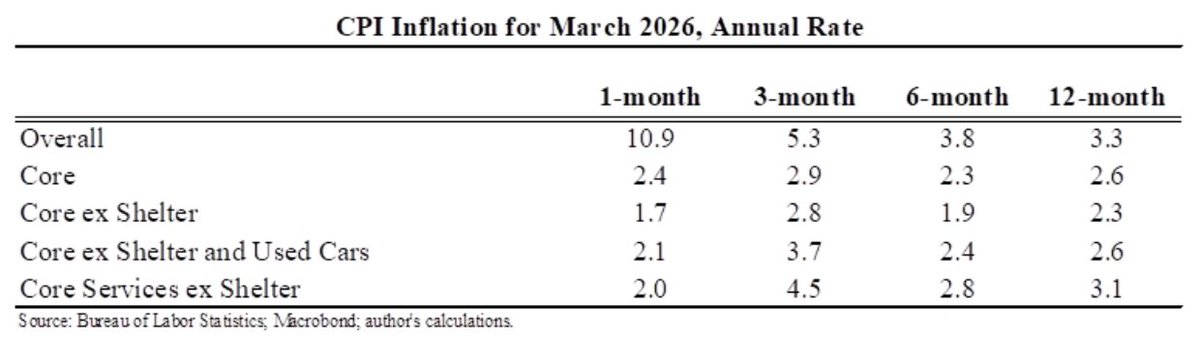
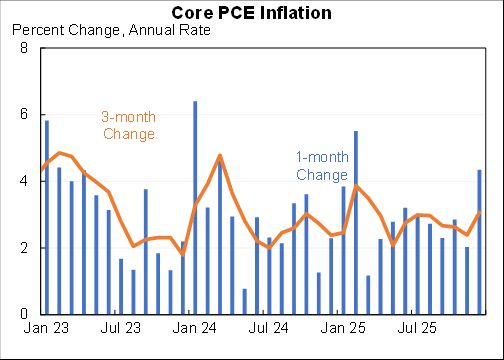
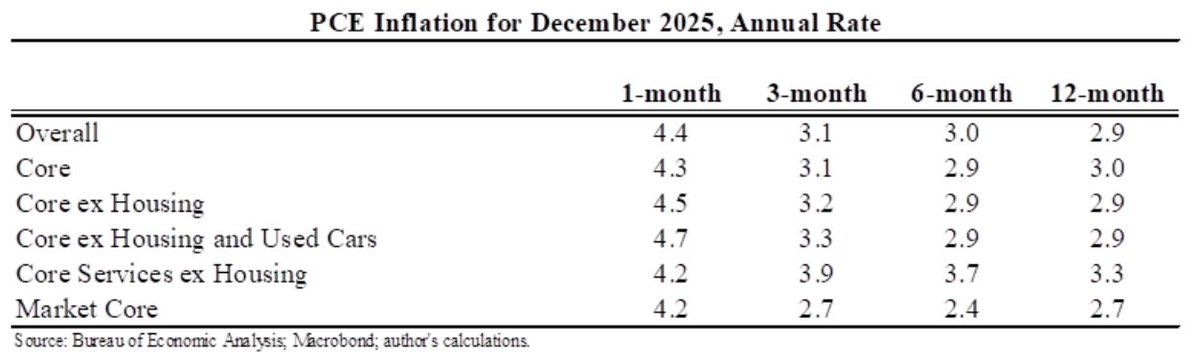
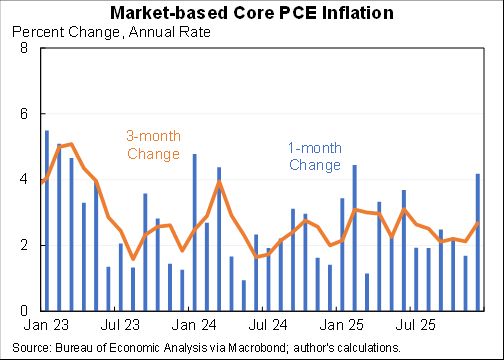
New NYT: CPI was super hot. But core was relatively tame. Two huge one-time factors raising inflation: tariffs & Iran. Fed can't solve them because they're not about excessive demand. Only Trump or time can solve.
Now the usual wonky thread I didn't have time for before.
The job market continues to be reasonably good (for an aging workforce with low net immigration).
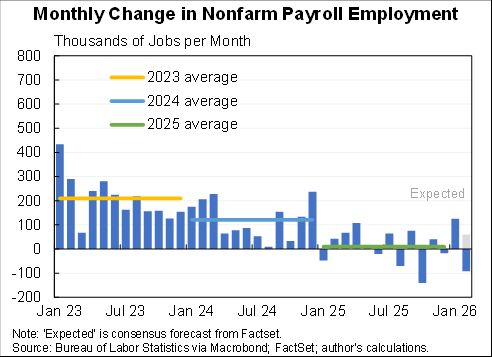
178K jobs in March, much a bounceback from strikes and weather that resulted in -133K (revised) in February. The three month average is 68K.
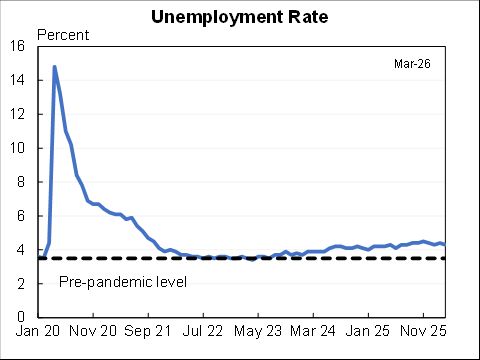
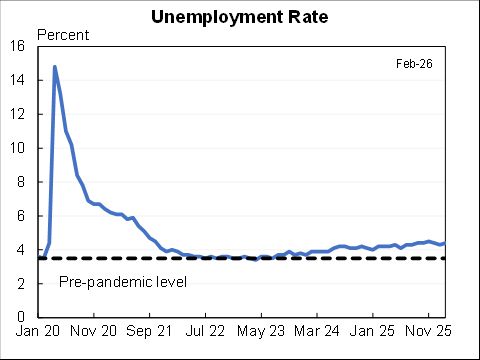
Urate ticked down to 4.3%.
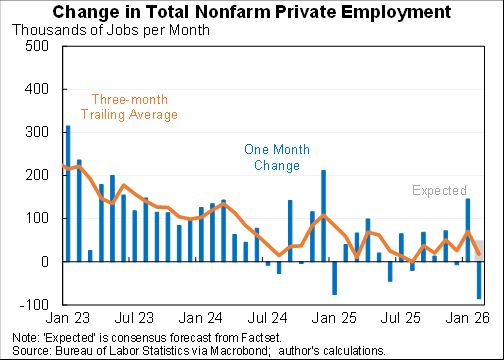
We're past the large shifts in government jobs that were confusing the interpretation of overall jobs numbers last year. But still, I'll show you the private numbers (possibly the last time until needed again)--you can see the difference between this and total from last year.
The stability of the unemployment rate is extraordinary and unprecedented. It is 4.3% now, only 0.1pp higher than it was 12 months ago.
Note estimates of breakeven job growth range from about 0K to 50K/month. Don't need a lot of new jobs to keep unemployment from rising.
Jobs report uniformly weak: 92K jobs lost (with job losses in almost every industry), household survey employment down too, unemployment rate up to 4.4%, participation down, avg weekly hours flat.
Main sign in the other direction was strong wage growth.
The dynamics for private employment look just like overall (86K lost in private with govt basically flat.
Unemployment rate still stable or slightly rising. Breakeven job growth is in the 25-50K range so negative jobs months will be more common and normal going forward. Note 3-month moving average of jobs is 6K so a bit below this range.
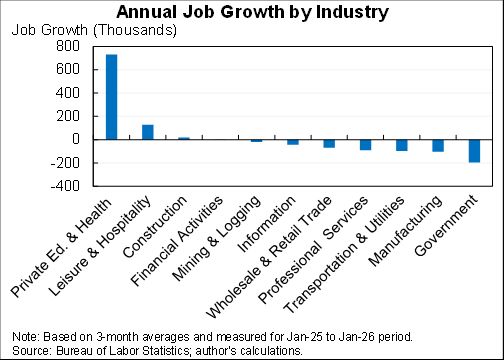
More than *all* of the jobs added over the last year have been in private education & health services.
Total jobs: 359K
Private education & health services: 773K
All other sectors: -414K
This might look surprisingly unbalanced. It's actually the opposite.
A 🧵
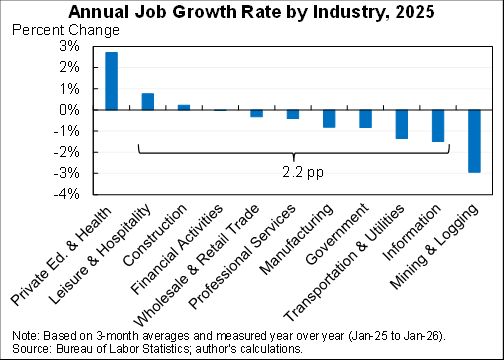
Here is percentage job growth across sectors over the last year. Dropping the two most extreme they range from 0.8% for leisure & hospitality to -1.5% for information, a 2.2pp difference.
(Note this post generally uses 3 month moving averages to smooth otherwise volatile data.)
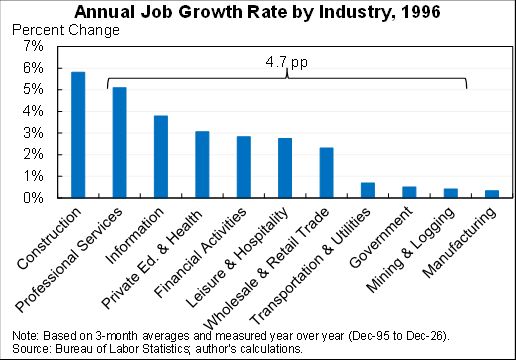
This is job growth in 1996. It looks more balanced than 2025 because every industry added jobs. But actually the gap between the second highest (professional services at 5.1%) and second lowest (mining at 0.4%) is 4.7pp. Much more dispersed than this year.
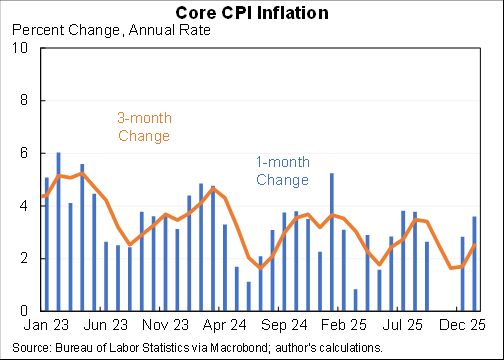
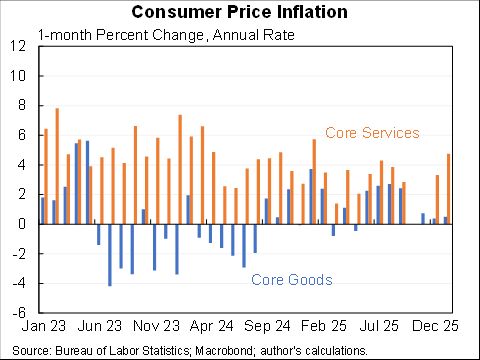
Core CPI inflation rose during the month of January. But it fell and was relatively muted over longer periods of time--although still some concern the numbers a bit lower due to shutdown-related quirks.