My 7 tips that I have found useful for implementing #simulation for CPD at @UnityHealthTO 1.Be honest and genuine – This is SO important yet also not a simple hack. This will need to be context specific.
2/
2.Circulate case stem in advance – creating an honest & trustworthy learning env't for te participants. Ppl worry about surprises. Eliminate them. I send out case stem +/- entire case document if requested (anonymous of course). Idea borrowed from @INFOdebriefing
3/
3.Make it truly interprofessional – as @Inject_Orange says, we need to ensure RNs (and other professions) are NOT just confederates but participants there to learn, teach and provide perspective. This is critical.
4/
4. Follow the data – our research suggests q3month simulations, + IPE that is high stakes, low freq are what people want. Also make sure they get CME credit for it. And if you can, rare procedures are always well received. (data soon to be published) cc @AKHallMD Tim Chaplin
5/
5.Provide coffee/food – this may seem trivial but it goes a long way. It shows you care.
7. Use QI/new equip/processes simulation to encourage participation. Make it less about "education" and more about testing new stuff so ppl sense urgency esp if recent cases, key for change management. hbr.org/2008/08/harvar…
This makes participant easier.
7/
8. Modest expectations – when I began, I thought weekly simulations should be the goal. That’s not reasonable, nor is that what people want. Remember the end-user. Tailor it to their needs
End.
• • •
Missing some Tweet in this thread? You can try to
force a refresh

As a physician at a downtown urban hospital where many of our patients are homeless then to see a hospital in one of Canada's richest postal codes use private donor $$ to "solve" their ED wait times is nothing short of appalling.
I am all for innovative solutions. I've spent my career researching and testing them. And in fact I applaud @sunnybrook for trying to think outside the box to solve a disastrous problem (ED wait times).
Though there's something quite unsettling about this idea
2/
1. This is a bandaid solution. There will be no decrease in need of MDs...so what is the long game here? Using donor $$ to fund operational and staffing needs is really unprecedented.
2. What happens when that donor comes in? I hope that the triage process will be followed 🤨
3/
On the backdrop of increasing ED wait times we have completely inept decisions by MOH @fordnation & @SylviaJonesMPP cutting MD hrs at St. Michael's Hospital @UnityHealthTO & other hospitals
This isn't the amount MD's get paid. There's no $$ benefit to us having more hrs.
This is the number of hrs of MD coverage the govt funds within the ED. E.g. we have ~100hrs of MD coverage in our ED. We divide this over 12 shifts/day.
2/
This is based on complex math linked to archaic calculations and patient volumes. The MOH uses out of date and inadequate formulas to attempt to decide how much staffing should be in an ED.
Funnily enough, EDs are penalized for long wait times negatively impacting hrs...
3/
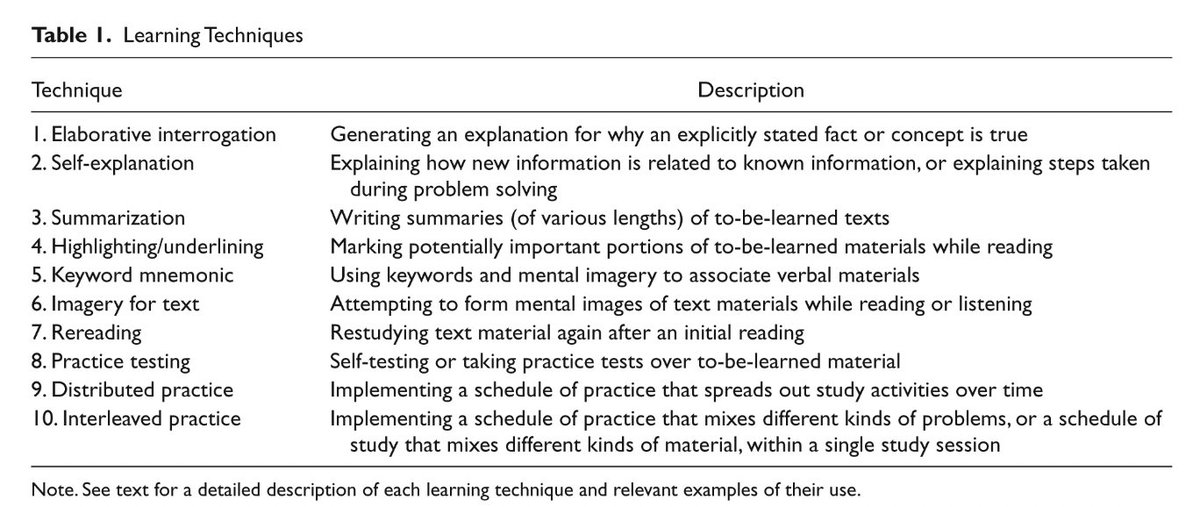
I'll briefly mention the techniques that I utilize and teach
1. Distributed practice - spreading out study activities over time
- far more effective to study 1hr for 5 nights than 5hrs on 1 night
- this approach benefits long term retention
- basically cramming doesnt work!
2/
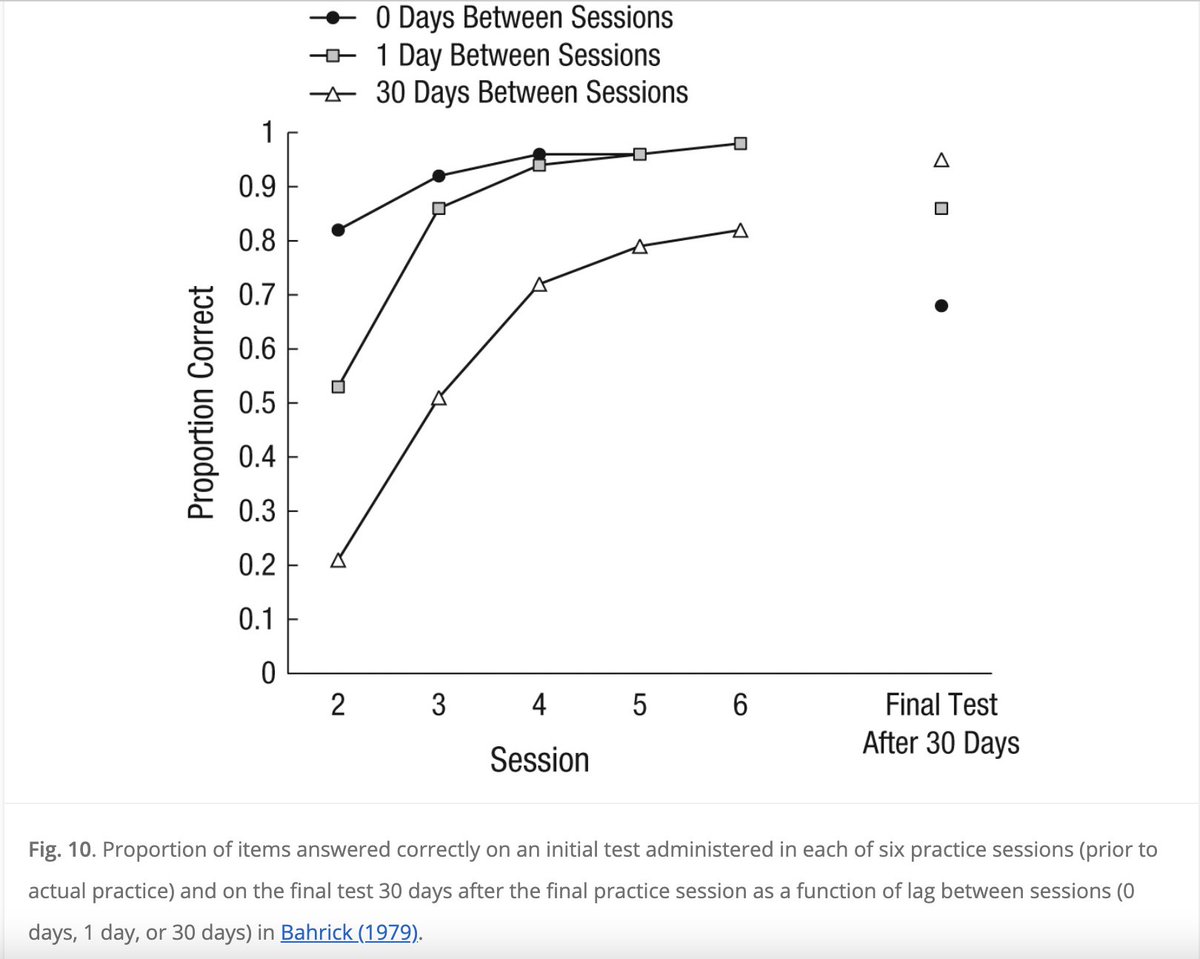
In one study, spaced practice where students had 1 or 30 day between sessions produced better results than 0 days betw sessions when evaluated on the final test
Notably, 30d betw sessions was worst at the beginning but overtime was best strategy
Make no mistake the recent words of the premier touting the strength of our healthcare system are not anchored in reality.
The many amazing healthcare workers battle a dysfunctional system to continue to deliver care despite the govt
Let me help the premier understand better 1/
Working in our current healthcare system is like running on treadmill with no end, no food, no water and the pace continues to increase. It’s not sustainable and eventually bad things happen.
A summary
- there aren’t enough nurses
- rural EDs close regularly (that’s crazy)
- EMRs aren’t compatible across institutions and govt is complicit in this - wasting money, time and harming pts
- there aren’t enough family physicians and those remaining want out
3/
First, we pulled off one of the largest randomized trials looking at practice in the #meded literature.
We enrolled 176 emergency medicine residents across North America at 5 sites. It was a huge undertaking and not an easy study to complete, esp the retention testing.
Key to this conversation is, what is deliberate practice & mastery learning?
Deliberate practice, long studied by Ericcson requires several elements with a primary goal of improving.
Also referred to as 10,000hr rule (from Gladwell) but this is rather a misrepresentation
Starting March 31st @ONThealth announced they will purposefully & systematically reduce healthcare access to those who are marginalized or under resourced.
Ont govt will end a program that provided healthcare access to the uninsured.
Here’s a 🧵 on what this means.
1/
At first glance, this might seem to only affect visitors or travellers (which it will) however it will deliberately negatively impact many Ontario residents who have lost, can’t renew or have an expired OHIP card.
These are people who are in fact OHIP-eligible.
2/
At our hospital, this will represent 1000s of pts per year.
The vast majority are patients who lack the resources to sort out the process required to apply for or renew an OHIP card.
A process made easier with a drivers licence, home address or collateral forms of ID.
3/