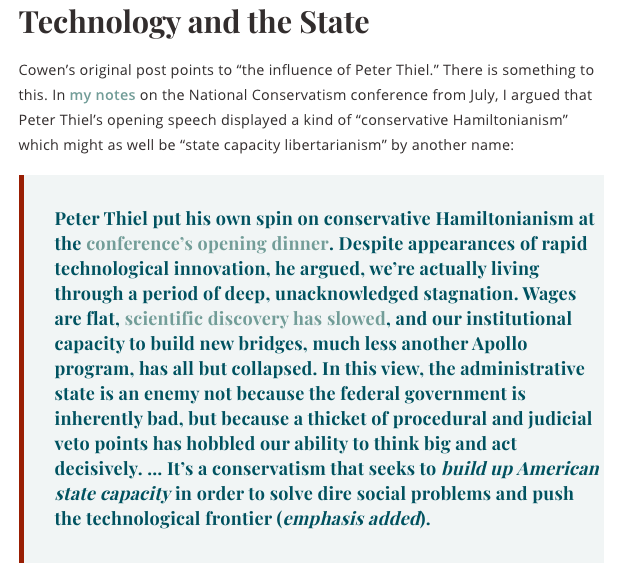
What explains the rise of State Capacity Libertarianism, @tylercowen's umbrella term for folks with pro-market, pro-growth views who nonetheless favor a strong, capable government?
@tylercowen The first motivation I see is the relationship between technology and the state. An entrepreneurial state can enable new technologies, but capturing the benefits of things like AI will require building privacy and civil liberty protections into the technology itself.
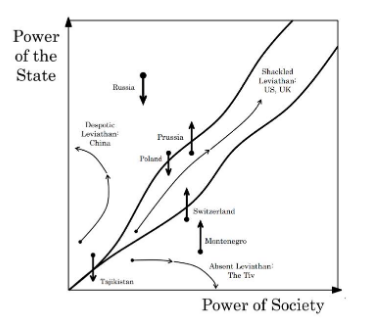
@tylercowen Consider @mgurri's Revolt of the Public thesis. If information tech and mass protest are destabilizing, lower state capacity countries may well attempt to import a Chinese-style panopticon. We need to export tech that can secure public order while protecting minority rights.
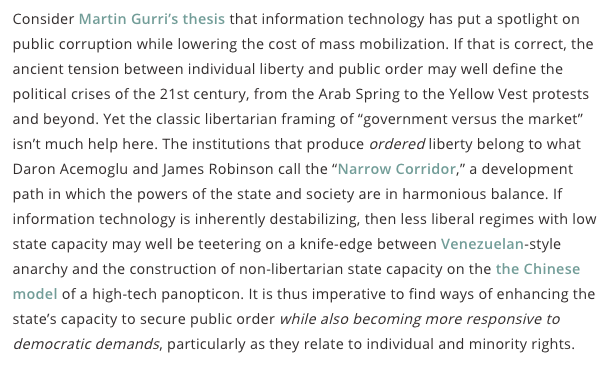
@tylercowen@mgurri Cyber-libertarians used to imagine a future where technology undermines the state's authority. State Capacity Libertarianism says that might end up being true, but be careful what you wish for.
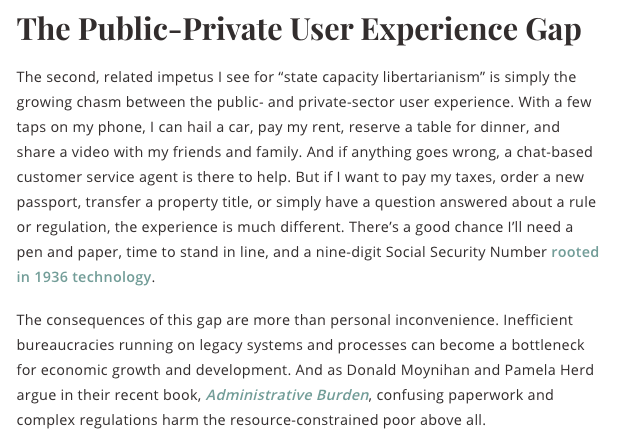
@tylercowen@mgurri The second motivation for SCL is what I call the growing public-private UX gap.
Calling a taxi used to be a pain in the ass, but now we get upset if our Uber is 2 minutes late. Younger libertarians are right to wonder why the US government is built on decades old firmware.
@tylercowen@mgurri An older generation of libertarians promoted dysfunctional government as a strategy; like "culture jamming" but applied to bureaucracy. Taken to its logical extreme, it becomes a strange kind of libertarian masochism. It also doesn't work.
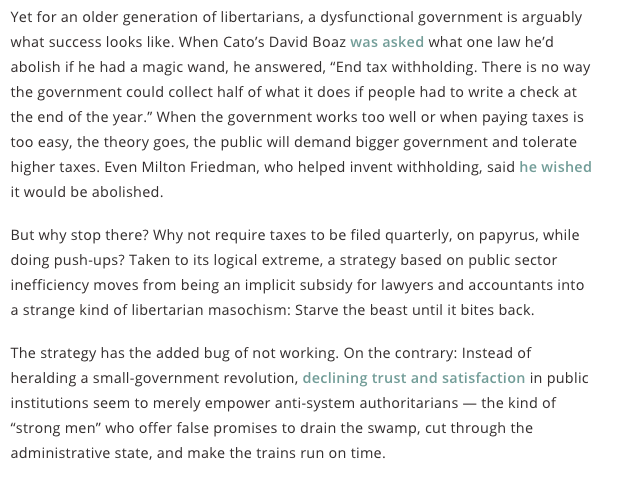
@tylercowen@mgurri In 2015 I argued that libertarians should be directionally for an Estonia-style e-government. "Oh, so they can steal from us more efficiently?"
Yet the same tech that makes taxes and transfers automatic can also dramatically reduce regulatory burdens. readplaintext.com/disrupting-bur…
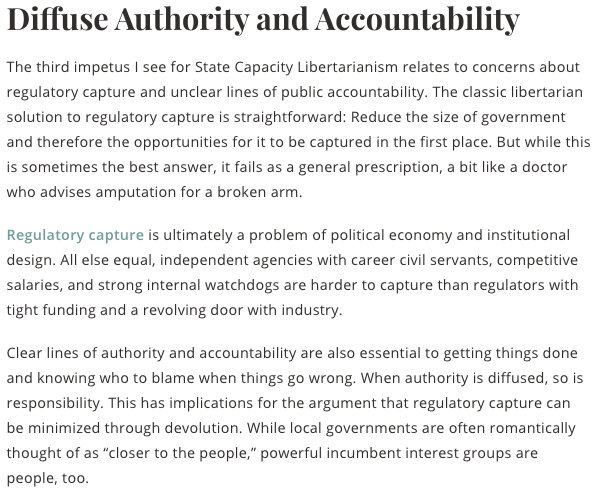
@tylercowen@mgurri The third motivation I identify is the institutional sclerosis that results from diffuse lines of authority and accountability.
Poorly funded and fragmented regulators are easier to capture. And devolution to local governments often makes things worse!
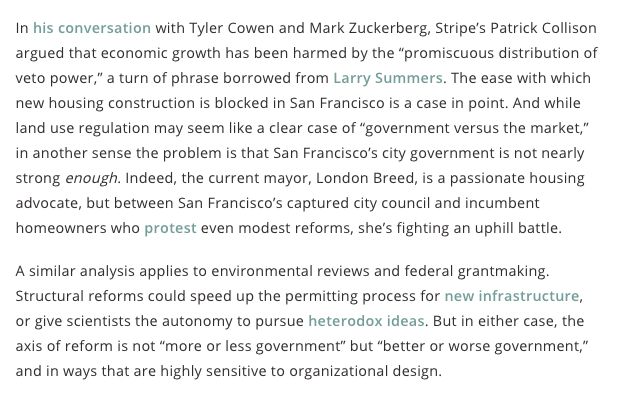
@tylercowen@mgurri@LHSummers and @patrickc have referred to the “promiscuous distribution of veto power" over things like infrastructure and housing construction. But is the problem that San Fransisco's government is too strong, or is it that SF's executive is not nearly strong enough?
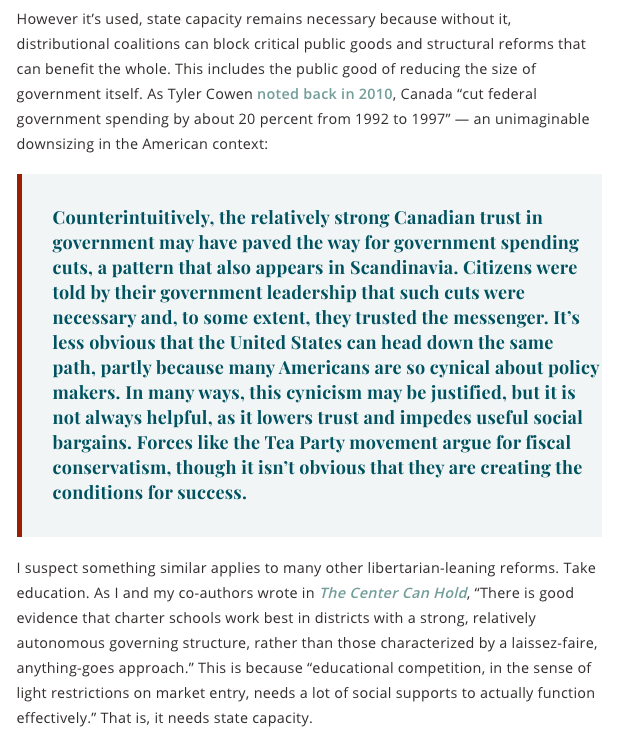
@tylercowen@mgurri@LHSummers@patrickc State capacity is necessary to overcome distributional coalitions that would otherwise block public goods and reforms that benefit everyone. This includes government downsizing! As @tylercowen noted in 2010, high trust in gov't let Chretien cut Canada's federal spending by 20%:
@tylercowen@mgurri@LHSummers@patrickc America abolished slavery and brought the states back into union under the leadership of Abraham Lincoln — perhaps the single most state capacity- and liberty-enhancing move in U.S. history. Today, however, it feels like we can’t even abolish the penny...
Because it's an oxymoron. To the extent SCL is focused on understanding the conditions of institutional decline and renaissance, it's speaking the language of conservatism. And there's nothing at all wrong with that. 😁
• • •
Missing some Tweet in this thread? You can try to
force a refresh

Mormonism has the best theology and institutional set of all the major religions. Yes, its founding myths are weird and ahistorical, but this is true of every religion.
In many ways, Mormon theology is *more* realistic than mainline Christianity. Let's count the ways...
For one, Joseph Smith had the benefit of knowing circa 1830 that other planets existed, and so incorporated it into LDS theology.
It may sound weird to learn that exalted Mormons can become as gods on their own planets, but imo this adds plausibity post-Copernican Revolution.
Given its origin in the industrial revolution, Mormonism has an unusually materialist interpretation of God not as omnipresent, but rather as a being that can move with great rapidity from place to place, almost like a telegraph signal.
That means investing in techno-industrial assets, reducing the time it takes to get permits and creating the financial structure to scale up domestic production for global markets.
We've got a policy playbook about to launch on this very topic:
This is not an endorsement, but I think the "Trump just likes tariffs"-take is missing the forest for the trees.
I think there's a p(=30%) chance that we are instead witnessing the first (albeit somewhat clumsy) phase of a deliberate strategy for controlled de-dollarization.
People will dismiss this as 5D-chessing Trump's economic ignorance, but I've been in or around this world (libertarian-populist fusionism) for over a decade, know many of the relevant thinkers and theories, and have a reasonable track record at interpreting the context clues.
I've had o1 summarize a steel-manned version of what I think might be going on (again, 70% chance I'm totally wrong / I'm right but they hit a political wall):
A steel-manned version of this strategy would argue something like the following:
1) Immediate Shock to the System (Tariffs)
- By imposing universal tariffs, the US intentionally undermines the stability of the dollar as a trade currency and signals that global partners can’t rely on “business as usual.”
- This short-term shock (“raising entropy”) is precisely the point: disruption forces other countries to reduce dollar holdings or consider alternative reserve arrangements, setting the stage for a monetary reset.
- Once international partners start pivoting away from the dollar, the US simultaneously slashes spending and raises tariffs to build fiscal resilience.
- This is meant to head off the classic “fiscal theory of the price level” risk—i.e., that ballooning debt would trigger an inflationary spiral when faith in Treasuries falters.
- By being the first mover, the US can control the pace of de-dollarization and mitigate the risk of a full-on default or hyperinflation event.
3) Future Phase: Capital Flow Controls
- Merely using tariffs might not be enough to pry the world away from entrenched dollar reliance, so the US steps up to more powerful levers: capital flow restrictions, transaction taxes, or “market access charges.”
- That further discourages foreign entities from holding US assets while bolstering domestic funding channels (or pushing the US to self-finance more of its debt).
- Though draconian, these measures accelerate the pivot to a new monetary arrangement by removing the implicit promise that foreigners can freely invest or transact in dollars.
4) Reset to a “Harder” Monetary Standard
- After orchestrating the initial storm, the US reveals a new, more disciplined monetary regime (for instance, a partial gold- or commodity-backed system) or at least a big Bretton Woods–style conference.
- The aim is to restore credibility by showing that, under the new rules, neither Congress nor the Fed can perpetually run deficits or inflate away debt.
- This new system, by design, makes it harder for the US to finance endless military adventures or large domestic deficits through reserve currency status—tying policymakers’ hands in the future.
5) Reindustrialization & Domestic Reset
- As the dollar eventually depreciates once its “exorbitant privilege” fades, US manufacturing becomes far more competitive internationally.
- Lower real wages and cheaper assets (in dollar terms) entice domestic investment in industrial capacity. Over time, that fosters a base of production and skilled labor that the US has struggled to retain in a dollar-dominant environment.
- Yes, US consumers face immediate pain through higher import costs and austerity, but the steel man argument says the country emerges with a more balanced external account and healthier industrial sector.
In short, the “positive spin” is that deliberate chaos now forestalls a worse forced collapse later, and that by preemptively engineering the demise of the dollar standard, the US can steer toward a monetary regime less prone to endless deficits or foreign entanglements—and ultimately emerge with a revitalized industrial base. The next key phase (if tariffs alone fail) would likely be direct controls on foreign capital flows, culminating in an overt reset to a “harder” standard meant to restore confidence post–de-dollarization.
---
Me again: To reiterate, I'm not endorsing this strategy or even its internal coherence. This is just an educated guess at the underlying method to the madness, and a potential interpretive framework for understanding the admin's actions going forward (including things like dismantling USAID, etc).
This from @ByrneHobart also underlies my intuition that AI's impact on government will be more fragmenting than centralizing.
Mass production is giving way to mass differentiation, which undercuts the Coasian logic of a uniform regulatory state. thediff.co/archive/data-p…
@ByrneHobart I'm looking forward to the new Richard Langlois book which deals with these themes in the context of 20th century managerialism. As he notes, the second-best logic of vertically integrated managerialism already began unwinding in the 70s. amazon.com/Corporation-Tw…
@ByrneHobart The price system is becoming more important, not less, given growing computational complexity.
AI is a context machine and universal translator. There is no need for a proverbial lingua franca once you can construct faithful maps between different local contexts.
Who's making the GPT-4 teddy bear that will talk with your infant child and teach them a 2nd language? Seems like such an obvious product.
Furby is in for a massive upgrade. The camera in its head will recognize your child's face and send a push notification if it sees something strange. Parents will track learning progress, inject prompts and review transcripts through the app, all for a small monthly subscription.
This is how you build an AI moat. While the cost of inference will continue to fall, the subscription pricing to keep your child's best friend alive will be sticky indeed.