Let's talk about something totally different, for once. I've got a few questions on diastolic strain rate before this really broke loose, so I'm going to do a tweetorial on this, realising the danger of it drowning in corona. These are Una peaks in Antarctica. Image
1/ looking at e' diastolic velocities, the earliest onset is in the base, with increasing delay towards the apex. This is the case also for peak e' velocities, and diners from the systolic velocities. However, at the same time, the end of the e' wave is nearly simultaneous Image
2/ This is not the case for strain rate. the deformation of e' also starts at the base, with increasing delay towards the apex, but for strain rate both start, peak and end propagates from the base to the apex. Image
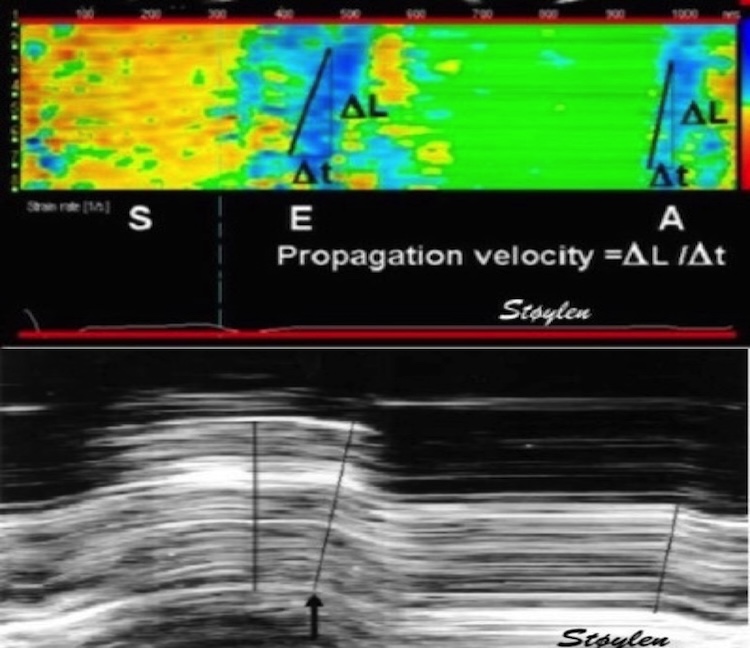
3/ This can be illustrated in colour M-mode. the downwards velocities are blue, the elongation (strain rate) is cyan. The diastolic deformation is a discrete event that propagates from the base to the apex, while the velocities add to each other due to tethering. Image
4/ It can be illustrated with this analogy: A row of cars starting up, movement has to start with the first car, and then follow with the cars behind. Colouring the cars acquiring velocity in blue, we see the start of the wave in front, adding one car at a time till all are blue.
5/ Colouring only the cars with DIFFERENT velocity, we show the interval where distance increases, i.e. the row deforms. It shows the difference between deformation and motion, and illustrates that the deformation is a discrete event, propagating in a wave.
6/ It1s just the same with myocardial deformation. The basal motion has to start at the base, and then propagate towards the apex. And as the wall elongates locally, it also thins. And the basal velocity is the sum of the added local deformations Image
7/ In reduced diastolic function, this propagation velocity is reduced ncbi.nlm.nih.gov/pubmed/11287889 , and this will lead to a slower velocity addition, resulting in a wider and lower peak e' velocity Image
8/ So peak e' and strain rate e propagation velocity are strongly related, and probably measure more or less the same. Image
9/ but what about peak diastolic strain rate? Well, as shown this is a measure with different timing in the different levels base to apex Image
10/ To get a measure of the peak diastolic train rate for the whole ventricle, it will have to be averaged. It can be shown as seen here, simply with a long ROI covering most of the wall Image
11/ But then consider this: As strain rate is the velocity difference / length, and as the apical velocity is close to 0, average strain rate is the inverse of the basal velocity. This is true both for systolic and diastolic strain rate ncbi.nlm.nih.gov/pubmed/32154940 Image
12/, and thus it is doubtful that peak diastolic strain rate adds any useful information either diagnostically or prognostically over tissue Doppler e', even if studies will show diagnostic and prognostic value, it's the emperor's new clothes. Image
Sorry folks, but this is my qualified opinion. Still nice to think about something else, isn't it? Una's peaks was to show the significance of the multiple peaks. Here is another beautiful picture from Illulissat Icefjord in Greenland to rest the eyes on Image

• • •

Missing some Tweet in this thread? You can try to force a refresh

 

Keep Current with 🇳🇴🇩🇰Asbjørn Støylen 🇬🇱🇵🇸🇺🇦

🇳🇴🇩🇰Asbjørn Støylen 🇬🇱🇵🇸🇺🇦 Profile picture

Stay in touch and get notified when new unrolls are available from this author!

Read all threads

This Thread may be Removed Anytime!

PDF

Twitter may remove this content at anytime! Save it as PDF for later use!

Try unrolling a thread yourself!

how to unroll video
  1. Follow @ThreadReaderApp to mention us!

  2. From a Twitter thread mention us with a keyword "unroll"
@threadreaderapp unroll

Practice here first or read more on our help page!

More from @strain_rate

Jul 25, 2024
🧵Atrial strain 1/ In Norway, we have an idiom: “The north wind is just as cold, from wherever it blows”, meaning the basic properties of something doesn’t change with the perspective you apply. Image
2/ AV-plane motion exerts opposite effects on the ventricles and atria: LV shortening vs Atrial elongation in systole, LV elongation and atrial expansion during early and late LV diastole. Thus, both LV and LA strain are inseparable from AV-plane motion. Image
3/ Global left ventricular systolic strain (GLS) is the relative shortening of the LV (wall) by the longitudinal contraction of the LV, the physiological interpretation is as a measure of myocardial systolic function. Image
Read 10 tweets
Jun 18, 2024
🧵On the Wiggers diagram. It is an illustration of temporal relations of atrial, ventricular and aortic pressures with ventricular volumes, in a simplified, schematic illustration of the main relations, for basic teaching purposes, but is not the full truth about physiology. Image
The full picture is far more complex, the typical version of the Wiggers diagram as shown here, do not show the effects of inertia of blood, the knowledge from newer physiological studies with high-fidelity catheters, nor from Doppler and TDI. Let’s look at what’s missing.
#1 The atrioventricular pressure curves cross over in the middle of atrial systole, reversing the gradient from positive to negative, as documented by
Carmeliet;
Appleton: pubmed.ncbi.nlm.nih.gov/2208210/
pubmed.ncbi.nlm.nih.gov/9362417/
Image
Read 15 tweets
Jun 6, 2024
🧵on ventricular ejection. Does blood always flow downwards a pressure gradient? Certainly not. A pressure gradient accelerates stagnant blood to flow down the gradient, but blood in motion may flow against the pressure gradient (by inertia), being decelerated. Image
2/ It was shown in the early 60ies that the pressure gradient from LV to Aorta was positive only during early ejection, and then negative during most of ejection. Pressure crossover occurred earlier than peak pressure. pubmed.ncbi.nlm.nih.gov/13915694/
Image
3/ The negative gradient after pressure crossover would then decelerate LV outflow, so peak flow must be at pressure crossover. As flow = rate of LV volume decrease, peak rate of volume decrease mus also be: - later that AVO (due to the acceleration) - before peak pressure Image
Read 10 tweets
Apr 18, 2024
Old misconceptions become as new. A 🧵 A recent paper focusses on pre ejection velocities as a contractility measure. In addition, the authors maintain that these velocities are isovolumic contraction, which they also maintain, is load independent. pubmed.ncbi.nlm.nih.gov/37816446/
All three concepts are wrong. True, the peak contraction velocity (peak rate of force development) occurs before AVO, and thus is afterload independent. But it's not preload independent and thus not a true contractility measure. pubmed.ncbi.nlm.nih.gov/13915199/
Image
2/ Peak RFD corresponds to peak dP/dt, which is during IVC,m but closest to the AVO. pubmed.ncbi.nlm.nih.gov/5561416/
Image
Read 13 tweets
Apr 14, 2024
🧵 on atrial systole. 1/ Already in 2001, did we show that both the early and late filling phase was sequential deformation propagating from the base to the apex. pubmed.ncbi.nlm.nih.gov/11287889/
Image
2/ This means, both phases consist of a wall elongation wave, generating an AV-plane motion away from the apex. So what are the differences? Image
3/ Only e’ correlates with MAPSE, so the elastic recoil is finished in early systole, while a’ do not, so atrial systole is a new event, caused by the next atrial contraction. pubmed.ncbi.nlm.nih.gov/37395325/
Read 12 tweets
Apr 10, 2024
🧵1/ Sorry, I accidentally deleted the first tweet in this thread, here is a new and slightly improved version. Looking at the physiology of AVC propagation velocity, there are confounders galore, so taking it as a marker of fibrosis, is premature, to put it mildly.
2/ Firstly, The AVC is an event of onset of IVR, i.e at a part of heart cycle with relatively high cavitary and myocardial pressure. This may contribute to wall stiffness, which again may affect (probably increase) wave propagation velocity. Image
3/ Secondly, This may affect AS patients; who may have a higher wall/cavity pressure at end systole than controls, and thus higher pressure related stiffness.
Read 11 tweets

Did Thread Reader help you today?

Support us! We are indie developers!


This site is made by just two indie developers on a laptop doing marketing, support and development! Read more about the story.

Become a Premium Member ($3/month or $30/year) and get exclusive features!

Become Premium

Don't want to be a Premium member but still want to support us?

Make a small donation by buying us coffee ($5) or help with server cost ($10)

Donate via Paypal

Or Donate anonymously using crypto!

Ethereum

0xfe58350B80634f60Fa6Dc149a72b4DFbc17D341E copy

Bitcoin

3ATGMxNzCUFzxpMCHL5sWSt4DVtS8UqXpi copy

Thank you for your support!

Follow Us!

:(