Economic stimulus, by definition, is action by the government to encourage private sector economic activity by engaging in targeted, expansionary monetary or fiscal policy.
Policy tools often used to implement economic stimulus include lowering interest rates, increasing government spending, & QE, to name a few. All these tools are means to stimulate demand & spur consumption to keep the economic cycle moving.
However, how providing a loan or credit to a section of the society can be considered as a stimulus package? By a similar measure, can we treat it as income in our books instead of showing it as a liability so that we never have to repay it?
As of 2019, the total loans disbursed by all banks increased from 87.46 lac crores to 97.10 lac crores. That would be an 9.64 lac crore 'Economic Stimulus' in 2019, going by this accounting!
By the way, the banks don't have a choice but to grant an additional loan to ensure that the MSMEs survive and don't turn sick! It is a normal banking practice!
It is true that some loans have been announced with government guarantees and that may lead to bad loans and will have a fiscal impact. But that happens in usual time also.
By terming providing 'loans' as stimulus, we are just indulging in financial and accounting jugglery
As Tom Hanks said in the movie Sully - "Can we get serious now" ?
• • •
Missing some Tweet in this thread? You can try to
force a refresh

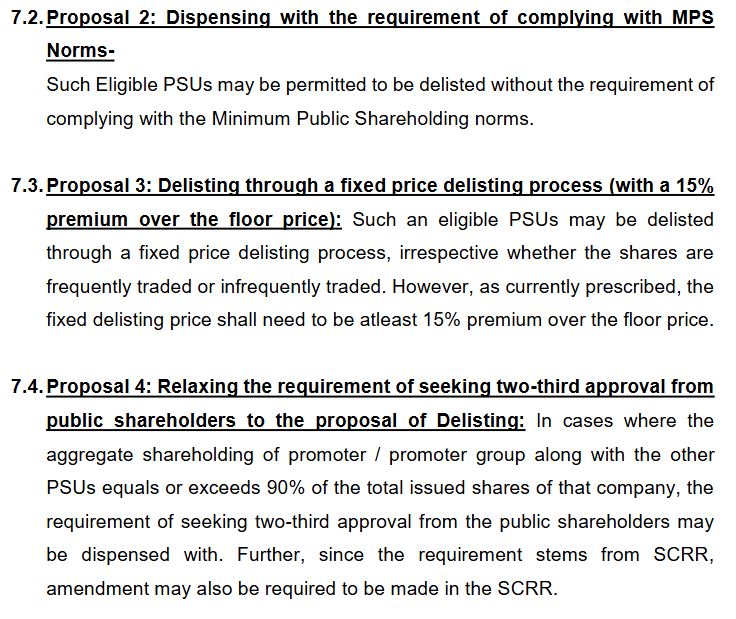
SEBI in a consultation paper has proposed direct delisting of PSU companies where public shareholding is more than 90% and MPS norms are not being met (74% within 3yrs of listing) due to weak business model, loss making entities, outdated tech or just not enough float.
It has been proposed to delist them with a 15% premium to the floor price (60 days VWAMP or highest price paid by PACs in 26w/52w volume weighted average price)
The requirement of seeking two-third approval from the public shareholders can be removed.
Many stocks with hyper inflated prices due to low float can fall into this category (ITI, FACT, KIOCL, HMT etc) and can be delisted under new norms in HCY26. Once the value is realized, it may be easier to sell their assets or just merge them with other PSU/Private entities.
Markets had an extremely smooth run-time in last 5 months, much ahead of everyone's expectations.
Older and wiser investors are unduly cautious while newer and bold investors with YOLO approach wants more.
Time for some investment lessons learned from past cycles 🧵
(1) Define your investment objectives and goals clearly.
Success in investment depends largely on clarity in investment O&G. Factors like growth, yield, income, risk, are dynamic & will keep on changing every year.
Investors must periodically re-evaluate objectives.
(2) Forming a solid investment team is critical to successful investment strategy.
Carefully assess the honesty, competence, and objective of those giving you investment advice & services.
DIY investors need to make sure they have sufficient time and skill set to execute.
A thread of the 10 best podcast episodes (& series) I listened to this year #2022inreview
PS : I use @Spotify as my platform, so hyperlinks are from there. In the case of the series, I have shared a link to the first episode.
This is across genres. RT for wider benefit.
(1) For over ~4hrs, @amitvarma and @BShrayana discuss the complexities of being a woman in India. Context is the latter's wonderfully written - "Desperately Seeking Shah Rukh" which is a cleverly disguised economics book talking about movies.
(2) Summarizing gist of the business is a forte of @bizbreakdowns and this one chronicling GE's dominance and decline is a treat, specially inputs coming from Josh Aguilar, @MorningstarInc analyst who has tracked the company closely for many yrs.
Certain business channels allowing ONLY SEBI registered analysts & advisors to come on their shows from NOW ON after all this brouhaha is just hogwash.
This should have been done always in the past but that's not how money is made on channels.
Eventually all business channels need to survive which means more hits and clicks across various social media platforms. So called finfluencers provided that on a platter, regulation be damned.
So now following the RA (2016) or RIA (2013) regulations smells of hypocricy.
Every finfluencer has been blantantly disregarding RA/RIA regulations for years in the name of 'only for educational purposes'.
Regulations are clear, if you want to talk about stocks across ANY platform, get a license from SEBI. But this has been rarely practiced.
Quite a lot of investors are worried about the FPIs dumping Indian equities and concluding that this is the prime reason for the ongoing correction in stock prices.
A 🧵 to understand details about FPIs buying and selling in financial markets before jumping to conclusions
(1) FPIs are NOT a uniform class of investors.
Some examples:
Pension funds - very long term horizon (multi-decades)
Hedge funds & AIF - very short term horizon (3-6m)
EM funds - buy/sell as basket including India
ETFs - MSCI, iShare EM, iShare Asia, FTSE
(1a) All these investors differ in Investment:
- Horizon
- Objectives
- Strategies
They rarely act in unison as the universe of investible stocks is also different.
To assume that all FPIs are selling at the same time violating the mandate & exiting India is bit overdramatic.