Once upon a time a long time ago, researchers submitted manuscripts to peer reviewed journals. Much of this research was thus highly, regarded, & influential, bringing us such important concepts like implicit racism, benevolent sexism, stereotype threat, & the F Scale & 1/x
The research also impacted policy - ended segregation, justified affirmitive action, and set laws for hiring to avoid workplace discrimination as well as protect those w disabilities. The research was historically used as anti-fascist and anti-communist propaganda in 2/
an effort spearheaded by the OSS. Social science should be at least partially credited for the attitude that prejudice is bad imo. It can also be credited for undermining arguments about genetic superiority by showing how SES confounds any such conclusions 3/
Social science research influenced the removal of homosexuality as a mental disorder. And, it takes for granted that, multicultural competence is a good thing. It promotes diversity. It pathologizes bigotry. Who in their right mind would want to take it down? I’ll wait...4/
Before going further, just circling back to another contribution of social science to political policy: John Bowlby, attachment researcher, testified to Congress in the 50s about the nature of the damage done by child separation. Dunno the context but the gov wanted to know. 5/
So what is the good of using hyperbolic,overly general, all-or-none statements like “there is a replication crisis in social science” and then amplifying like CA micro-targeting persuadables, recruiting others to say the same and amplify their careers(eg Peterson, maybe Pinker 6/
The good from the perspective of evil is that there is now an army of “experts” perceived as credible by a younger demographic who can advance whatever message they want. Unlike the Post war period, these have been anti authoritarian messages, relegated to specific undergrad U 7/
*not been anti authoritarian....
From the perspective of the Koch Reich, they invested in an army of academics to be influencers - within and outside of the academy. Their goal: erode confidence in social science as a legitimate discipline capable of providing 8/
factual information with policy implications that can and should be applied. Enter: “A replication crisis” and a Koch Reich billionaire named Arnold. 9/
After palling around w the Koch Brothers, Arnold finds his boy. An academic who wrote a paper called something like “don’t rust the results of science papers.” I don’t know the readership then but currently it’s reportedly the most read work per twitter. happen w/out Koch? Naw...
[fyi-this is not mobbing or ad hominem. This is something like journalism I think?]
So when Arnold’s boy publishes a pre proof print of a study describing the benefits of a pharma drug on Covid using stats that would surely earn him an F in any doctoral program, you should know why that happened. When social science is maligned w the “replication crisis” trope,
you should know where that came from and why it became politicized. When you see Arnold’s boy minimizing Covid nursing home deaths with childlike statistical arguments, you know why. That. Is. All. @Stanford wtf
@threadreaderapp unroll
cc @LincolnsBible @MelissaJPeltier @page88
Guess no dice on the unroll
Footnote: one area of science has embraced the professor in question and use the “replication crisis” as a rallying cry. Guess which one? Pharma clinical trial research. Shocker 🙄
How one goes from philosophy of science expert critic to helping run and publicize a clinical trial is a bit weird too. #COVID
cc @RealJesseLuke @JRBneuropsiq @GoldfriedMarvin
cc @LincolnsBible @carouzzz @Nick_Carmody @MelissaJPeltier
cc @AllenFrancesMD
• • •
Missing some Tweet in this thread? You can try to
force a refresh

Borderline Personality Disorder (BPD) is at once a disorder of the totality of what is meant by personality in a psychodynamic framework ie the capacity to be alone, self-soothe, to love, to play, and more broadly self/emotion-regulation. It is also putatively a disorder of the totality of mood, anxiety, and impulse control psychopathology. 1/
And of course, the “border” herein can be said to be the line between psychosis and neurosis, ie there is slippage. Last but not least, we have the DSM categorical personality disorder type known as BPD which was defined thoughtfully enough to house all of the above meanings as well as to form its own unique shape (identifiable pathological personality pattern)—
2/
stormy relationships, affect storms, unstable sense of self as manifested by eg moving constantly where one lives or what one’s job is, destructive overdependence, interpersonal manipulation & triangulation, subjective emptiness, superficial self harm and threats of self harm often thought to occur in the context of attention seeking,
Object relations and what might be labeled the British Middle School (of which Winnicott would be located) predated inter subjective and relational schools. Relational & inter subjective are products of an intellectual historical evolution.
1/
Thus, there is overlap. Yet they are distinctive along a dimension that is helpful in conceptualizing and classifying schools of psychoanalytic thought over time: one person/two-person-psychology continuum.
2/
In short, Freud = 1 person psychology (focus on patient, analyst as authoritative source of knowledge) & Relational & Intersubjective = 2 person psychology (focus on the “interpersonal matrix” 🙄 2 person co - constructed space,
3/
🧵 10 Best Behavioral #Science Books on #Psychoanalytic #Psychology:
Towards Bridging the Gap with Academic Psychology:
General #textbooks and specific #books with the most hard nosed-science derived, empirical evidence in support of #psychodynamic theory & practice.
1/
🥇1st place goes to a series of books published by the Analytic Press starting in the mid 80s. Each book is a numbered volume in this series of empirical studies and psychodynamic perspectives on topics within academic psychology. Edited by Bornstein, R.F. and Masling, J.
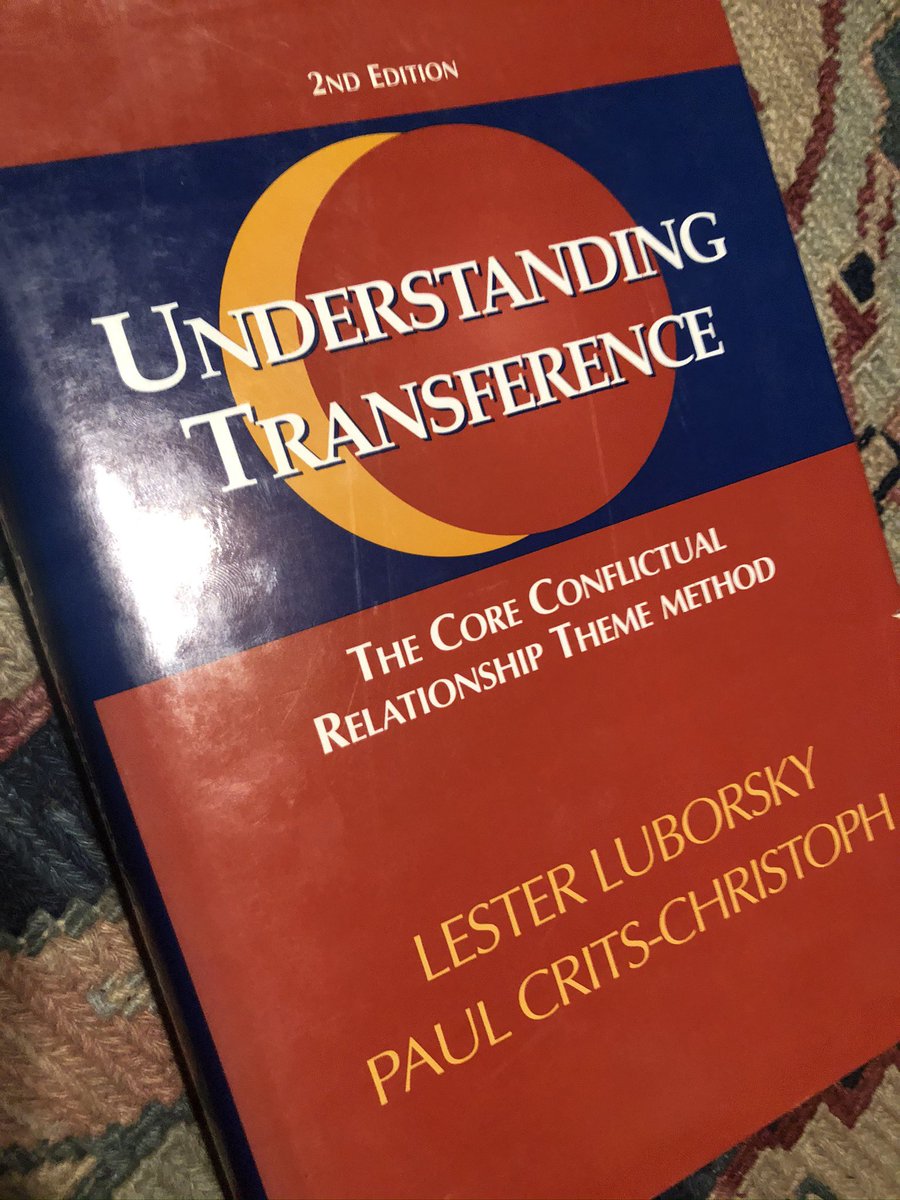
🥈2nd place goes to a classic in psychodynamic empirical researchiana. “Understanding Transference” by Luborsky & Crits-Christoph. It contains the gold standard operational definition of transference & a quant coding system for its measurement: Core Conflictual Relationship Theme
Many have taken swings and hit home-runs, doubles, or fouled out when defining psychoanalysis, psychoanalytic psychology, or the psychodynamic perspective. What we know for sure is that it is both a theory of mental life and a professional technical practice. As a theory, it consists of core principles, constructs, and models for the classification of mental functioning. As a practice, it is comprised of a dialectical continuum between affirmation and confrontation (or support and expression).
Psychoanalytic theory conceptualizes human psychology at the level of motivation (instincts, drives), social relationships (object relations), personality (ego functioning), psychopathology (defense mechanisms, neurosis), development (separation-individuation), neuroscience (neuropsychoanalysis), and cognition (ego functioning). It literally can be subdivided into domains the exact same way as academic psychology. It should not be surprising many central constructs to both differ in name only or in emphasis.
It is in connection to the psychoanalytic theory of psychopathology that the features of the technical practice of psychodynamic psychotherapy and psychoanalysis can be traced. The basic assumption is that we know information we don’t want to know and resources are devoted to the maintenance of blissful ignorance. However, in reality, there is no such thing as blissful ignorance. There is only a leaking dam best illustrated by “serenity now” in Seinfeld gradually leading to “insanity later” when someone ‘cracks’ or ‘blows.’ The different ways in which people keep what they don’t want to know, understand or think about unknown, unprocessed, and ergo unproblematic are called defense mechanisms. They are similar to “coping skills” from academic psychology but differ in core respects.
After finally imbibing virtually every legal action, court document, and news article regarding the 2014 DOJ - LSAT Consent Decree which was the end result of an investigation started in 2010 by California, which went to court in 2012, & was thereafter under the reigns of Perez… twitter.com/i/web/status/1…
What the embedded thread above describes is a view justifying skepticism for interpreting processing speed as veridical de facto & categorically tapping core dimensions of ADHD. It appears the LSAT was actually well aware of every theoretically & empirical development in clinical… twitter.com/i/web/status/1…
psychology so much so as to reject requests for accommodations inferred to be based on a dubious view of processing speed for instance, which as can be seen in my embedded thread above, is a view for which I am sympathetic to. 3/
It does seem like 2014 was monumental in ushering in safetyism, & there is more of proximate concrete causal explanation than typically understood. It’s the deleterious sequelae of Perez in Civil Rights at DOJ going drunk with power and apparent unstoppable competence. Disorder… twitter.com/i/web/status/1…
Trigger warnings only make sense imo in the context of an admin policy of risk management such that the institution is seen to be mitigating risk of discrimination against a new postmodern, overly general protected class covered by the ADA for example.
Subjective explanations of disorder/disability became prioritized over objective evidence and data as legal precedent by virtue of at least one consent decree that changed the face of standardized testing, leading ultimately to the putative dissolution of standardized tests in… twitter.com/i/web/status/1…