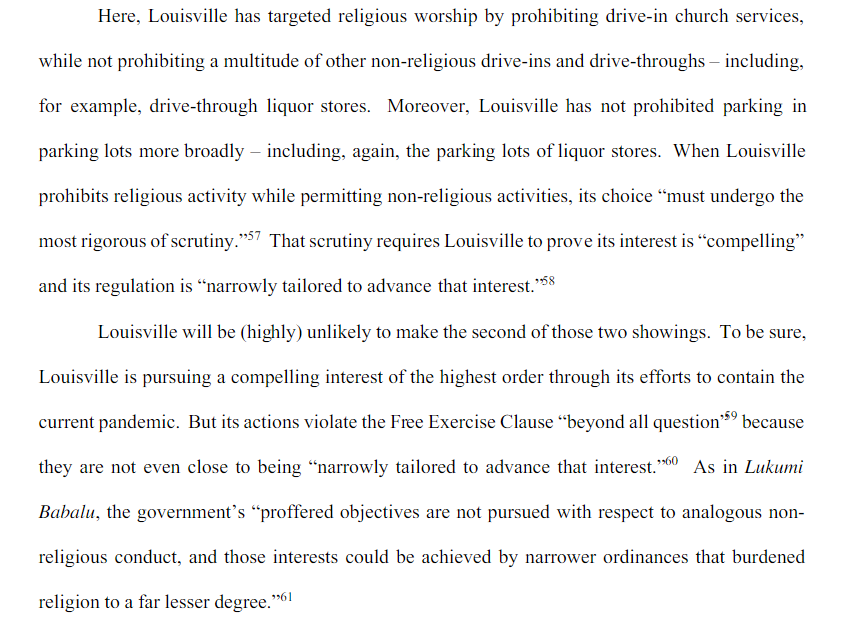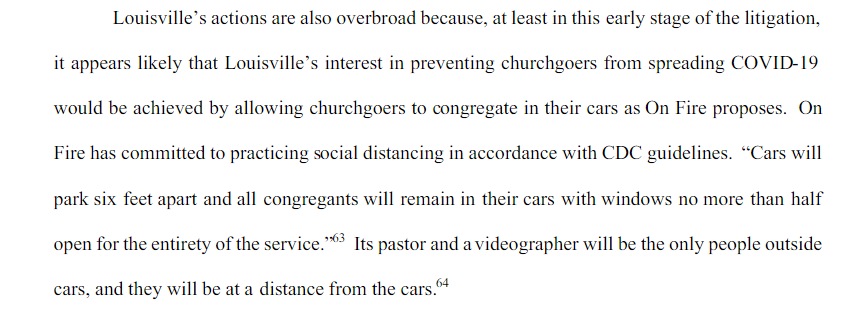
This is gibberish. I know you genuinely believe it, and I'm sorry for that. I know you've been told it by people you trusted. But it's not the law. You've been misled.
CDA § 230 has nothing to do with whether Twitter conducts itself as a platform versus a publisher.
CDA § 230 has nothing to do with whether Twitter conducts itself as a platform versus a publisher.
I expect we'll be talking a lot about this in the next few days, so here's a head start: there is no platform/publisher distinction.
All CDA § 230 does is protect a website from liability for user content & user moderation. It doesn't matter if the website is also a publisher.
All CDA § 230 does is protect a website from liability for user content & user moderation. It doesn't matter if the website is also a publisher.
Put another way, if I have a blog, and I have open comments, CDA § 230 means, generally, that I can't be held liable for my commenters' posts.
It doesn't mean that my blog has to be nonpartisan and a-political! A law like that would violate my First Amendment rights.
It doesn't mean that my blog has to be nonpartisan and a-political! A law like that would violate my First Amendment rights.
That's all CDA § 230 stands for: a website or web service cannot be held liable for the content or moderation of its users.
There is no "non-partisan platform" requirement in the law. And all you had to do to find that out is read the very short operative section of the law:
There is no "non-partisan platform" requirement in the law. And all you had to do to find that out is read the very short operative section of the law:

You are correct, but you don't realize that gets you nowhere. Under CDA § 230 I am responsible for my own content and moderation, but not the content/moderation of other users.
That's groovy. It doesn't get you to: "therefore you cannot edit my comments."
That's groovy. It doesn't get you to: "therefore you cannot edit my comments."
This example illustrates the imaginary trade-off. There is nothing in CDA § 230 that conditions liability protection on neutrality or nonpartisan-ness or an agreement not to kick out the Pepes. There never was.
CDA § 230 was designed to *encourage* content-policing.
CDA § 230 was designed to *encourage* content-policing.
And to find that obscure nugget out, all we had to do was scroll to the very next section of this very accessible and easily-understood law:

It's clear after a couple rounds that we're dealing with two different varieties here.
The first don't realize that publishers are protected under § 230 from liability from the content of users.
The second thinks abolishing § 230 would mean a freer internet.
The first don't realize that publishers are protected under § 230 from liability from the content of users.
The second thinks abolishing § 230 would mean a freer internet.
Both of these species are wrong, but they're wrong in different ways. One simply can't read an easily-understood law. The other has a fundamental misunderstanding about human nature.
This is precisely the argument that Congress rejected when it created § 230.
Congress didn't want comment moderation to cause websites to become liable for the comments they didn't delete. Congress feared imposing such liability would stifle speech on the internet.
Congress didn't want comment moderation to cause websites to become liable for the comments they didn't delete. Congress feared imposing such liability would stifle speech on the internet.
§ 230 came about because a congressman read a news report about a judicial decision holding ISP Prodigy liable for the comments of users that it didn't delete on the theory that Prodigy, which billed itself as the family-friendly alternative to AOL, had moderated other comments.
The congressman thought it was counter-intuitive that Prodigy, which was trying to keep it clean and safe on the internet, be held liable for comments while AOL, which was a trash bin, was not.
The whole point of § 230 was to *encourage* ISPs to moderate the content of users.
The whole point of § 230 was to *encourage* ISPs to moderate the content of users.
Most importantly, § 230 specifically includes a provision providing that no website or ISP be held liable for moderating content.
If this is an accurate preview of Trump's EO (if!), that provision of the EO is dead in the water as inconsistent with § 230.
If this is an accurate preview of Trump's EO (if!), that provision of the EO is dead in the water as inconsistent with § 230.
Today the most powerful man in the world will claim his speech is being suppressed because someone disagrees with him and says so on their own website.
Setting aside for a minute that the EO's interpretation of § 230 conflicts with the text of § 230,, the interpretation does not bind any court, where § 230 is typically raised as a defense to civil suit.
Just what is it Trump followers think they're getting here?
Just what is it Trump followers think they're getting here?
And if the answer to that is, "well, the AGs could sue for false advertising," I'm sorry to break it to you, but they could do that *now*. There's a reason none of those suits have gone anywhere.
Oh, btw, the ALT-code for the section symbol (§) is ALT-0167.
(You might need this one today.)
(You might need this one today.)
It's a little cliche to say "start with the text of the statute" (I mean, who does that?), but you will notice that CDA § 230 does not condition the liability protection in subsection (c)(1) on the actions described in subsection (c)(2).
Trump's EO conflicts with the statute.
Trump's EO conflicts with the statute.