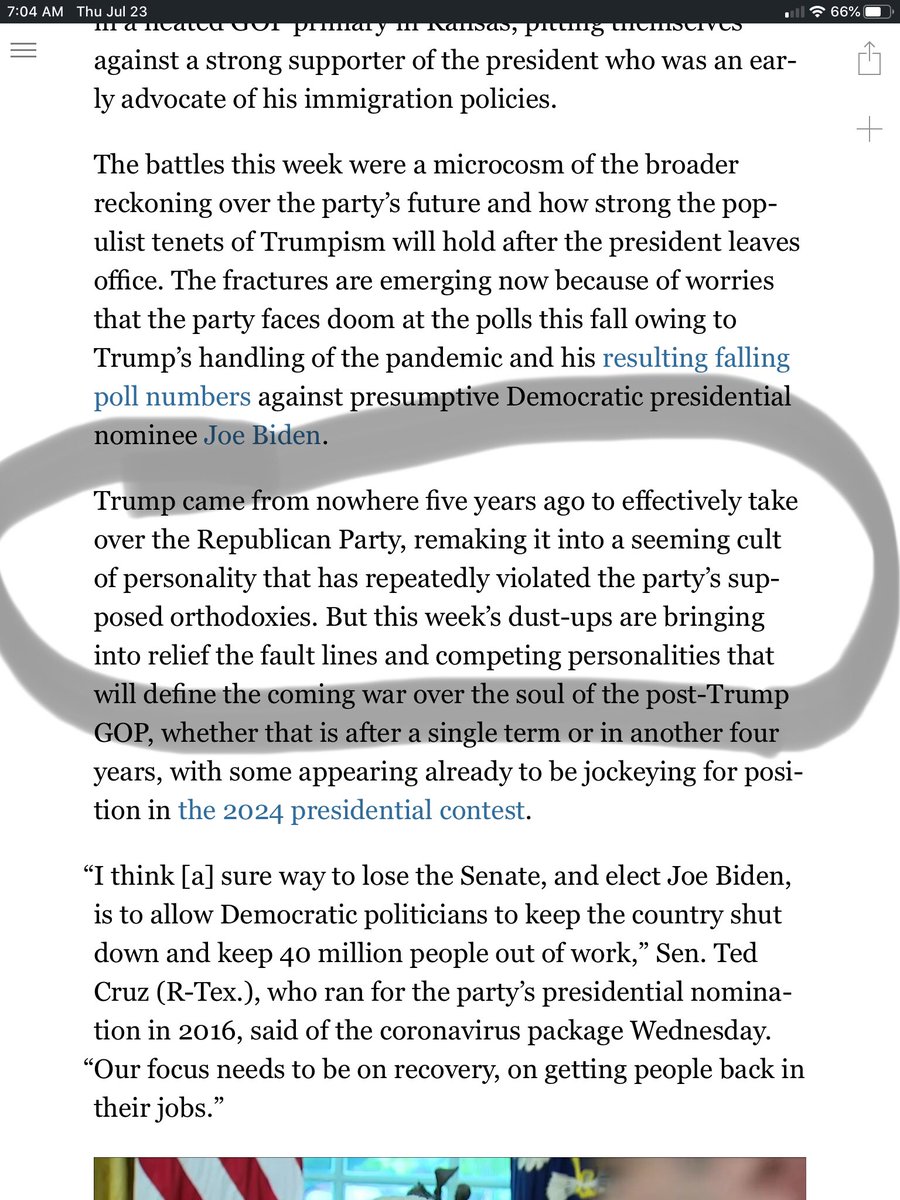
This piece takes Trumpism to be a total rejection of “traditional” GOP orthodoxy and does not reckon at all with how the Party laid the groundwork for Trump./1 washingtonpost.com/politics/worri…
The idea that Trump “came out of nowhere” and “violated the party’s supposed orthodoxies” ignores the long-term trends that led to the embrace of Trump by GOP voters and most of the establishment./2
Other than trade, he ran, as I showed in this piece from Fev 2016, on a standard conservative platform: anti-abortion, pro-gun, tax cuts for the rich, anti-minimum wage increases, eliminate the debt, repeal Obamacare, intense xenophobia, being “tough.” /3 baselinescenario.com/2016/02/03/don…
And this line about the “traditional fiscal concerns of the Republican Party” made me livid. In blowing up the deficit Trump is acting like a “traditional” GOP president (see Reagan, GW Bush). Remember when VP Dick Cheney said “deficits don’t matter”? /4
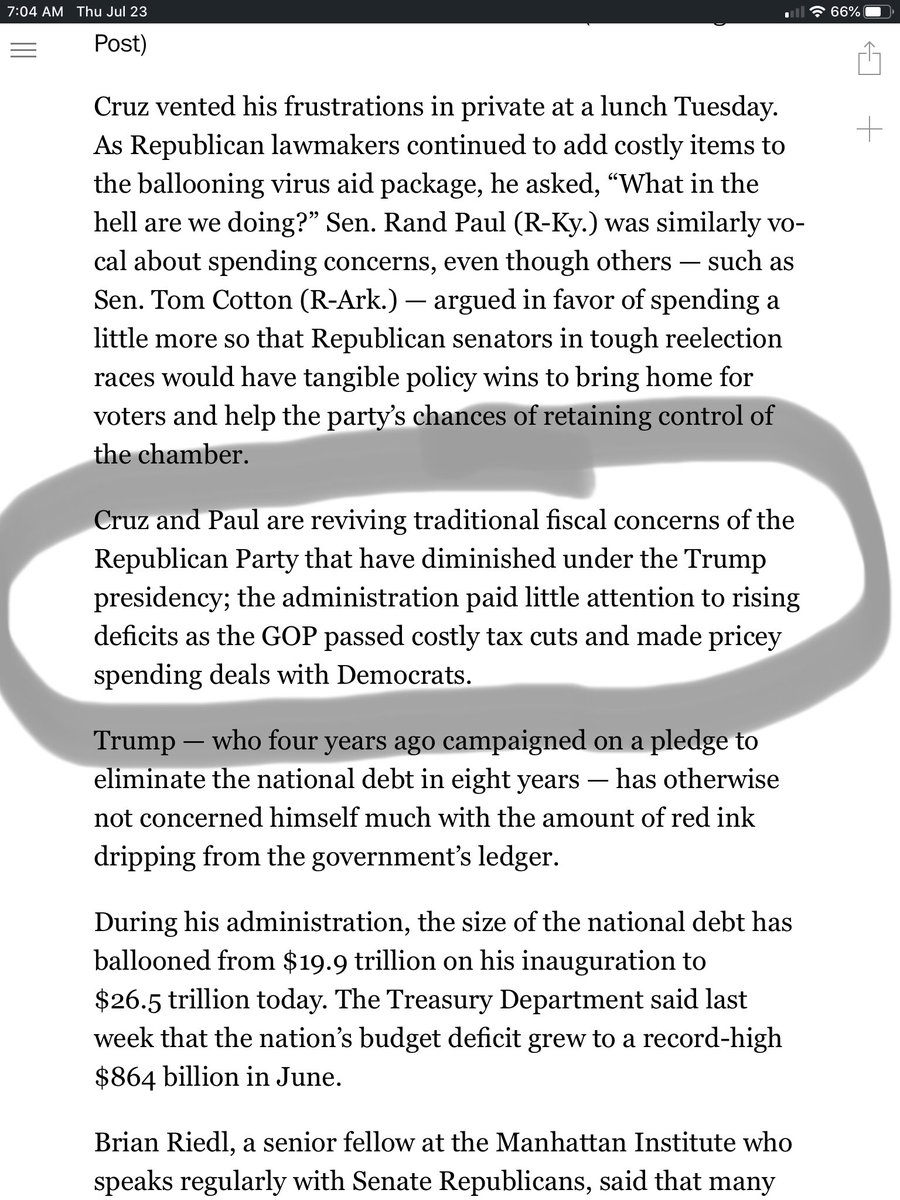
Everyone knows that “traditional” deficit hawkery only rears to head when a Democrat is president. Why perpetuate such obvious bs, especially when the Party nearly unanimously supported the 2017 tax scam that amounted to a massive giveaway to the rich and corporations? /5
How long does it take before a belief widely ignored by the Party whe it is in power stops being labeled an “orthodoxy” or a “tradition”? Is four decades enough time? /6
At some point, we stopped talking about the GOP’s “traditional” support for “free soil.” So it can be done./7
After two generations isn't it time that we described GOP "traditional orthodoxy" accurately (including, first and foremost, tax cuts for the rich) and stopped pretending that it has anything to do with concern about the deficit? /8
• • •
Missing some Tweet in this thread? You can try to
force a refresh

One important point missing from the discourse about Steve Scalise calling himself ‘David Duke without the baggage,’ is that, when he used the label, this was already a viable political lane, one used to describe other politicians, before Scalise. /1 theguardian.com/us-news/2023/o…
In 1990, the Alexandria Town Talk used the phrase "David Duke without the baggage" to describe a winning political formula in Louisiana politics. /2
In 1991, U.S. Rep. Clyde Holloway, seeking to advance in the Governor's race, said he was "a great alternative to David Duke, without all the baggage."/3
A central fact is that, in the midst of a UAW strike, Trump spoke last night at a nonunion factory. Yet the @nytimes mentions this only at the end of the 6th paragraph and the @washingtonpost brings it up in only the 19th paragraph. These are failures of framing./1
It seems disingenuous for the Times subhed to claim that both Trump and Biden spoke to people "affected by the United Automobile Workers strike," without mentioning at the outset that only one of them spoke directly to striking workers. /2 nytimes.com/2023/09/28/us/…
Similarly, for the Post headline to be that Trump "demands union votes" without mentioning at the outset that he did so at a nonunion factory strikes me as somewhat misleading./3 washingtonpost.com/politics/2023/…
A few comments on this piece, which makes some good points but also imo mischaracterizes key issues. /1 nytimes.com/2023/03/27/bri…
To say, "Today’s left is less...patriotic than the country as a whole and less concerned about crime and border security," is to take the conservative critique of "the left" as accurate rather than the perspective of those who self-define that way./2
In contrast, this summation of the pre-Trump Republican Party accepts their self-description: "Republicans were mostly comfortable pushing for lower taxes and smaller government (other than the military)."/3
No doubt, GOP rhetoric in 2024 is "dark," perhaps unprecedentedly so, but this piece understates the continuity in the apocalyptic style in conservative political speech./1 washingtonpost.com/politics/2023/…
There's not much "sanguine optimism," in Ronald Reagan's fearmongering 1961 anti-Medicare speech, which ends with his claim that "you and I are going to spend our sunset years telling our children... what it once was like in America when men were free."/2 americanrhetoric.com/speeches/ronal…
Here's a thread I did last year on a NY Times article that posited a similar discontinuity./3
Republican claims of being angry--visceral or otherwise--is often reported as being newsworthy in itself, in a way that it is not for other groups in society.
One of the modes of elite victimization is to take claims of anger among the powerful to be a self-justifying force, rather than to address the question of what justifies that anger. /2
A good question to ask is why are they angry about the enforcement of the law--in this case ensuring that the wealthy actually pay the taxes they owe?/3
"Punctured myths make us better students of history, but they leave nothing to live up to. Shame is a shaky foundation for any project of renewal." I'm not sure why the first claim necessarily follows or why history should necessarily promote a "project of renewal." /2
Moreover, I don't think that the history of "terrible subjects" is necessarily based on a model of producing feelings of "shame." /3