Interestingly Crom Dubh's day, #Lughnasadh marks the beginning of the mating season of the Aurochs, wild Eurasian cattle, the totem animal of the first farmers...This Vinca culture bucranium. They were positioned over house entrances...
Crom Dubh was probably brought into Ireland from the Balkans. It is the Balkans that we find his twin, Hromi Daba...And their granddaddy From Div, Thunder Giant/God...And the key to understanding the true nature of Crom Dubh...Sky father turned into Devil. oldeuropeanculture.blogspot.com/2019/08/bull-o…
The link between bulls and the date that marks the end of summer beginning of autumn led to discovery of mythologised animal solar year markers, which then turned out to be everywhere... oldeuropeanculture.blogspot.com/p/animal-solar……
• • •
Missing some Tweet in this thread? You can try to
force a refresh

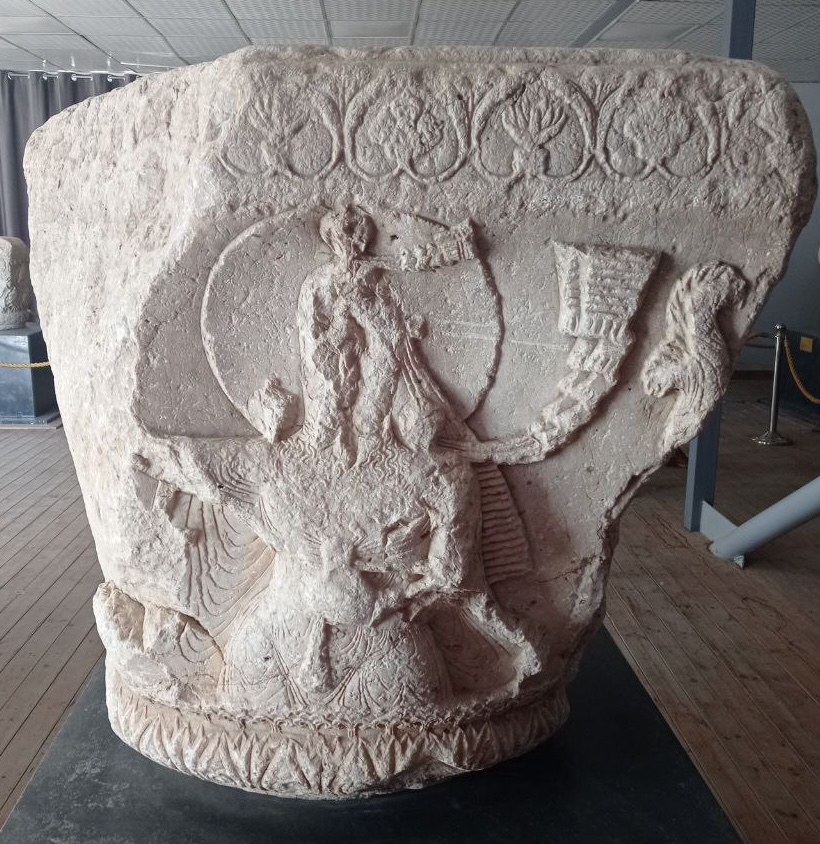
Thread: Late Sassanian depiction of a deity on a column capital now held in Taqe Bostan , which @persiaantiqua identified as Mehr (Mithra) based on the fact that he is surrounded by blooming lotuses... en.wikipedia.org/wiki/Taq-e_Bos…
Mithra was directly associated with lotus, to the point where on the most famous relief of Mithra, the one from Taqe Bostan, he is actually depicted standing on a lotus flower, radiating light, while witnessing Ahura Mazda giving ring of power to king Ardashir II...
Why Lotus? Mitra originates in India. Where he was, in the earliest times, directly associated with Varuna, the old Monsoon good whose Vahana was a crocodile, an animal calendar marker for the monsoon season in India....
Thread: Two Sassanian wall relief slabs dated to the 5th-6th c. AD, depicting rampant ibex goats flanking "the tree of life"...
This is an ancient symbol found throughout Iran, Mesopotamia, Central Asia, Levant, Crete. The reason for that is that in all these regions, year is divided into two halves:
Thread: 900-700 BC Syro-Hittite relief from Carchemish which everyone believes depicts the ancient Sumerian Hero Gilgamesh as master of animals, holding the horn of a bull and the leg of a lion. Museum of Anatolian Civilizations (Ankara, Turkey). Who is this dude really?
If we interpret the animals as animal calendar markers, which they always are in compositions like this, The Dude (with big D) stands in the moment when bull (summer) ends and lion (autumn) begins (end of Jul start of Aug)...
Thread: Illustration by Bernard Zuber for Maurice Garçon’s La Vie Execrable de Guillemette Babin, Sorciere, 1926.
May Day Eve (April 30) is across Northern and Central Europe known as Walpurgis Night, the night when everyone is trying to "ward off, scare, witches"...
Why?
Maybe this has something to do with the old Celtic calendar which divided the year into two halves:
Winter (Samhain, 1st of Nov - Beltane, 1st of May)
Summer (Beltane, 1st of May - Samhain, 1st of Nov)
Thread: Goats flanking the tree of life. Ritual vessels from Gonur-depe, the administrative and ritual center of Ancient Margina, the Northern regions of the Oxus civilization, dated to 2300˗1600 BC. Pic from researchgate.net/profile/Nadezh…
The reason why we find goat flanking the tree of life in Iran, Mesopotamia, Central Asia, Levant, Crete is because in this part of the world, the climatic year is divided (roughly) into hot/dry summer (Apr/May - Oct/Nov) and cool/wet winter (Oct/Nov - Apr/May)...
Oct/Nov is also the time when male ibex goats start their ferocious mating fights...And because the wet season in these parts of the world starts when ibex goats start mating, ibex goat became an animal calendar marker for the beginning of the rain season...