Working through some thoughts but should probably wait to post until people are awake on the east coast.
In defeat, the Dem coalition got more efficient:
-In 2016, Trump lost the popular vote by 2.1% but had 241 House Republicans in 2017
-Last night, Trump won the popular vote by 1-1.5% (?) but might only have 217-220 House Republicans in 2025
After Republicans romped in the 2010 midterms you could look back at the blue waves in 2006-08 and say Americans were blowing off steam for the wars and the GFC. If Dems have a good 2026 maybe we say something similar about Covid/inflation/2020-22.
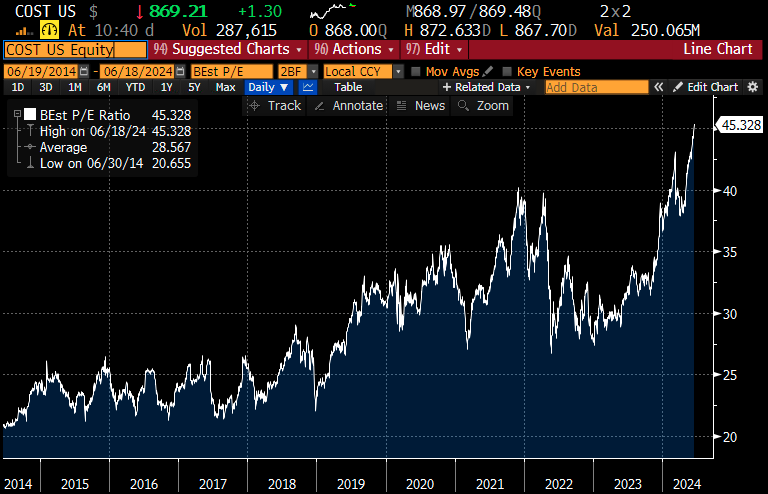
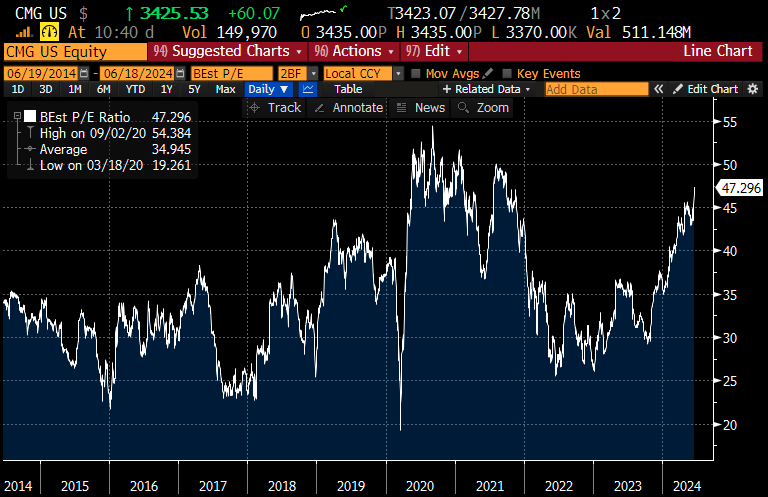
24-month forward P/E for $COST and $CMG -- my brain just doesn't work this way:
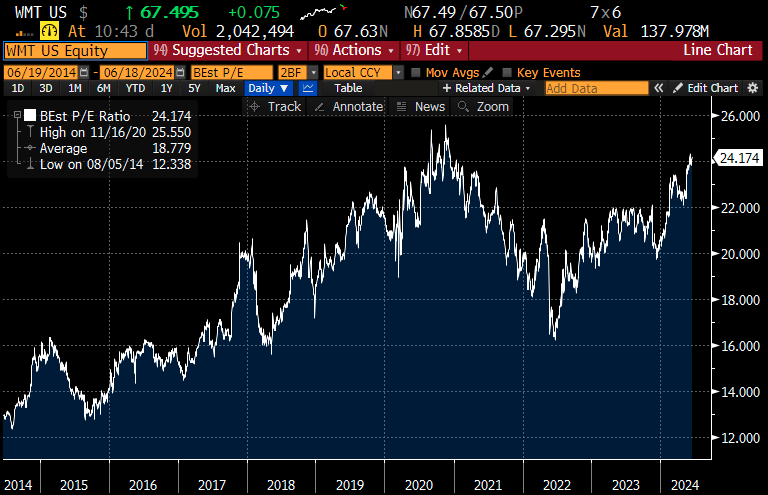
$WMT too -- not quite as extreme but the same mega quality bid:
We saw in the 2010's that fixed income managers had ways of rationalizing 10-year yields at 1.5%, and similarly I'm sure there will be people out there who can rationalize $COST at 60x earnings or $WMT at 40x earnings.
Idea I’m toying with:
-20-somethings have far better jobs/more money than the 20-somethings of 10-15 years ago
-At the same time, they either can’t afford or are being outbid on houses by older Millennials
-that leaves a lot of excess cash for leisure/gambling/investing
Even as the labor market has improved, it doesn’t seem like marriage/having kids/buying houses is happening earlier for this cohort of 20-somethings, so where else is the money supposed to go? Not sure if this is a one-time dynamic or a new normal.
Good one here — anecdotally, young people spend way way more going to their friends’ weddings than even people my age did when we were 27-33.
1/Biggest structural changes since 2019:
-impact on urban downtowns/CRE from remote/hybrid work
-auto industry capex (and sales) shifting from ICE to EV, particularly outside the US
-Silicon Valley firmly focused on AI instead of the 2010’s growth vectors
-dawn of the GLP-1 era
2/ -Abortion/courts now being an issue that benefits Democrats rather than Republicans
-Solar energy being a much larger share of global power generation/installation
-Streaming has won, the cable bundle in “runoff mode”
-the decade of college-educated burbs rather than cities
3/ -I’m less sure about whether inflation/interest rates belong here than I would have a year ago. Think we’ll know more after 2024
-supply chains shifting from China to Vietnam/India/Mexico
-China now a massive force in the global auto industry
-China’s econ boom over?
Something you hear at the end of every US expansion is “We’ve exhausted [growth pattern of the last cycle], where’s the growth going to come from?” And the magic of the US is we always find some new growth model that’s different from the prior one.
I didn’t appreciate this in 2008 when critics said “We don’t need any more big box stores, everyone has borrowed too much money, the suburbs are tapped out” which was true, but then we got an urban/tech-centric growth cycle plus the fracking boom.
The obvious one right now is “unemployment is structurally low and we’re not going to find another billion workers to add to the global economy” but that just means the next growth cycle can’t be as [cheap] labor-intensive as the past 40 years. We’ll find something else.
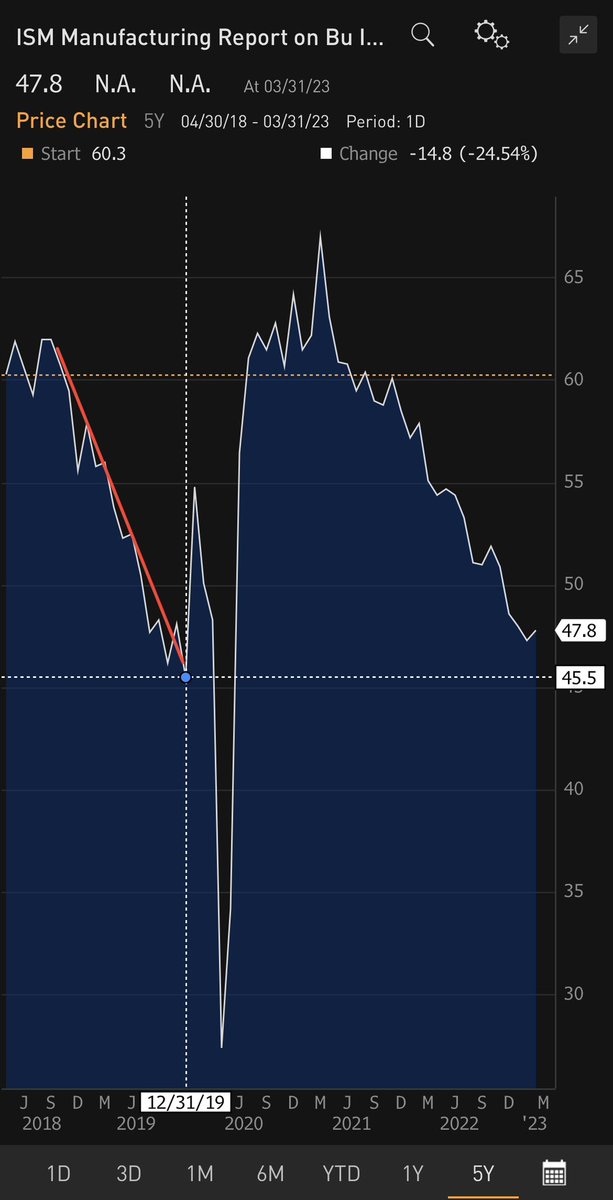
While “textbook macro pessimists” wait for another shoe in the economy to drop, another thing for them to consider is coming into the pandemic, we were at the tail end of a 15-month downtown/stall in the manufacturing economy:
This is part of what made the March 2020 equity selloff so tough — we were at the start of a cyclical upturn. And obviously, we then got one a month later from stimulus and such, but it’s important in the context of thinking about typical recession risk dynamics.
So as we think about things now, the real economy was pretty de-risked heading into the pandemic. Then we got some pandemic-specific excesses, but outside of tech nobody was going hog-wild with investment and capex activity in 2020-22, they were just trying to survive.