There are four categories of responses to this type of article. Each of these correspond to one of the four classical theories of truth. Let's examine each of them in turn, as an exercise in critical thinking.
The first response is to evaluate the argument based on its argumentative structure. Do the conclusions flow logically and coherently from the premises? Are there inconsistencies or logical fallacies in the reasoning?
This is the coherence theory of truth.
This is the coherence theory of truth.
The coherence theory of truth states that a claim is true if it is logically coherent with all of its upstream propositions.
Basically, the whole 'Socrates is a man, all men are mortal, therefore Socrates is mortal shebang.'
On this basis, Milo's piece passes the bar for truth.
Basically, the whole 'Socrates is a man, all men are mortal, therefore Socrates is mortal shebang.'
On this basis, Milo's piece passes the bar for truth.
His conclusions flow logically from his premises.
He argues that Progressive Summarisation is a lousier method because it produces thinkers who are uncritical and who regurgitate old ideas. His premise is that blind summarisation will not lead to novel insight.
He argues that Progressive Summarisation is a lousier method because it produces thinkers who are uncritical and who regurgitate old ideas. His premise is that blind summarisation will not lead to novel insight.
If we accept this premise as true, then everything else follows logically. There are no logical inconsistencies in his argument (that I can detect). So it passes the bar for truth with regard to coherence.
Thankfully, coherence is not the only theory of truth we have.
Thankfully, coherence is not the only theory of truth we have.
The next theory is the correspondence theory of truth. That is, what is true is what corresponds to observed reality.
Here, the premises begin to fall apart. Is it true that summarisation leads to bad thinking? Are there examples or counter examples?
Indeed there are.
Here, the premises begin to fall apart. Is it true that summarisation leads to bad thinking? Are there examples or counter examples?
Indeed there are.
Lawyers cannot remember the details of every case. So they use something called 'headnotes' to summarise the key judgments of relevant case law. These are raw, 'blind' summaries.
You may even purchase them. en.wikipedia.org/wiki/Headnote
You may even purchase them. en.wikipedia.org/wiki/Headnote
This is a longstanding practice in law. Many if not most lawyers do this. They do this because no lawyer can hold all the relevant cases in their heads.
And yet, they are able to come up with novel, powerful legal innovations in court. Why?
And yet, they are able to come up with novel, powerful legal innovations in court. Why?
This is because the 'chunking' afforded to them by their headnotes allow them to construct novel cases.
We have our first counter-example.
@fortelabs actually argues this is one of the benefits of PS. Milo does not address this.
We have our first counter-example.
@fortelabs actually argues this is one of the benefits of PS. Milo does not address this.
Milo’s premise doesn’t seem to match up to reality. There appears to be novel thinkers who are able to do good thinking, and who are aided by blind, raw summaries.
Perhaps critical thinking is orthogonal to summarisation technique? Hmm. We shall see.
Perhaps critical thinking is orthogonal to summarisation technique? Hmm. We shall see.
The third theory of truth is the consensus theory of truth. This theory states that what everyone agrees on is true, is true.
You might think that this is a stupid theory, but consider: how do we know that Perelman solved the Poincaré conjecture? en.wikipedia.org/wiki/Poincar%C…
You might think that this is a stupid theory, but consider: how do we know that Perelman solved the Poincaré conjecture? en.wikipedia.org/wiki/Poincar%C…
When Perelman's proof was discovered, there were only a handful of mathematicians in the world who could verify it. Perelman was 39. The Fields Medal (math's highest prize) could only be awarded to mathematicians below the age of 40.
The mathematicians RACED to verify the proof.
The mathematicians RACED to verify the proof.
You may read more about it in this fantastic piece: newyorker.com/magazine/2006/…
We believe that the Poincaré conjecture is true because those small handful of mathematicians announced that it was true. We must trust in their consensus that it is true.
We believe that the Poincaré conjecture is true because those small handful of mathematicians announced that it was true. We must trust in their consensus that it is true.
The scientific method works similarly as well. We trust in scientific consensus in highly technical domains, because we have no other way to verify what is true, as ordinary laymen.
Back to Milo. This theory of truth doesn't seem to apply here. We shall move on.
Back to Milo. This theory of truth doesn't seem to apply here. We shall move on.
The final theory of truth is the one that I think is more relevant: the pragmatic theory of truth. The pragmatic theory states that what is true is what works for you.
This is most useful, because Progressive Summary and Progressive Ideation are *both* actionable methods.
This is most useful, because Progressive Summary and Progressive Ideation are *both* actionable methods.
This means that we may verify it through actual practice.
But actual application is expensive. It takes time. Are there other ways to apply this theory of truth?
As it turns out, there are.
But actual application is expensive. It takes time. Are there other ways to apply this theory of truth?
As it turns out, there are.
One implication of this theory of truth is that practitioners using it *should* be able to demonstrate results. In other words, it is more likely to be true if it works FOR THEM.
So our next question is: is there proof that these practitioners are able to produce novel thinking?
So our next question is: is there proof that these practitioners are able to produce novel thinking?
With @fortelabs, the answer (to me) is a clear yes. I believe PS is the best currently-known application of JIT principles to knowledge work. I even went back to the source (Taiichi Ohno's Toyota Production System) to verify for myself.
I recognise the contribution Forte has made to the current state of knowledge work.
Further proof, his synthesis of Toyota’s methods continue to haunt me:
Further proof, his synthesis of Toyota’s methods continue to haunt me:
But what about @NickMilo? What novel insights has he published? Where is his proof of work? Where are the examples of the 'better thinking' that we are promised?
If progressive ideation is that wonderful, we should see the proof in his body of work.
If progressive ideation is that wonderful, we should see the proof in his body of work.
To be fair, perhaps Milo does not have a large enough body of work to evaluate. But this makes me down-weight the usefulness of his technique.
But. There is a negative signal in the piece itself.
Milo cites ‘mirror neurons’, a highly discredited finding in neuroscience.
But. There is a negative signal in the piece itself.
Milo cites ‘mirror neurons’, a highly discredited finding in neuroscience.
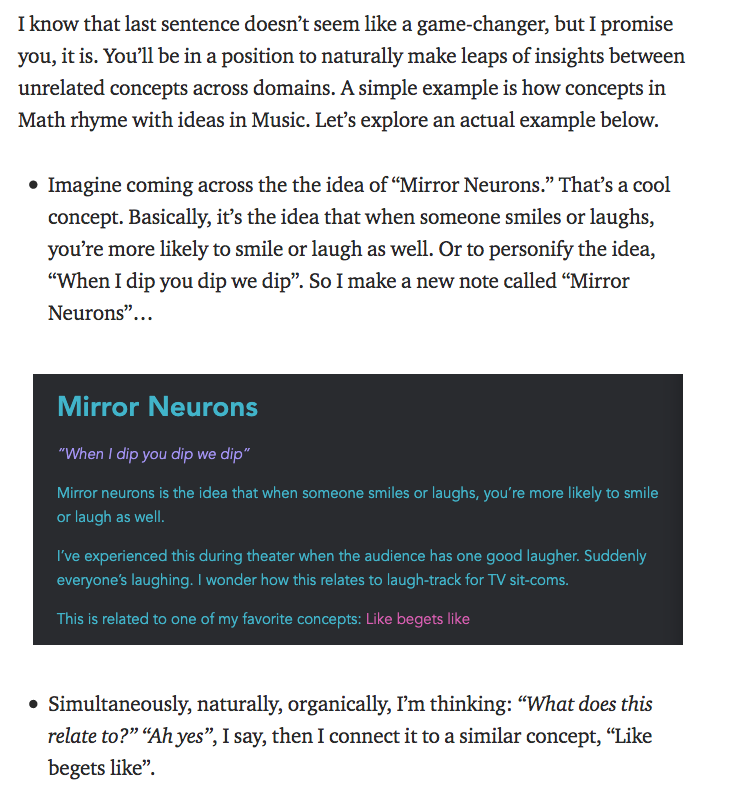
I'm not even talking about 'a little discredited', or 'still hotly debated'. It's been 20 years since V.S. Ramachandran popularised mirror neurons. And that's 20 years for evidence to slowly accumulate AGAINST the thesis.
You don't even have to look very far; just google.
You don't even have to look very far; just google.
"Wait, are you telling me that someone who is trying to promote better thinking used an example of a highly discredited theory IN his example of better thinking?"
Uhh, yes.
So that makes me down-weight the technique even more.
Uhh, yes.
So that makes me down-weight the technique even more.
The truth is that I don't really have a dog in this fight. I have tried Progressive Summarisation, and it's worked for me. If Milo had demonstrated good thinking, with novel insight scattered in his body of work, I would be willing to give his technique a go.
But, alas.
But, alas.
I think the *real* takeaway is this: critical thinking is independent of the tool you use for summarisation.
I wrote this thread as an example of how to apply the four classical theories of truth when evaluating some claim on the internet.
I wrote this thread as an example of how to apply the four classical theories of truth when evaluating some claim on the internet.
Arguably, learning to do this is more useful than over-optimising some reading strategy or other.
To recap:
There are 4 theories of truth:
- Coherence
- Correspondence
- Consensus
- Pragmatic.
Use them. You may be surprised at how much better your thinking gets.
To recap:
There are 4 theories of truth:
- Coherence
- Correspondence
- Consensus
- Pragmatic.
Use them. You may be surprised at how much better your thinking gets.
The end.