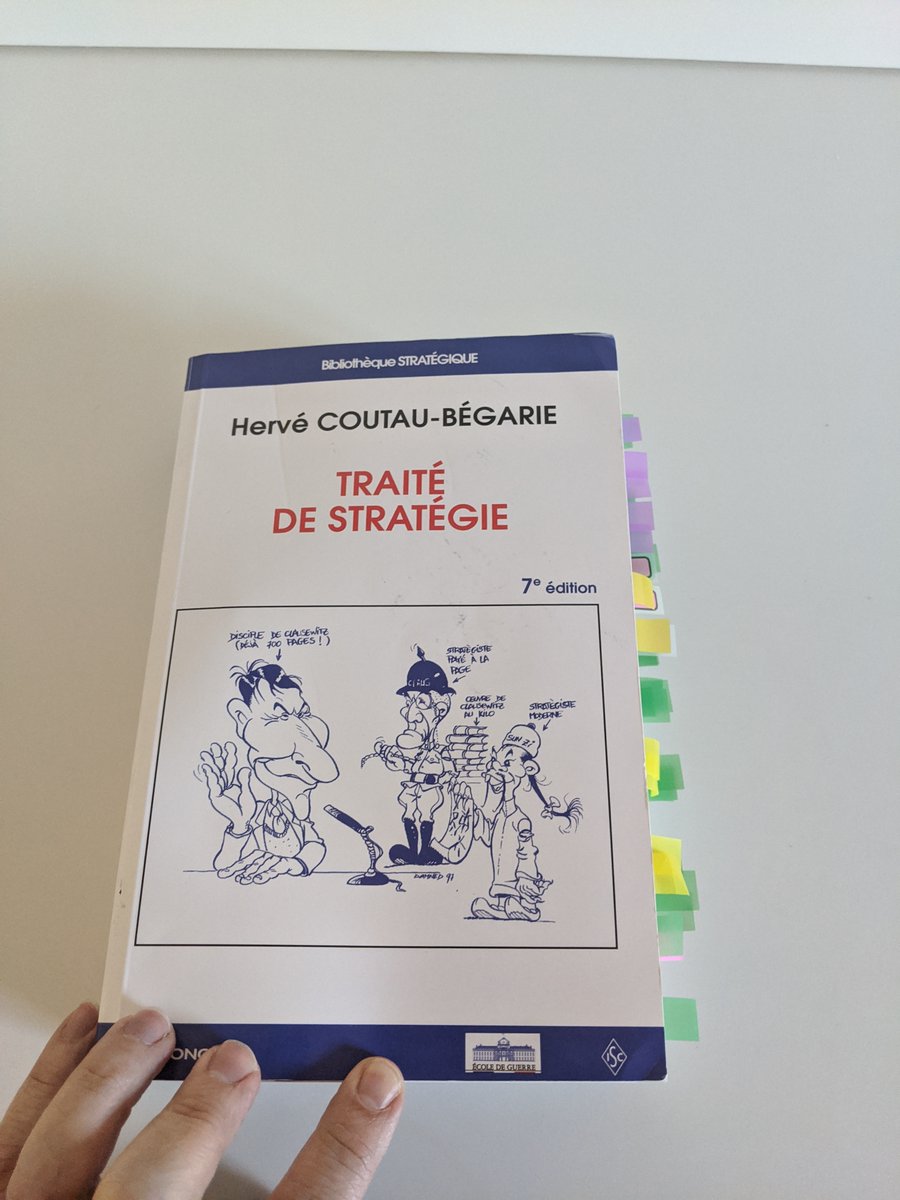
1. So, this book. It's a major reference for French mil and nat sec types, and with reason. I'm not done with it yet, but already I've learned an exceptional amount. I did find a contradiction, however, that's relevant for @#Barkhane and FR STABOPS in general.
2. Coutau-Bégarie (HCB) stresses the relevance of FR's colonial experience, saying FR Army exceptionally good at using local auxiliaries and establishing contacts with the population. "This heritage is not lost," he says (p. 476). I've heard this from many Fr senior officers.
3. Then, in a section on "the loss of efficacy of regular strategies," (sec. 275), he talks about how "post-modern armies" are increasingly incapable of dealing with irregular or assymetric threats. They rely increasingly on fire power...
4. ...are more reluctant to engage with enemy, because of risk of casualties, and are more and more cut off from the population (p. 529). Meanwhile, the enemy is perfectly integrated with the people and doesn't fear death.
5. Also, contemporary STABOPs differ from colonial ones in that two prerequisites are missing, a clear policy that's easy to understand, and real empathy with the population. (p. 530)
6. So here's the thing: HCB doesn't take the simple logical step of including the FR Army in that generalization, even though it is obvious.
7. I think that when it comes to dealing with locals and working with them, the FR Army is convinced it has a "savoir faire" that makes it an exception to the rule. I'm not so sure that's true any more. They might still do it better than the US, but not enough.
8. By the way, HCB also says a reason for the failure of contemporary efforts has to do with the obligation to rely on the local government, which often is ineffective "whebn it is not altogether corrupt." Should sound familiar.
• • •
Missing some Tweet in this thread? You can try to
force a refresh

1. One of the insights I got from researching my #Denmark video was coming to a better understanding of how Denmark understood its task of pulling its share of the weight. A thread. 🧵
2. Historically Denmark's focus was on on controlling its strategically valuable home territory (the Danish straits), which meant clashing with its immediate neighbors and keeping its gaze to the north and east, into the Baltics.
3. It didn't worry much about its north Atlantic possessions because it didn't need to. What people fought over was access in and out of the Baltics, not #Greenland, #Iceland, or the Faroes, none of which was worth much.
1. My own thoughts on what *should* be and what *is* for Israel-Palestine. A thread.
2. Sane people agree that a 2-State Solution (2SS) offers the best chance of peace. I've always endorsed the idea and still do, and I'm in favor of anything I think makes that possible. But it is absolutely not a guarantee, and getting there will be extremely difficult.
3. Both sides have their maximalists, their extremists. In what proportions? It's really hard to know. For one thing, it might not matter, as it only took one shooter to kill Rabin, although he was the product of a milieu that encouraged him.
Who's ready for Volume VI of Admiral Raoul Castex's magnum opus, Théories Stratégiques? Who? Only France's genius 20th century naval strategist, who's unknown outside France bc he wrote too much and most ppl can't bother. But that's what I'm here for. Very long thread:
1. This vol is entitled "Strategic Mix" (Mélanges stratégiques) which is stuff that wasn't meant to be included in this work, the last vol of which was supposed to be vol 5. But he couldn't help himself. Vol 6 post-dates 1940, which should make it particularly interesting.
2. Per the table of contents, which the French insanely insist on putting in the back of books, the topics include:
Stuff about geography
Stuff about "rears" (militarily speaking...not physiognomy)
Observations about maneuver
Ops plans
"Sources of Strategy"
Stuff about WW2
Time now for vol. 5 of Raoul Castex's Théories Stratégiques. This volume is entitled, "The Sea Against the Land." And it's a big one. The longest.
1. Couteau-Bégarie, the editor, says the thesis is this: "The sea was the agent of execution and realization of the Dispersit superbos proclaimed by the Magnificat. Yes, 'he counfounded the superbs,' and the sea was the instrument of his will...it saved in all circumstances...
2. ....the freedom of the world and civilization." That's a quote of Castex, that Couteau-Bégarie cites. v 5 p. v.
1. #Mali has appointed General El Hadj ag Gamou as governor of #Kidal. It's an interesting choice. Who is he? What does this mean? A thread.
2. Gamou is a Tuareg from the Imghad caste. Tuareg society is divided by caste and tribe. Imghad tribes are vassal tribes. The noble tribes (in Mali) are the Illelan. The top-tier nobles are Ifoghas.
3. Gamou's tribe is from Menaka, which I suspect means that his tribe was once a vassal to the Iwllemmedan confederation. That was the dominant Tuareg confederation in Mali until the French broke it apart together with its allies, the Kel Adagh, in 1916.
1. Hamas and Hezbollah have mastered asymmetrical warfare. Militarily weaker than Israel, they have found a key vulnerability by encrusting themselves amid civilian populations at a time when...
2... global public opinion demands a maximalist approach to discerning between combattant and presumably innocent civilians. Moreover...
3....military power by definition is not a tool built for such discernment. There is zero way to combat Hamas or Hezb without killing lots of civilians. There's just no way. Which leads to several critical questions.