Last week, I posted a thread addressing a common criticism of transgender athlete policies, namely that they’re based on evidence in non-athletes. Here’s that thread, for a reminder. Today, I want to mull on another common issue raised in objection:
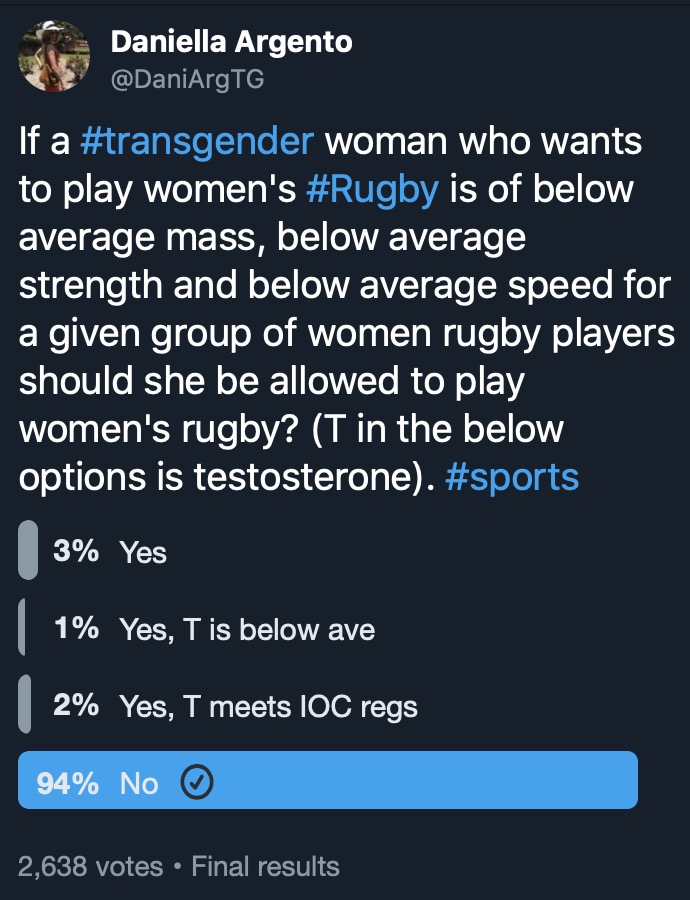
The objection is this: People argue that because trans women are often smaller, lighter, slower, weaker etc than biological females, it should be fine for them to compete as women. It’s an “overlap argument". Here’s one example of that thinking (this particular poll backfired):
The premise of the argument is this:
- Testosterone confers upon males advantages including size, strength, speed, power. This is why women have a separate category;
- If someone identifies as female (trans women), provided they’re not too big, strong, fast, they can compete as W
This leads the argument that trans women inclusion should be dealt with on a case by case basis. If you measure & limit enough variables, problem solved! Right?
Well, no, and I just want to think out loud about some issues. Here’s an example of the actions it calls for (4/)
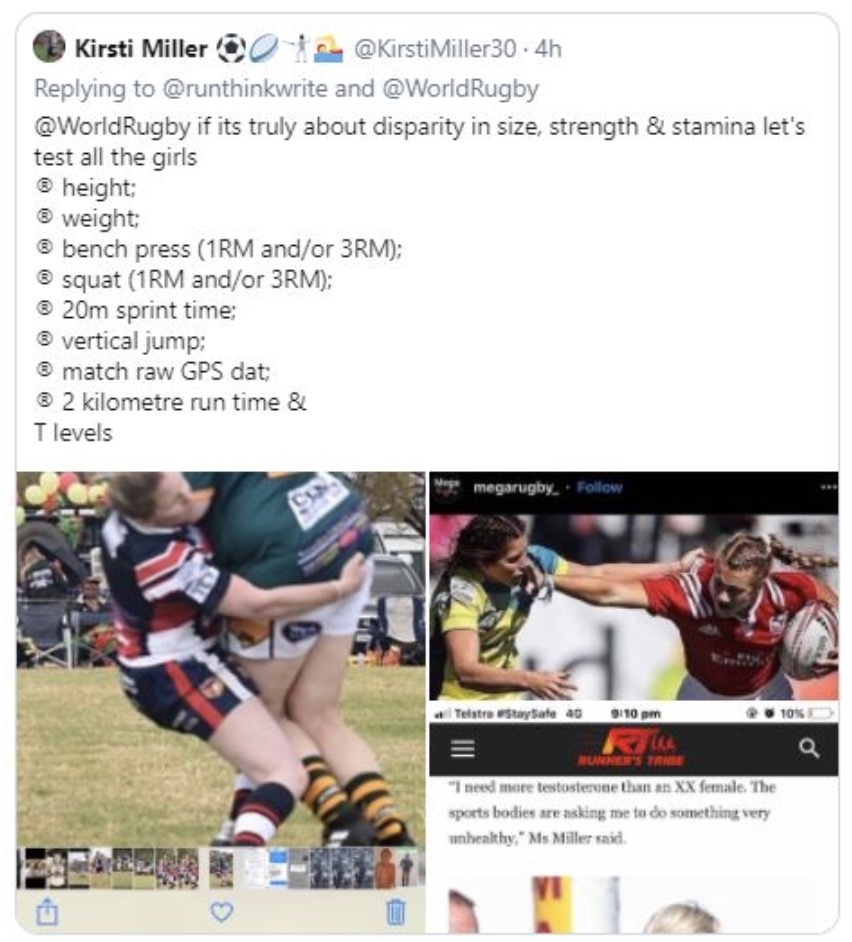
So, first, let’s begin by recognising that there IS overlap between M & F in pretty much every variable we can think of associated with sport. Many women are faster, stronger, heavier, taller than many men. This is obvious. How many of you men are faster than Radcliffe? Yep (/5)
We can (and have) quantified this for mass in rugby, for example. See figure below - the typical male is slightly heavier than the 99th percentile for females (the heaviest 1% of women almost as heavy as typical males). So there is clearly overlap in each attribute, independently
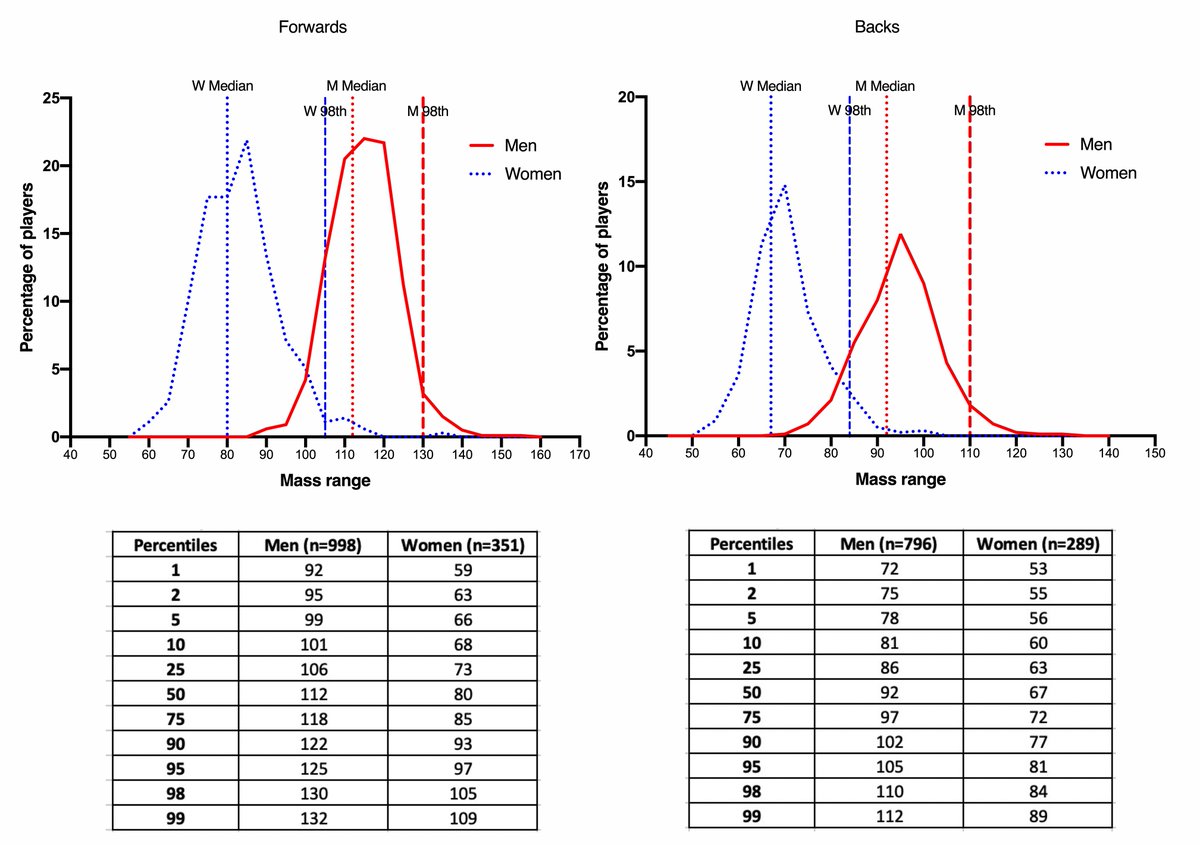
The argument now is that some trans athletes, those who overlap and are lighter than males, should be included because if mass is the problem, they create no problem. Except…couple of things. First, mass is not the only thing that matters. It’s one of many attributes that drive
…performance and safety risk. Even at the same mass, evidence is compelling that men are stronger than women. In fact, to match strength, you often need a male who is 20% to 30% lighter than a female. So simply focusing on mass misses many of the factors for safety & performance
But more to the point, where do you set a threshold? Should it be 75kg? 90kg? 60kg? No matter where you set it, the group of humans who fall just under it, AND who have strength & speed advantages would all be male. So this idea of ‘limits’ is a shortcut to ‘no women in sport'
Second, it’s a misunderstanding of why categories exist. Do you allow a 27 year old adult to play against 17 year old children if they’re “a bit smaller than average and not that strong”? Would you allow a weak heavyweight to fight middleweights just because they lack strength?
In other words, why make an exception that allows someone to cross into a protected category just because that person lacks the attributes that category is associated with? The sexes are divided by sex, not weight/strength etc, even though they may be correlated with it.
Next, a philosophical question - if sport is to set up some kind of ‘bright line test’ to decide which applicants for women’s sport should be allowed in and which should not, how does one draw that line? Is sport going to decide who is “womanly enough” for sporting purposes?
On what basis might sport decide that person A cannot play women’s sport, but person B can? Some complex algorithm that factors in all the relevant attributes? Think of how that would be tested. It’s more discriminatory than ever, and lacks rigor and integrity. I can’t see how
…sport can be tasked with running that test. It would also have to be ‘cheat proof’ (look at paralympic classification for why), done regularly, and it would need to be absolutely accurate, or it would not address the risk issues anyway. I don’t know what these tests look like?
In short, the “overlap” argument seems to me to argue for a new way to categorise people for sport, and it’s one that would end women’s participation in sport, because wherever you draw a bright line, biological males will have performance advantages in other attributes around it
• • •
Missing some Tweet in this thread? You can try to
force a refresh

@seaningle @Aletheia_70 Can confirm! The Semenya CAS case was the first time that a sport made a public statement, in effect, a commitment to biological reality, in the sense that they said "They are male". Prior to that, if you look at the language in Dutee Chand's CAS hearing, they kind of sidestepped
@seaningle @Aletheia_70 ...some important biological points. For instance, they wouldn't have said "Chand is male", but rather "Chand has elevated testosterone". By Semenya, they literally asserted "The reason Semenya has not run even faster is because Semenya is a mediocre male". It was eye-opening
@seaningle @Aletheia_70 ...for everyone involved, and I remember reflecting on that case, and the moment they did that, the whole dynamic changed. Their argument also included a table that juxtaposed XY (male), XX (female) and XY DSD physiology, in various domains. So for instance, genetic, hormone,
So much wrong with this. For one, it applies a stereotype to women they're supposed to argue against. For another, and this is crucial, what these people haven't yet realized is that no matter what happens next, sport MUST have a means to identify males. They are to be excluded
That is, sport has made the call, rightly, to close the boundary around women's sport. It is female only. It follows, then, that sport has to be able to identify who should be included, & who should be excluded. The SRY screen, then test for eligibility is one means of doing this
The other way of doing this, if the SRY screen/test process is scrapped, is to rely on visual appearance and subjective judgment of who belongs and who does not. Maybe they would create a reporting system for 'official complaints'. Allow protests and then investigate cases.
@Nakabuleluwa @drjamesdinic @ProfTimNoakes This desire for a bottom line is what creates a 'market' for the kind of reductionist, over-simplified & selective thinking espoused in that review. Physiology is complex - there are many ways to achieve some outcomes. But if the outcome is performance, low to zero CHO is not one
@Nakabuleluwa @drjamesdinic @ProfTimNoakes Also, very little that has been discussed here is actually new. You could've had lectures in 2002 and heard the same discussions and debates that are now being "debunked" by the paper. Only, the review leaves out dozens of papers that contradict its desired thesis. Can people...
@Nakabuleluwa @drjamesdinic @ProfTimNoakes ...exercise on low CHO intake? Of course? Does fatigue co-incide with EIH? Yes, of course. It's been known for years. Thus, does CHO ingestion prevent EIH and thus delay fatigue? Yes, obviously. None of this argues that high performing athletes can perform OPTIMALLY on low CHO
One thing about this, aside from it being typical academic circle-jerk insecurity (so needlessly, too), is that the integrated model proposed by @drjamesdinic doesn't actually make the same claims that many people (including Tim) proposed as far back as 2001. What James' model is
...explaining (correctly) is that both peripheral and central carbohydrate stores matter to exercise performance and fatigue. It's still a relatively narrow view on exercise, isolating one of many 'homeostats' that regulate or limit fatigue & performance, depending on context.
What Tim et al have argued (as per James initial tweet here ) is that "brain energy balance" matters, not peripheral glycogen levels, and so athletes can get away with very low CHO intake, 10g/hr levels. The bizarre irony is that to make this case,...
There's a whole interview with Malcolm Gladwell that I hope you'll listen to (it's great! link below), but part that is getting a lot of attention is this clip right near the start, and I thought I'd share some context & thoughts
So context, he's talking about a panel that happened in Boston at @SloanSportsConf a few years ago. I was a panelist, and he was the moderator/chair. I was significantly outnumbered on that panel, and my main recollection was that it was a bit of a car crash! speaking for myself!
I recall murmurs & dissent to just about everything I said (male advantage is real, enormous and should be excluded from women's sport, testosterone suppression doesn't take it away, no such thing as meaningful competition), and cheers when trans advocates spoke! I wasn't happy!
Two things these men (& very occasionally women) have in common when offering these 'insights' are: 1) Ignorance (perhaps chosen) of the policy leads them to criticize a straw man or fiction 2) They never offer a solution of any kind for women's benefit 🧵 theconversation.com/world-athletic…
For example, he writes the following. But the WA policy, from its origin, has been CLEAR that it's not simply the SRY gene, but the complete journey from that gene through to androgenization that is being excluded. That's why WA explicitly states the exception, as shown (blue)
He doubles down on his simplistic understanding of the process - SRY is step one, and then "further medical assessments" establish a diagnosis, which would very quickly identify the detail he asserts as if nobody has thought of it. He appears not to understand how 'screens' work