Seaver Wang Profile picture
Sep 1, 2020 15 tweets 4 min read Read on X
An important article by @Chris__Reddy on the recent Mauritius oil spill:

"It is critical that casual observers stay informed about the realities of the situation, rather than abandoning Mauritius's economy..."

(a thread)

"If those notions become cemented in people's minds, it will hurt Mauritius's crucial tourism and fishing industries and could compound the country's problems by causing longer-lasting economic and psychological harm than the oil spill by itself." (1)
Dr. Reddy, who has studied oil spills for 30 years and conducted research as part of the response to the BP Gulf of Mexico spill, cautions that it is too early and potentially damaging to assume that the Mauritius spill damage is permanent. (2)
At the same time, we must also amplify the voices of Mauritians infuriated, devastated + deeply worried by the oil spill + its effects. For a nation with natural beauty, the ocean + the waterfront economy as core to identity, this is a terrible event (3)

theguardian.com/commentisfree/…
I’m recalling some powerful quotes from interviews in a paper by @Meghan_M_Shea, James Painter, and @shannonosaka from this February on how climate/environmental reporting portrays Pacific Island nations: (4)

link.springer.com/article/10.100…
Mauritius is of course an *Indian Ocean nation*, not a Pacific island state, yet many of the same issues associated with reporting on small island countries are at play, so the following quotes from the above paper are worth considering within a broader context. (5)
“There’s a real lack of Pacific news in international news outlets. I mean, we hardly get mentioned … unless it’s a cyclone or an earthquake, you’re not going to see mention of the Pacific at all, which I think is a really big problem" - a Pacific NGO organizer (continued) (6)
"a region that comprises 30% of the ocean EEZs [Exclusive Economic Zones] doesn’t receive more attention … There’s a real gap in just our stories being told and being acknowledged as people." - a Pacific NGO organizer (7)
“I think there is still that kind of background, broad grand narrative around a kind of helplessness and incapacity that sort of contaminates a lot of reporting and diminishes the Pacific to a kind of passive entity to whom things are done…” - an Australian journalist (8)
A Nature feature on the Mauritius spill clarifies: “When you look at images in the media, it can feel like the whole of Mauritius is under oil. But the oil reached only 15 kilometres of the 350-kilometre shoreline, so it could have been much worse.” (9)

nature.com/articles/d4158…
As Dr. Reddy emphasizes, with the help of remediation, oil-contaminated ecosystems can recover with time. The current spill absolutely threatens fishing and affected marine + coastal life, but neither is it necessarily the final end times for this biodiverse ecosystem. (10)
I think this Nature feature does well in highlighting two things:

- the mobilization of Mauritians with international scientists + responders to contain/assess spill’s impacts
- the importance of remedies to prevent future groundings + reform compensation frameworks (11)
This was unquestionably an unacceptable accident. Japan has an obligation to lead containment and long-term remediation of the spill’s effects, and to compensate Mauritians for the ecological and economic consequences. (12)
Simultaneously, the international community should continue to extend aid to Mauritius while reforming marine navigation practices and restructuring oil spill insurance to remove the loophole reducing compensation for bulk carrier accidents. (13)
More broadly, important to reflect that island nations rarely receive coverage outside of crises, particularly given climate change, and we should reconsider whether int’l media coverage fairly reflects citizens’ circumstances, needs, demands, and ambitions. (END)

• • •

Missing some Tweet in this thread? You can try to force a refresh

 

Keep Current with Seaver Wang

Seaver Wang Profile picture

Stay in touch and get notified when new unrolls are available from this author!

Read all threads

This Thread may be Removed Anytime!

PDF

Twitter may remove this content at anytime! Save it as PDF for later use!

Try unrolling a thread yourself!

how to unroll video
  1. Follow @ThreadReaderApp to mention us!

  2. From a Twitter thread mention us with a keyword "unroll"
@threadreaderapp unroll

Practice here first or read more on our help page!

More from @wang_seaver

Apr 1
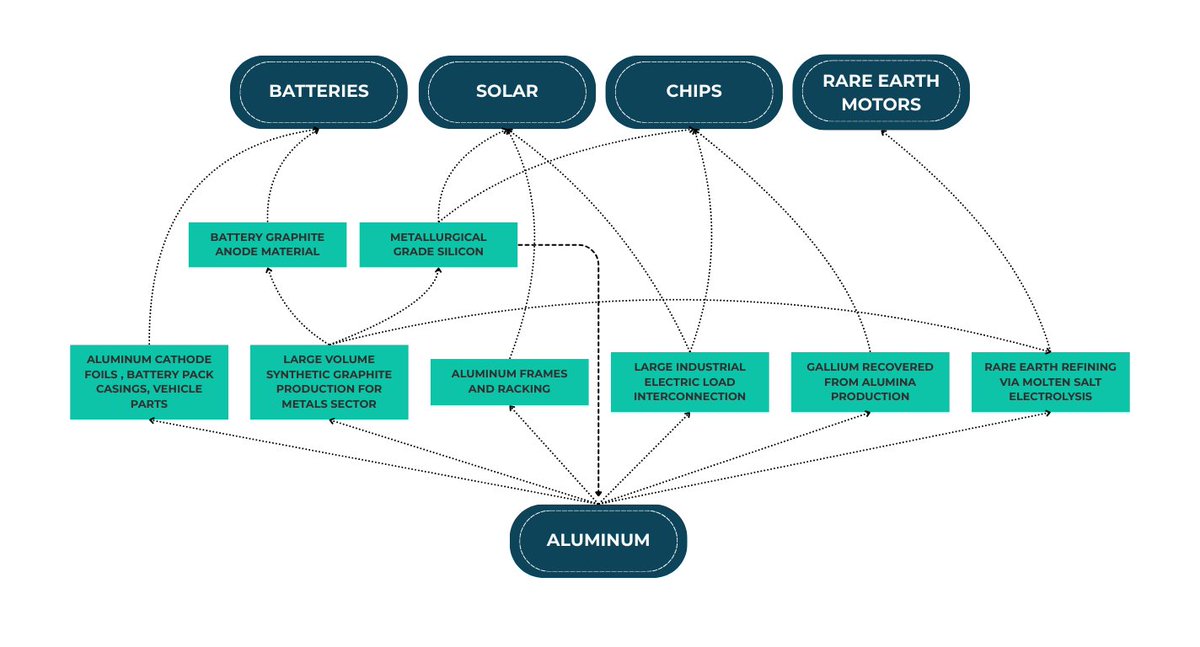
In a new piece, I emphasize how the ability to build new upstream metallurgical and chemical plants is crucial to industrial competitiveness and the downstream ability to mass produce drones, batteries, or electric cars.

In other words, what if it’s all the aluminum tech stack? Image
“Raw materials importantly determine the performance or form factor of the final product—the size or thinness of the silicon wafer, the capacity and longevity of the battery, and the strength of a permanent magnet motor.”

breakthroughjournal.org/p/the-aluminum…
The “aluminum tech stack” is a provocation to be sure, not a verbatim thesis. Yet the connections it highlights are remarkable:

- A country producing 15 million tons of aluminum (China in 2010) is coincidently producing 6-7 million tons/yr of carbon based anodes whose production route is similar to synthetic battery graphite.
- I actually forgot to add the statistic that 25% of Chinese aluminum consumption goes to transportation sector applications.
- Common aluminum alloys require silicon metal, which is also a key feedstock for solar and chips. In fact, a number of metallurgical silicon smelters in China are co-located with aluminum smelters.
- Alumina refineries upstream of aluminum smelting recover gallium, a key semiconductor material, as a byproduct. Circa 2012 the world’s largest producer of gallium was the Aluminum Corporation of China.
- Aluminum smelting expertise is highly inter-transferable with rare earth metal refining, a similar electrolytic process.
- Planners and engineers adding 1-2 million tons of aluminum capacity yearly across China can similarly accommodate other electricity-intensive heavy industries.
- Lithium-ion batteries use aluminum foils as the current collectors at the cathode end.Image
Read 14 tweets
Feb 9
Let’s be clear how much the frame on the aluminum “long green march” story in China has now shifted, from “renewables are cheaper than coal so China is now moving heavy industry to where renewables are!” to “I built a plant here to use cheap coal mined 8 miles down the road, and now the govt is making me buy renewables certificates for 30% of my power needs”

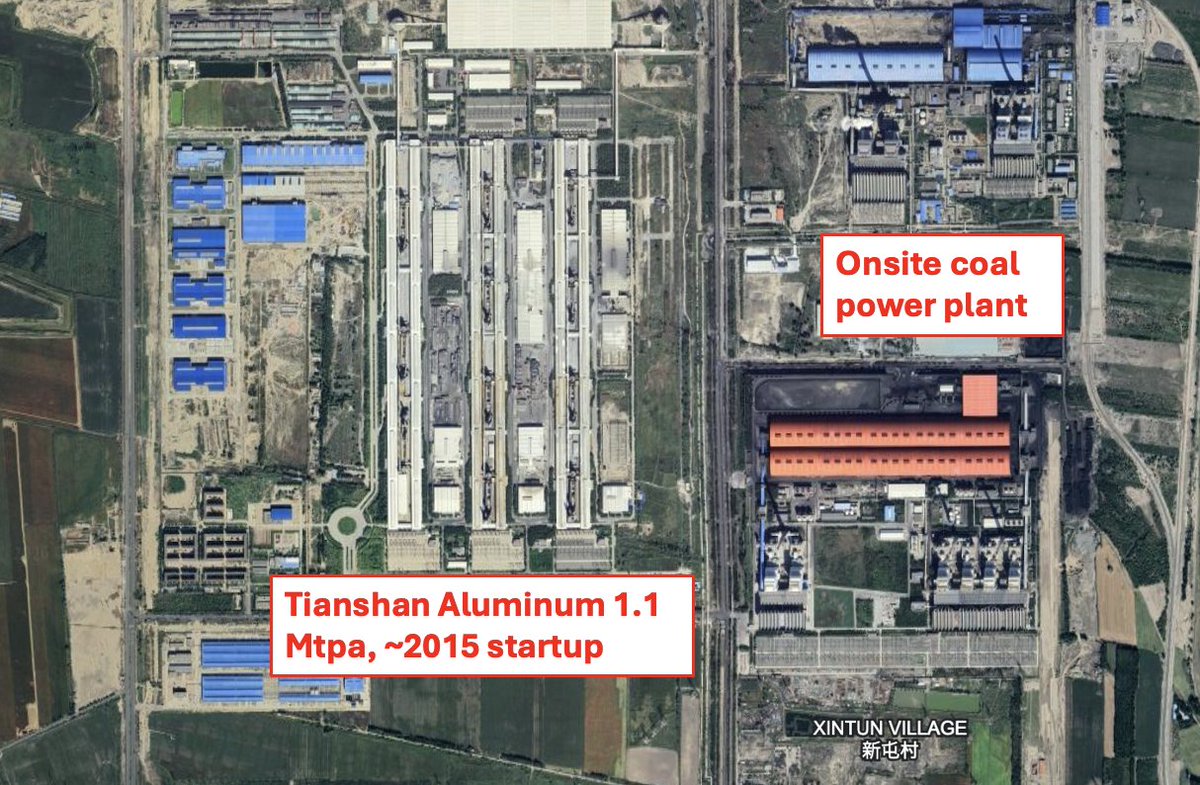
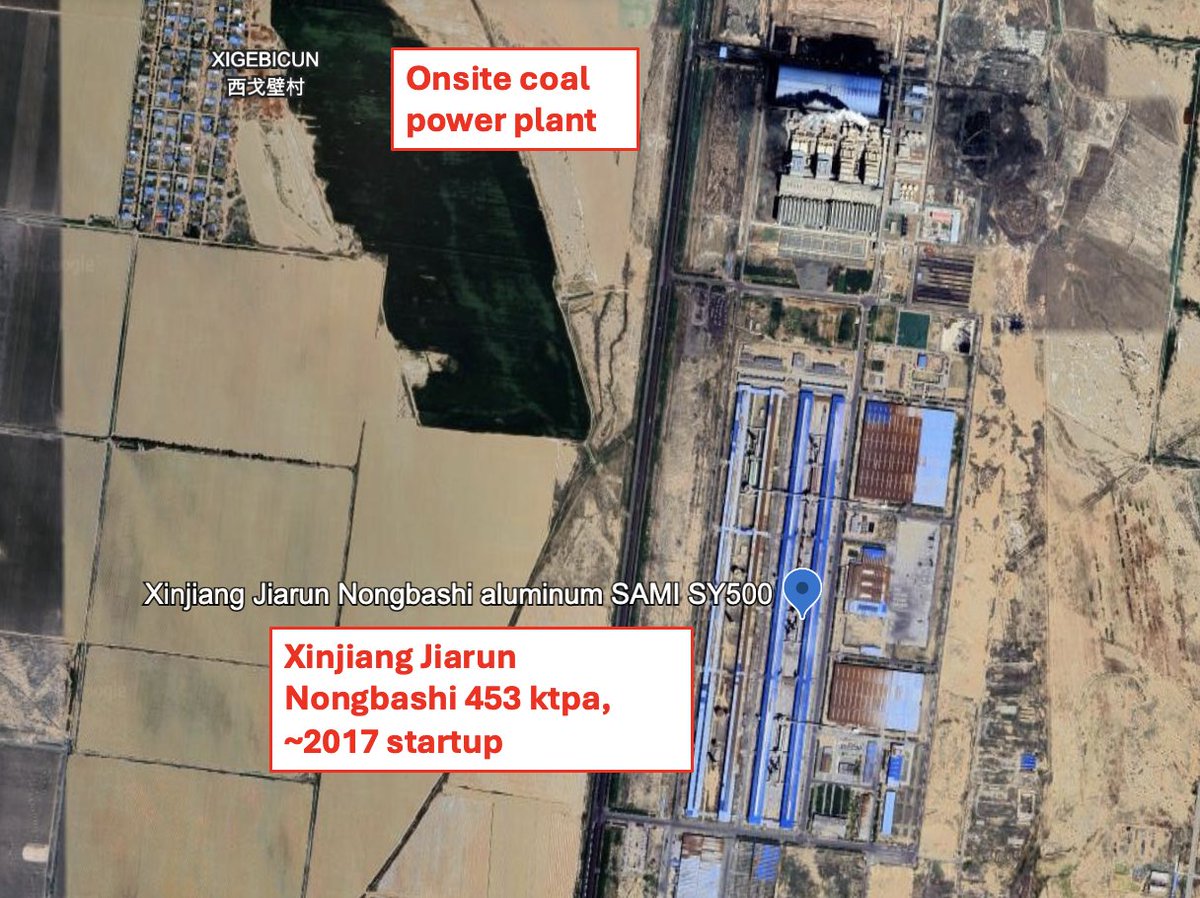
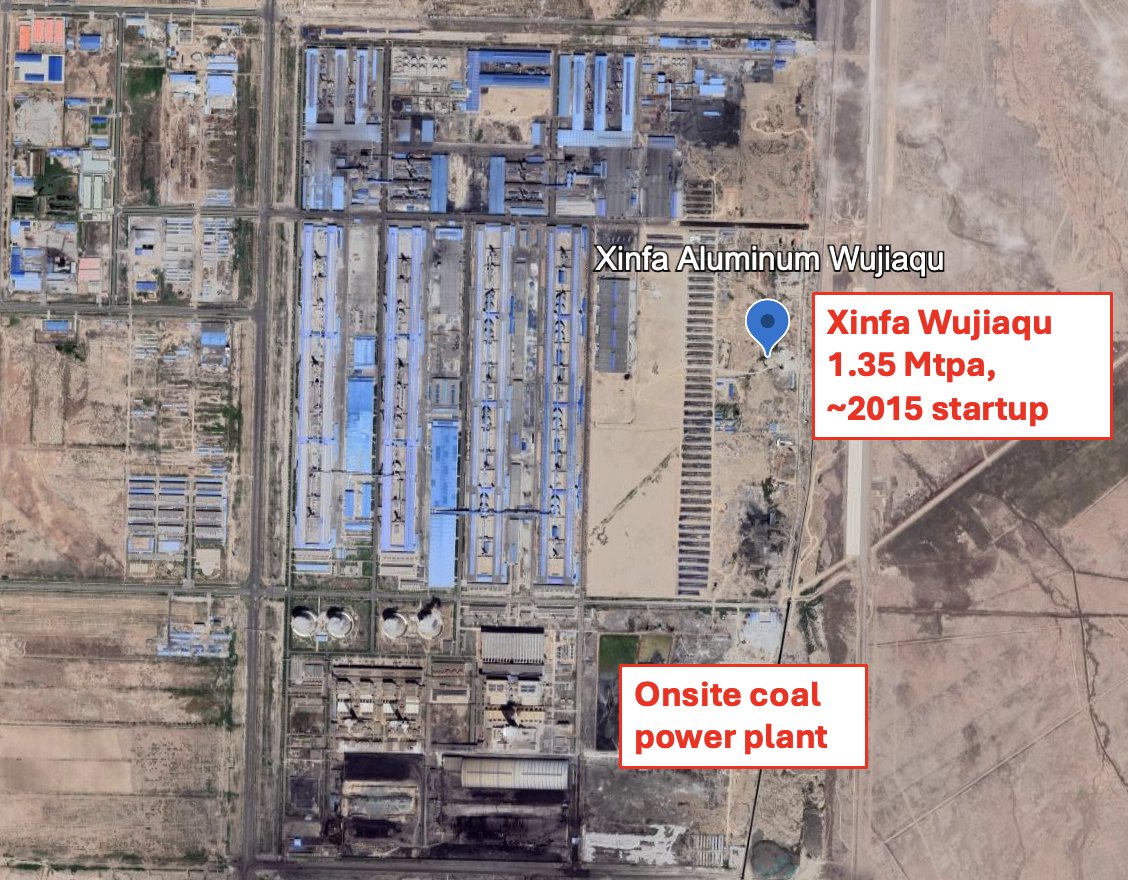
As I do think it’s useful for the climate folks and what I’ll call the "China futurist" folks in this convo to understand what these plants in Xinjiang + Inner Mongolia look like, I’m going to show each of them here while I lay out some thoughts. 🧵

Tianshan Aluminum, Xinjiang 44°25'N 86°04'EImage
Why is this important? I don’t think there’s any question solar/wind will supply much of our future energy. The risk is this:
Hallucinating that solar/wind are *already* cheaper than fossils for directly supplying heavy industry will skew policy + advocacy over the next 5 yrs, lead to inevitable disappointment, and end up further entrenching Chinese dominance of strategic manufacturing.

Xinjiang Jiarun 44°18'N 86°25'EImage
After all, low Chinese solar/wind/battery project costs are likely at the extreme end of what Europeans, Japan, or CAN/AUS/US could hope to bring about 5 yrs from now. If not even the Chinese are jumping to build fully green-powered industrial complexes now, how can leapfrogging towards a solar/wind electrostate vision for say Europe be the key to reasserting industrial competitiveness?

Xinfa Wujiaqu 44°16’N 87°42'EImage
Read 18 tweets
Sep 18, 2025
Amused that Alexander Zaitchik @newrepublic attacks @billmckibben’s citation of my paper on clean tech minerals in critiquing McKibben’s “ecomodernist optimism” on green growth, yet doesn’t point to anything specifically wrong with my research.

Spoiler: I’m right.🧵 Image
I think this is an example of the shallowness of some pushback against ecomodernism. Despite revering "scientific" refutations of growth, critics often don’t actually read underlying research, let alone offer specific critiques of research they dislike.

newrepublic.com/article/199748…
Zaitchik’s core critique of my work is:
- I find global mineral reserves suffice for decarbonizing the power generation sector to 2050 for nearly all minerals in 75 scenarios.
- but another Cornell/UMichigan study finds copper can’t “be mined fast enough” to electrify the US.
Read 17 tweets
May 7, 2025
Ketan mocks inertia chatter re: Spain outage while misunderstanding inertia. Inertia doesn’t scale with generation output but rather with spinning generator mass. Spain had 4 reactors online, 2 at 70% power. Inertia equivalent to 4 reactors at full power!

More thoughts below.🧵 Image
In his blog post + thread, Ketan shares ~10 graphs of Spanish grid data to show how in April 2025 Spain’s nuclear fleet was generating at historic record lows. Except it’s largely misleading as nuclear generation is a poor proxy for the % of grid-forming resources on the grid. Image
Inertia scales w kinetic energy of spinning generators, which are synced to grid at fixed rpm even if output to the grid is reduced.

Spain: 2/4 nuclear units at 70% power but inertia equiv to 4 units at full power. This is in line with other past spring/fall shoulder seasons. Image
Read 31 tweets
Mar 11, 2025
21 House Republicans just wrote a letter urging continued IRA energy credits. Most have solar/wind projects or clean tech factories in district, or are in swing districts. THREAD🧵

Arizona 6th - Juan Ciscomani - Many solar projects. Battery factories in Tucson. Swing district. Image
California 20th - Vince Fong - Bakersfield area, R+16 district but lots of solar and amazing solar resource potential especially to the southeast near Edwards Air Force Base, some good wind resource in the Tehachapi Mountains. Image
California 22nd - David G. Valadao - Bakersfield area neighboring the 20th district, lots of solar developments in the larger I-5 highway corridor. Competitive district. Image
Read 22 tweets
Apr 25, 2024
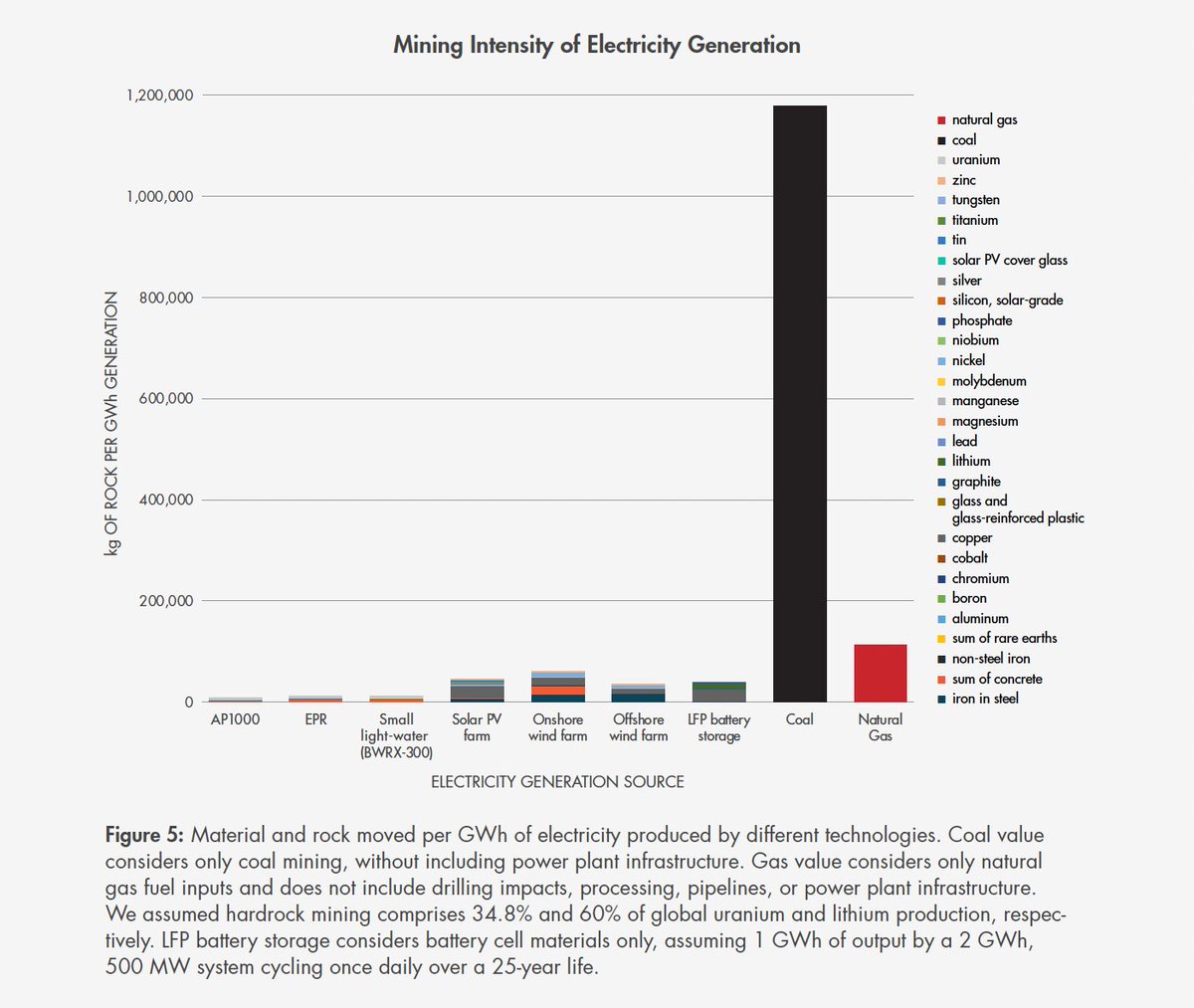
To supply low-carbon power to a grid via nuclear, solar, wind, or grid batteries, how much material must we dig up to build those power plants?
Answer: far less than for fossil fuels, with nuclear needing the least mining. New @TheBTI report by my team:
thebreakthrough.org/issues/energy/…
Image
Big takeaways:
Coal? Digs ~1.18 million kgs of rock+coal per GWh for fuel only
Solar+wind have improved much in last 10 yrs
Nuclear still needs least mining + critical minerals per GWh
Cu, steel, Ni, Li, U, Ag offer ways to improve mining footprint further
thebreakthrough.org/issues/energy/…
What inspired this analysis? Energy transition mining remains divisive, but discussions often cite flawed or out-of-date data, or end up handwavy. For this analysis, we wanted to make an up-to-date comparison, w transparent methodology using public sources
apps.openei.org/REMPD/
Read 24 tweets

Did Thread Reader help you today?

Support us! We are indie developers!


This site is made by just two indie developers on a laptop doing marketing, support and development! Read more about the story.

Become a Premium Member ($3/month or $30/year) and get exclusive features!

Become Premium

Don't want to be a Premium member but still want to support us?

Make a small donation by buying us coffee ($5) or help with server cost ($10)

Donate via Paypal

Or Donate anonymously using crypto!

Ethereum

0xfe58350B80634f60Fa6Dc149a72b4DFbc17D341E copy

Bitcoin

3ATGMxNzCUFzxpMCHL5sWSt4DVtS8UqXpi copy

Thank you for your support!

Follow Us!

:(