New preprint: "PopART-IBM, a highly efficient stochastic individual-based simulation model of generalised HIV epidemics developed in the context of the HPTN 071 (PopART) trial" with Mike Pickles, @dr_anne_cori @p_robot and friends. 1/n medrxiv.org/content/10.110…
A few years we found we needed an agent based model to simulate interventions against the HIV pandemic in southern Africa, and ended up developing a new one. We found that with heterogeneities and detailed interventions, ABMs were more parsimonious than compartmental models. 2/n
So we set out to develop a model that was, to paraphrase, "as simple as necessary, but no simpler". We wanted it to be computationally efficient so as to be able to do parameter sweeps and inference. Here it is 3/n github.com/BDI-pathogens/…
It simulates what we think we needed. A lot of parameters and computations are linked to the dynamic sexual network. 4/n Image
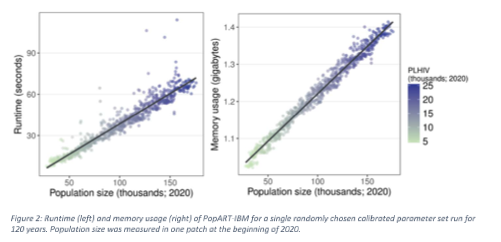
It's pretty nifty on a laptop. 5/n Image
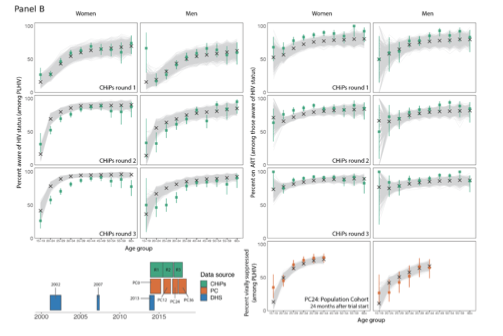
You can do Bayesian fitting to a whole lot of summary statistics 6/n. Image
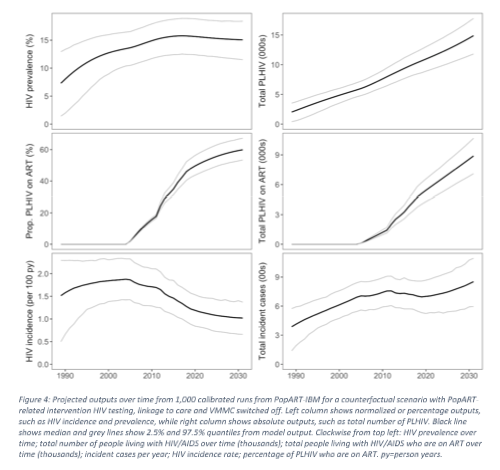
Epidemic curves describe the epidemic in the communities where we working in Zambia and South Africa. The numbers are always quite shocking. 7/n Image
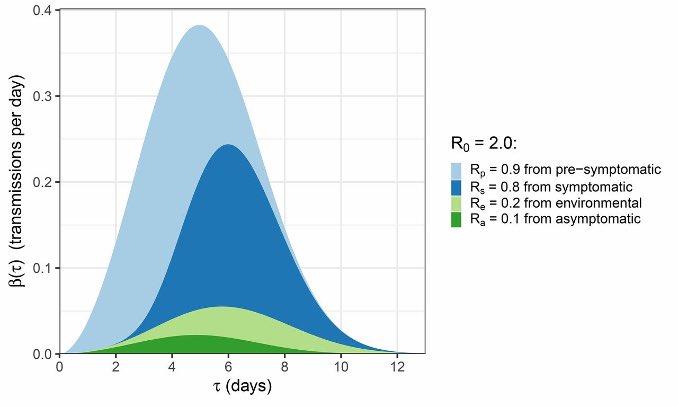
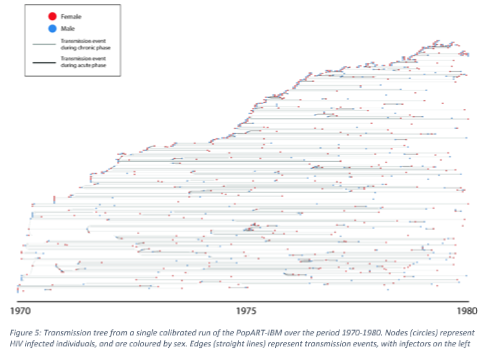
The model simulates individual transmission events, and the best fit epidemics have an interesting mix of transmission types, with two visible tempi of transmission. Clusters of rapid transmission, interspersed with long periods before the next cluster. 8/n Image
The model has limitations. Only heterosexual transmission is modelled. There are no key populations. 9/n
Recently, Rob Hinch has been re-coding to make it easier to make changes. Some of the coding concepts have made it into our COVID-19 simulator. 10/n github.com/BDI-pathogens/…
The work was done together with many wonderful collaborators from the HPTN 071 PopART trial 11/n nejm.org/doi/full/10.10…
Coming soon: to test the predictive ability of the model, we posted predictions from the model before the trial was unblinded. We will publish this alongside some learnings from re-fitting the model to the trial outcome. 12/end
Postscript 1: we welcome collaboration on using & extending this model. Our recent experience with OpenABM-Covid-19 shows that with generic network simulation, custom transmission and interventions, and a strong unit testing framework, this code is ready for collaboration. 13/12

• • •

Missing some Tweet in this thread? You can try to force a refresh
 

Keep Current with Christophe Fraser

Christophe Fraser Profile picture

Stay in touch and get notified when new unrolls are available from this author!

Read all threads

This Thread may be Removed Anytime!

PDF

Twitter may remove this content at anytime! Save it as PDF for later use!

Try unrolling a thread yourself!

how to unroll video
  1. Follow @ThreadReaderApp to mention us!

  2. From a Twitter thread mention us with a keyword "unroll"
@threadreaderapp unroll

Practice here first or read more on our help page!

More from @ChristoPhraser

30 May
“England 'risks Covid-19 surge' without test-and-trace safety net” I agree, and am concerned about rapid easing of lockdown. 1/n. theguardian.com/world/2020/may…
The ONS reports around 8,000 new infections per day, and that has not been declining quickly. 2/n ons.gov.uk/peoplepopulati…
The central estimate for the number people positive for currently shedding virus is 148,000 people for 27 April to 10 May, 137,000 people for 4 May to 17 May and 133,000 people for 11 May to 24 May. This indicates R very close to 1 during May. 3/n ons.gov.uk/peoplepopulati…
Read 8 tweets
9 May
Digital contact tracing may contribute to epidemic suppression of COVID. What are the trade-offs in choosing centralised or decentralised systems? . 1/n

github.com/BDI-pathogens/…
There are three broad aims to be optimised: prevention of infection and disease, minimisation of disruptive requests to isolate, and maximisation of privacy. 2/n
A clear assessment requires acknowledging that we don't know as much as we’d like about the details of how this virus spreads. And nor do we know enough about the context of how this intervention fits in broader public health measures that will get us safely out of lockdown. 3/n
Read 15 tweets
25 Apr
@yhgrad @nicolamlow @nataliexdean @EHaroz @DFisman @marcelsalathe @eggersnsf @jackiecassell @profhelenward Important point. It's not either/or, and in context the money is not the issue. Digital contact tracing solves the problem of speed and recall bias, which is critical when faced with pre-symptomatic transmission and transmission from mild infections.
@yhgrad @nicolamlow @nataliexdean @EHaroz @DFisman @marcelsalathe @eggersnsf @jackiecassell @profhelenward But to work, digital contact tracing needs support to reinforce messages, to provide information and reassurance, and crucially, to reach communities where uptake will be poor. We need to invest in multiple strategies, and build up evidence of what works and how to link together
@yhgrad @nicolamlow @nataliexdean @EHaroz @DFisman @marcelsalathe @eggersnsf @jackiecassell @profhelenward So digital contact tracing isn't about undercutting investment in vital services, its about solving a problem that is very hard to solve otherwise, how to get the message that someone is a contact of a suspect or confirmed case fast enough for it to be useful.
Read 7 tweets
4 Apr
“Quantifying SARS-CoV-2 transmission suggests epidemic control with digital contact tracing” science.sciencemag.org/content/early/… 1/
Isolation, contact tracing, and quarantine are proven methods of infection control, but for COVID-19 conventional tracing is too slow. 50% of transmissions happen before symptoms, so the epidemic is always a step ahead. 2/
Because it is near instantaneous, digital contact tracing changes that: if people install an app that ‘remembers’ contacts for them, and those contacts are instantly notified on diagnosis, this cuts a week of the whole process of contact tracing. 3/
Read 15 tweets
16 Mar
"Sustainable containment of COVID-19 using smartphones in China: Scientific and ethical underpinnings for implementation of similar approaches in other settings"

github.com/BDI-pathogens/…
This is work with clinical-scientist @OxfordViromics and ethicist @michaelethox . We'll be following up with the analytics piece soon.
We'll be updating the docs on the github. Some of this is on medarxiv, but I think they are swamped so we can update this version quicker.
Read 24 tweets
29 Feb
Discussions emphasising 'COVID19 is more serious than flu' will probably become moot in the coming days and weeks, and for many people already have, but in case you are engaged in them, I would consider trying to get accurate numbers for flu, and to make some general points. 1/n
First off, flu mortality is sufficiently low that it is hard to measure, and requires a degree of modelling just to get at. That in itself tells you something. 2/n
Second, the vast majority of flu cases are not reported or diagnosed, so data are pieced together from various surveillance systems and studies. 3/n
Read 15 tweets

Did Thread Reader help you today?

Support us! We are indie developers!


This site is made by just two indie developers on a laptop doing marketing, support and development! Read more about the story.

Become a Premium Member ($3/month or $30/year) and get exclusive features!

Become Premium

Too expensive? Make a small donation by buying us coffee ($5) or help with server cost ($10)

Donate via Paypal Become our Patreon

Thank you for your support!

Follow Us on Twitter!