Many pointing to studies that $600/week did not increase disincentives. Those studies relevant in saying that policy was good in April, May and June. But they have limited relevance for how to set policy in Dec and Jan when economy will be very different than it was in lockdown.
Moreover, part of why the $600 didn’t cause disincentives is that many expected them to be temporary so would rather be in a job. If they had been smoothly extended through January as many originally wanted that would have undone some of that temporary expectation.
Supporters of triggers and enhanced automatic stabilizers should ask themselves what formula they would have for unemployment benefits. Would you pre-specify that at 8% UR it would be $600/week? And if so was it WAY too low with UR of 15% in the spring?
Even if the weekly boost came down to $400 that would be much higher than the $25 per week in the last recession and enough to ensure that about two thirds of workers were getting more from unemployment benefits than they had been paid on their jobs:
It is too late to shift to replacement rates instead of flat dollar amounts. But that should be a priority for the future. Until then, we should adjust the flat weekly amount based on economic circumstances to balance support for consumption with fairness/work incentives.
• • •
Missing some Tweet in this thread? You can try to
force a refresh

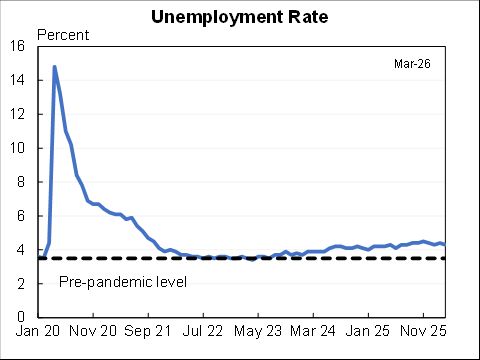
Jobs report uniformly weak: 92K jobs lost (with job losses in almost every industry), household survey employment down too, unemployment rate up to 4.4%, participation down, avg weekly hours flat.
Main sign in the other direction was strong wage growth.
The dynamics for private employment look just like overall (86K lost in private with govt basically flat.
Unemployment rate still stable or slightly rising. Breakeven job growth is in the 25-50K range so negative jobs months will be more common and normal going forward. Note 3-month moving average of jobs is 6K so a bit below this range.
More than *all* of the jobs added over the last year have been in private education & health services.
Total jobs: 359K
Private education & health services: 773K
All other sectors: -414K
This might look surprisingly unbalanced. It's actually the opposite.
A 🧵
Here is percentage job growth across sectors over the last year. Dropping the two most extreme they range from 0.8% for leisure & hospitality to -1.5% for information, a 2.2pp difference.
(Note this post generally uses 3 month moving averages to smooth otherwise volatile data.)
This is job growth in 1996. It looks more balanced than 2025 because every industry added jobs. But actually the gap between the second highest (professional services at 5.1%) and second lowest (mining at 0.4%) is 4.7pp. Much more dispersed than this year.
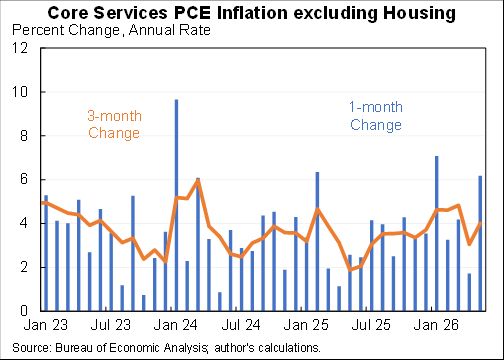
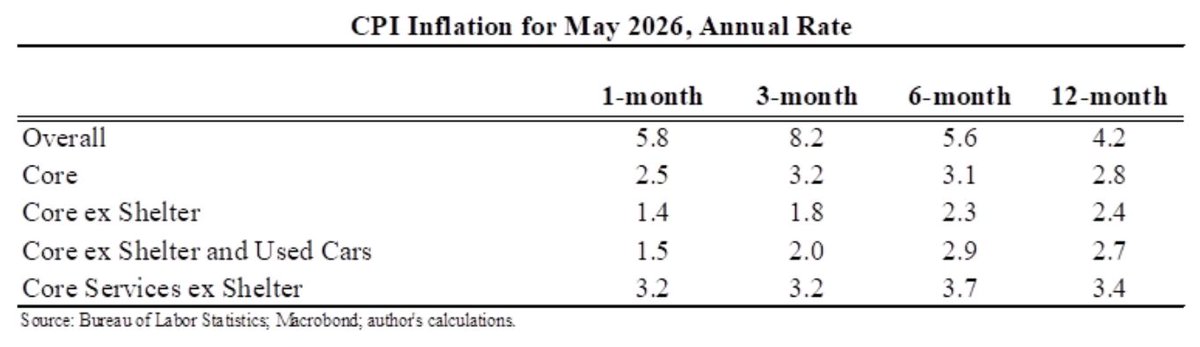
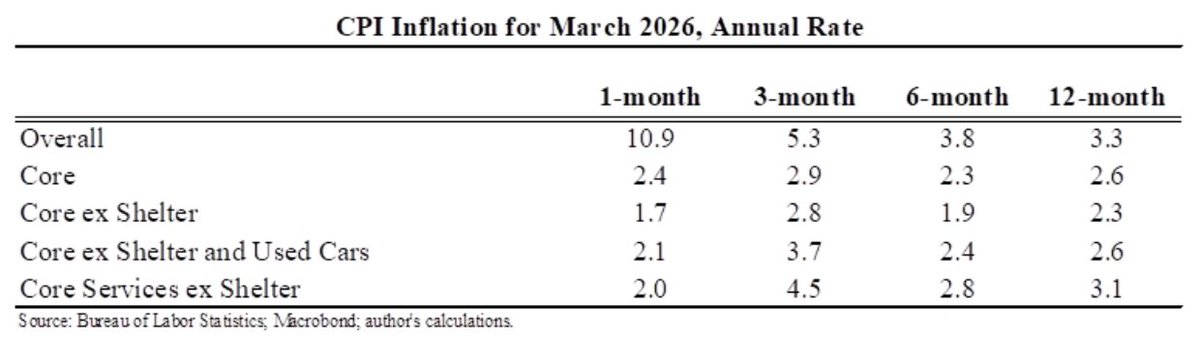
Core CPI inflation rose during the month of January. But it fell and was relatively muted over longer periods of time--although still some concern the numbers a bit lower due to shutdown-related quirks.
On the surface a strong jobs report (130K jobs & unemployment falls to 4.3%).
And just about every detail makes it even stronger: participation up, involuntary part-time down, hours up, wages up.
The mystery of strong GDP and weak jobs is being resolved in the direction of GDP.
The job growth happened despite further cuts in federal jobs. Private employment was up an impressive 172K.
Note, breakeven job growth is currently about 25-50K because of reduced net immigration & also more fully recovered participation. So job growth has slowed but the unemployment rate now seems to have stabilized after slowly and steadily increasing since mid-2023.
I will be enthusiastically supporting faculty legislation to cap the number of A's at Harvard at 20% (plus a bit). The collective action problem that has driven grades higher & higher over time is increasingly problematic. I hope other institutions consider similar steps.
I've talked to numerous colleagues & students about grade inflation. Almost all of them see it as a a problem. I've also heard about as many different ideas for solutions as I've had conversations. I would tweak this proposal in various ways. But would support it over nothing.
One place the current system fails--and it's not the only place--is honors. I'm on the Committee to recommend honors in the economics department. It's increasingly hard to distinguish excellence with so many A's. I believe that now even two A-'s makes you ineligible for Summa.