Quoted today in @axios article by @JacKnutson on tension btwn increasing copper demand for renewables and the need to significantly step up copper mining:
"a lot of people... in the clean energy sector are working very hard to reduce copper demand" (1)
For wind, official Vestas LCAs for hypothetical 50MW wind farms using V110-2.0MW, V100-2.0MW, and V90-2.0MW turbines yield copper intensities of 1740, 1700, and 3320 tons of copper/GW: (3)
As I allude to in the article, there is positive progress on these fronts though. Lots of work underway to reduce copper intensity in RE tech.
I don't think we're going to run out of copper either - global Cu resource is estimated to be ~4.5x the size of known reserves. (4)
We could also get a lot better at recycling copper at end-of-life, which could substantially reduce future demand.
All of that said, recycling won't keep pace with a large wind/solar buildout, so the need for mining of virgin copper and Cu production increase is very real. (5)
As Jacob outlines, this comes with the potential for environmental costs, so we should do our best to make sure best practices are followed to minimize risks of air, water, and soil pollution from mining/processing activities. (6)
However, I think it is important to keep in mind that realistically, many "extractive" industries aren't going anywhere. The circular economy isn't realizable anytime soon, and we WILL need mines to support the clean energy transition.
We need to come to terms with that! (END)
• • •
Missing some Tweet in this thread? You can try to
force a refresh

Amused that Alexander Zaitchik @newrepublic attacks @billmckibben’s citation of my paper on clean tech minerals in critiquing McKibben’s “ecomodernist optimism” on green growth, yet doesn’t point to anything specifically wrong with my research.
Spoiler: I’m right.🧵
I think this is an example of the shallowness of some pushback against ecomodernism. Despite revering "scientific" refutations of growth, critics often don’t actually read underlying research, let alone offer specific critiques of research they dislike.
Zaitchik’s core critique of my work is:
- I find global mineral reserves suffice for decarbonizing the power generation sector to 2050 for nearly all minerals in 75 scenarios.
- but another Cornell/UMichigan study finds copper can’t “be mined fast enough” to electrify the US.
Ketan mocks inertia chatter re: Spain outage while misunderstanding inertia. Inertia doesn’t scale with generation output but rather with spinning generator mass. Spain had 4 reactors online, 2 at 70% power. Inertia equivalent to 4 reactors at full power!
More thoughts below.🧵
In his blog post + thread, Ketan shares ~10 graphs of Spanish grid data to show how in April 2025 Spain’s nuclear fleet was generating at historic record lows. Except it’s largely misleading as nuclear generation is a poor proxy for the % of grid-forming resources on the grid.
Inertia scales w kinetic energy of spinning generators, which are synced to grid at fixed rpm even if output to the grid is reduced.
Spain: 2/4 nuclear units at 70% power but inertia equiv to 4 units at full power. This is in line with other past spring/fall shoulder seasons.
21 House Republicans just wrote a letter urging continued IRA energy credits. Most have solar/wind projects or clean tech factories in district, or are in swing districts. THREAD🧵
Arizona 6th - Juan Ciscomani - Many solar projects. Battery factories in Tucson. Swing district.
California 20th - Vince Fong - Bakersfield area, R+16 district but lots of solar and amazing solar resource potential especially to the southeast near Edwards Air Force Base, some good wind resource in the Tehachapi Mountains.
California 22nd - David G. Valadao - Bakersfield area neighboring the 20th district, lots of solar developments in the larger I-5 highway corridor. Competitive district.
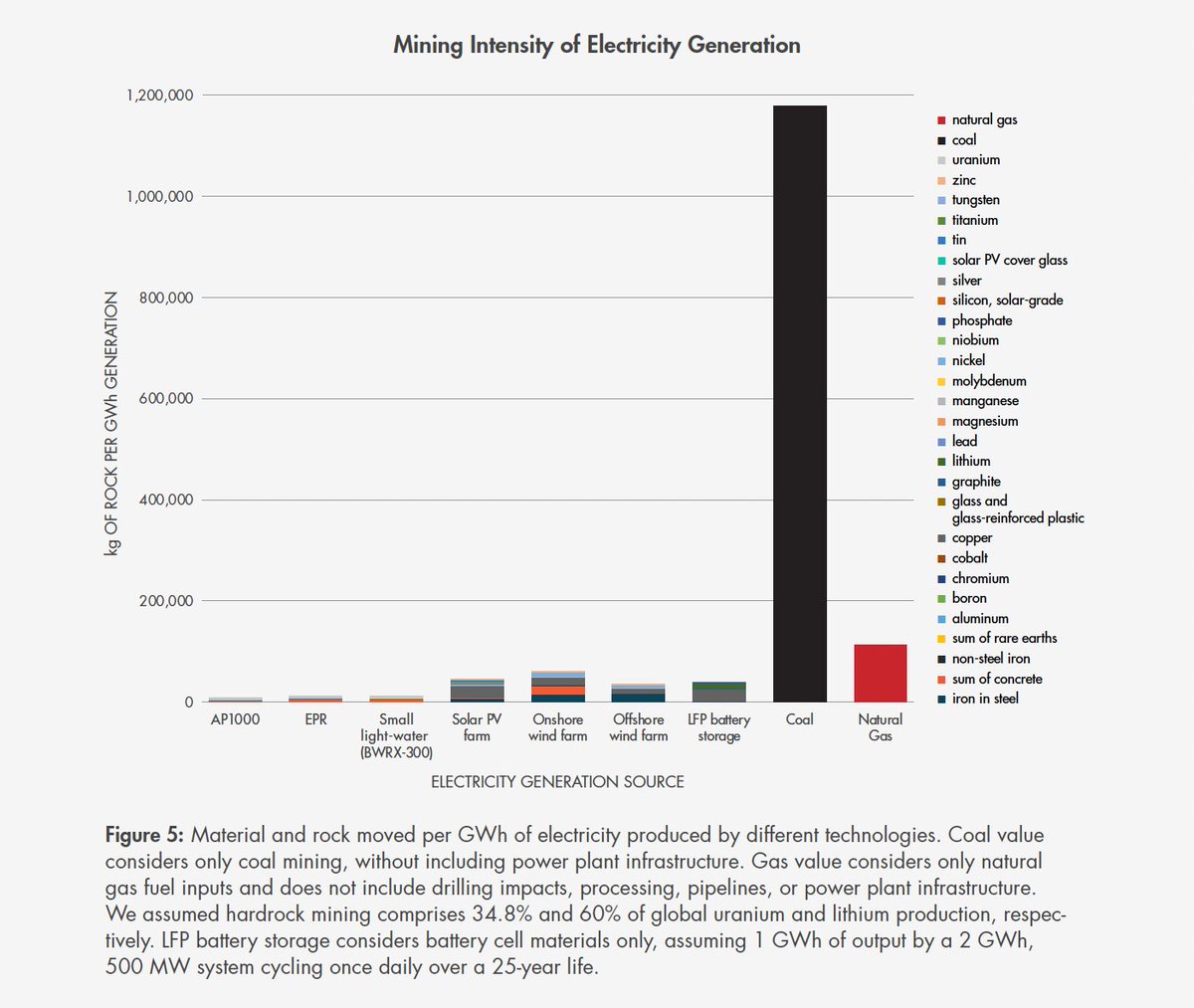
To supply low-carbon power to a grid via nuclear, solar, wind, or grid batteries, how much material must we dig up to build those power plants?
Answer: far less than for fossil fuels, with nuclear needing the least mining. New @TheBTI report by my team: thebreakthrough.org/issues/energy/…
Big takeaways:
Coal? Digs ~1.18 million kgs of rock+coal per GWh for fuel only
Solar+wind have improved much in last 10 yrs
Nuclear still needs least mining + critical minerals per GWh
Cu, steel, Ni, Li, U, Ag offer ways to improve mining footprint further thebreakthrough.org/issues/energy/…
What inspired this analysis? Energy transition mining remains divisive, but discussions often cite flawed or out-of-date data, or end up handwavy. For this analysis, we wanted to make an up-to-date comparison, w transparent methodology using public sources apps.openei.org/REMPD/
From 2018 to 2023, silver use in solar PV cells has dropped by around half! (h/t @solar_chase)
Indeed academic papers (incl my own) tend to lean several yrs out of date. But industry intel is often paywalled, hence my habit of obnoxiously saving whatever nuggets I come across.
This is a clear example of why getting the stamp of peer-review doesn't mean something is right or the golden truth of science.
The most crucial round of peer review is really the permanent, continuous reactions/feedback from other experts once a study is actually publicly read.
I had assumed 10g per watt in my @Joule_CP paper, and had thought afterwards that might've been generous--but now it's right on the money.
Where I was way off was concrete, which is no longer used to anchor solar mountings in most utility-scale plants.
Finally found time yesterday evening to take an unofficial satellite's-eye-view tour of the quasi-legendary Spruce Pine ultra-high-purity quartz mine in North Carolina.
It'd be an understatement to say this mine is currently key to the semiconductor + solar PV industries. 🧵
IIRC, there's no other ultra-high-purity quartz mine of this scale, creating quite the potential bottleneck. A fire at a Spruce Pine facility may have contributed to the 2008 spike in polysilicon prices that arguably set off the last decade's solar boom.
Ultra-high-purity quartz is used for chip factory tools + crucibles used to contain molten silicon during manufacturing of ultrapure monocrystalline silicon ingots for chips + solar PV wafers via the Czochralski process. Pure quartz reduces impurities in the resulting product.