
Debate in @ScotParl now about the draft Hate Crime and Public Order (Scotland) Bill: scottishparliament.tv
Tory MSP Liam Kerr says goal should be "unambiguous law without unintended consequences" and notes the "extraordinary timetable in the middle of a pandemic".
The Justice Committee has received 2,000 submissions which is the highest number received in this session of Parliament.
Says there are questions that must be addressed about whether the bill as drafted sends a message that "sex-based hatred is of less importance" and whether a standalone offence of misogyny is the right approach.
Thinks consideration of and decision regarding inclusion of sex as a protected characteristic is "too important to be left to secondary legislation".
Cites evidence from charity dsdfamilies vis-a-vis inclusion of 'variations of sex characteristics' as a protected characteristic, saying this is "a highly sensitive area" and "consideration must not be rushed".
Rona Mackay intervenes to note that a number of women's organisations support the inclusion of a standalone offence of misogyny.
Patrick Harvie intervenes to note that "pro-equality organisations argue in favour" of the new stirring up offences in Part 2 of the draft bill.
Liam Kerr cites evidence from @ForwomenScot and concerns about the potential chilling effect and impact on freedom of expression of new stirring up offences.
He goes on to say that "scrutiny not possible in a crowded parliamentary timetable".
Liam Kerr's motion is here: 

Minister Humza Yousaf welcomes the debate and says he doesn't doubt for a minute the sincerity of other members to tackle hate crime.
SG will "work tirelessly" with members and stakeholders on the bill. "Legislation in itself not enough to build an inclusive society" but having hate crime legislation shows that this behaviour will not be tolerated.
Making the case for the new stirring up offences, Yousaf notes threats he has received "all because of the colour of my skin".
Intervention from Liz Smith MSP saying "interpretation [of the bill] is open to so much chance and dispute".
Yousaf "all we are doing is replicating language" when extending the stirring up offence beyond race.
"This year is three years in the making since Lord Bracadale began his review" says Yousaf.
Notes "really powerful contribution" from Victim Support Scotland.
Patrick Harvie asks whether Minister agrees that the proposed new stirring up offence give clarity and that aggravated offences are "much vaguer".
Yousaf does not doubt there are some legitimate concerns that people have in relation to the stirring up offences and says he will listen to stakeholders and will actively look to see where we can find compromise.
Liam Kerr asks if Minister accepts that there is a danger Part 2 will take "all the oxygen and all that scrutiny" to the detriment of concerns about other sections of the bill.
Yousaf says he hopes Conservatives will not "torpedo" the bill in this parliament. The Minister's motion is here:
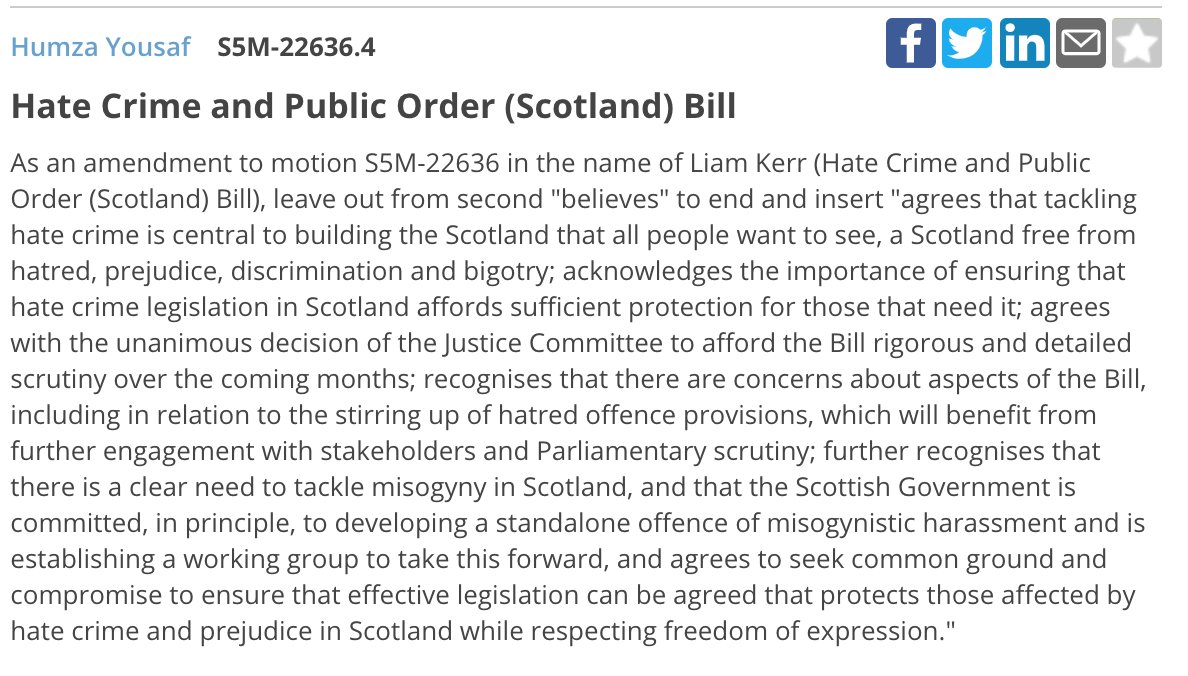
Labour MSP Rhoda Grant speaking now. Highlighting social media giving a new platform for expressing hatred and saying she knows what it is to be on the receiving end of misogynistic hatred.
Grant asks "why do women have to wait so long for this?" and that it's taking far too long.
"Freedom of speech must be protected". Says legislation is "not fit for purpose".
"It will catch much more than hate crime...the opposition of what it is meant to achieve" says Grant.
Concerned about the legal threshold and the fact that there is no need to prove intent, only that it need be shown to be 'likely' to stir up hatred.
Rhoda Grant's motion is here:

"... the door is left open is to stymy debate" saying "the government need to listen to concerns...and make sure it works for all Scots" says Grant.
Says SG must listen to the concerns expressed. Grant notes that "If they cannot do this, we will withdraw our support."
Green MSP John Finnie moves amendment in his name.

Finnie says freedom of expression right is not unqualified.
On misogynistic harassment "that is unfinished work".
Finnie says he has every confidence the Justice Committee will look at this. Has "every confidence in our system of parliamentary scrutiny".
Liberal Democrat MSP Liam McArthur speaks. His amendment is here:

"Scotland is not immune to racism or prejudice" says McArthur. "Of course freedom of speech is not and should not be an unfettered right. Balances must be struck."
Quotes Lord Justice Sedley: "Freedom only to speak inoffensively is not worth having".
The concerns we have seen regarding freedom of expression need to be taken seriously, says McArthur.
Notes the breadth and volume of opposition to Part 2 of the bill. "How has the government managed to antagonise so many?...it bears uncomfortable echoes with the Offensive Behaviour at Football Act."
Says Minister must do more than just hear the concerns. Thinks the government must set out its proposals before Stage 2 during a process "that is already tight for time".
In its current form, says Liberal Democrats cannot support the bill.
Rona Mackay MSP believes bill will not stifle freedom of expression.
Mackay says she is pleased the standalone offence of misogyny is going to be considered by a working group and notes it is supported by many women's groups.
Murdo Fraser MSP notes current court case relating to the attack on satirical magazine Charlie Hebdo. Recalls the solidarity shown after the attack in defence of freedom of speech.
Fraser states support for the abolition of the offence of blasphemy but thinks Part 2 of the draft bill will effectively try to introduce blasphemy law "in another guise".
It would be a "rich irony" if we introduced a law here that would see Charlie Hebdo's cartoon prosecuted.
References the debate about gender. In an open liberal and democratic society, people should be able to debate "in robust terms". Fraser says he is concerned about 'cancel culture'. Notes attacks on Germaine Greer and J K Rowling for stating a biological fact.
He quotes George Orwell "if liberty means anything at all it means the right to tell people what they don't want to hear".
Says the SG needs to think again when it comes to this bill. Invites members to support the motion in Liam Kerr's name.
Fulton MacGregor says he thinks the Kerr motion comes at it from the wrong angle. Acknowledges there are some concerns about the bill. Says he looks forward to scrutinising it as a member of the Justice Committee.
Says existing stirring up racial hatred offences have been working "effectively", something we considered in this recent blog: murrayblackburnmackenzie.org/2020/08/28/the…
MacGregor states that "this bill sends a clear message to society".
He notes that "the bill is supported by a large number of stakeholders", citing the Equality and Human Rights Commission, Equality Network, Victim Support Scotland and BEMIS.
Mary Fee says Labour is supportive of overall principles of the bill. Says it's important to consolidate into one Act of parliament. But says bill is "far from ready".
Says SG must work with stakeholders who have concerns about the bill and there "must be balance" in safeguarding protected groups from hatred and the right to freedom of speech.
"Negatively impacting the right to free speech is a line no democratic government must cross. Part 2 creates more problems than it solves."
Says she does not agree that the bill is sinister but that it is open to interpretation and does not want to see a repeat of the OBFA. Must not put police officers in a difficult position.
Ruth Maguire says "we must strike the right balance between all rights including free speech".
"Freedom of expression is a cornerstone of democracy. It is protected by Article 10 and carries with it duties and responsibilities."
Says she agrees with the Humanist Society and their concerns about freedom of expression. "To progress as a country we have to have that discourse."
Maguire is concerned that currently women campaigning for their sex-based rights are being targeted. Thinks it would be reassuring if Minister could say when the working group to consider the inclusion of sex as a protected characteristic will be established.
Liz Smith speaks about the fundamentals of what constitutes 'good law': clarity of purpose, to be understood in simple language, strong in its evidence base, workable and accepted by public. It represents the balance of the requirement for simplicity with legal precision.
She cites the Named Person legislation which was struck down in the UK Supreme. She compares it with the draft hate crime bill.
Says public "can see the glaring flaws all too clearly". Says SG is not listening to legal advice, police or many stakeholders. "If we proceed with this bill...we will be making bad law."
John Mason highlighting ongoing sectarianism in Scotland.
Agrees with abolition of offence of blasphemy and that he believes church and state should be separate.
Adam Tomkins cites defamation bill and the balancing of rights to freedom of speech and right to privacy.
Bill raises "extremely sensitive questions" about freedom of expression. Hopes justice committee and wider parliament will debate in the "same spirit" as the debate about the defamation bill.
Rights should be broadly and generously construed and limitations (on those rights) narrow and tightly construed. Burden rests on those who wish to curtail rights based on the test of necessity.
Does not want to see draft hate crime bill suffer the same fate as Named Person and OBFA.
It will be quashed in the courts or repealed. "We can get it right first time." We need robust and forensic scrutiny. We must make "good laws for the people of Scotland".
Shona Robison says important to remember origins of bill: Lord Bracadale's review. Says Conservative MSPs have "jumped on the bandwagon" following publicity about the bill.
Liam McArthur asks whether she would agree it would be helpful for the government to make clear its response to the concerns voiced before Stage 1.
Our job as legislators and parliamentarians is to get on with scrutiny and not just listen to "those voices that happen to be louder". She then quotes CEO of Victim Support Scotland.
Johann Lamont says this bill is "clearly contentious". Pleased Minister has not "gone to a comfort zone" by seeking to delegitimise those who are concerned.
Thinks the bill has created a "false binary". Says concerns are about unintended consequences. "There is no shame in getting a proposal wrong but there is shame in digging in...as we saw with the OBFA."
Sending a message and symbolic value is not enough. Education also important.
Women MSPs have had meetings in parliament on reform of the Gender Recognition Act. And yet Patrick Harvie denounced women involved in those meetings saying that parliament was "used as a platform for transphobic hate and bigotry".
"When does legitimate debate become hatred? It cannot be sufficient that there is a common sense view. The law must be precise."
Sandra White says she has genuine concerns. Says she has asked questions of Ministers. Who defines stirring up or intention?
Graham Simpson has concerns as a former journalist. It's an attack "on what you can say and what you can write". Concerned about attacks on J K Rowling for her views on gender.
"Newspapers should be able to publish without fear or favour"
Willie Rennie thinks the debate has brought the chamber together. He believes there is a consensus about amending the bill.
Cites Scottish PEN's submission which says that this represents a "substantial expansion in the criminal law".
Lib Dems support changing Part 2 of the bill "in a substantial way" but want this to come forward before Stage 1.
Patrick Harvie says he is not interested in hearing Murdo Fraser's concerns that others have been silenced.
Says there is a broad range of views about misogynistic crimes. If there is a consensus now on that, he welcomes it.
Says "we are on broadly safe ground" with wording on new stirring up offences because there has been a stirring up offence (on race) "for decades" which is compliant with ECHR.
If the Act breaches ECHR, it can be struck down.
Harvie says existing law represents a "cluttered and fragmented landscape".
Alex Rowley says Part 2 of the bill will require "substantial revision". Says it must protect free speech rights.
Humza Yousaf thinks it has been a "very illuminating" debate. Touched on jurisprudential issues. Says "there has been a huge degree of consensus".
He is happy to give commitment to come forward with SG's response to concerns before the Justice Committee begins its scrutiny.
Recognises the concerns about the legal threshold for the proposed new stirring up offences. Says it's one area he will reflect on to see if he can give some assurances.
Liam Kerr asks about timetable. Says he will do this before the Committee begins to take oral evidence.
Re sex aggravator, he says when he met with "local feminist organisations and groups that work with women", they said that best way to address misogynistic behaviour was via a standalone offence.
Wants to assure Ruth Maguire and Johann Lamont that this is an issue he will reflect on further.
Donald Cameron says that in his view the best exposition of freedom of expression is in Article 10 of the ECHR.
"We must be cautious and careful in legislating in this area."
He cites banners used on marches for Scottish independence which say "Tory scum out" and he defends the right of people to carry that banner without fear of being criminalised.
Concern about bill affecting legitimacy the of police in the eyes of the public from the Scottish Police Federation.
He asks why are only two protected characteristics are offered protection with clauses on freedom of expression?
He has "never doubted the sincerity" with which Humza Yousaf has brought forward this bill.
"We appeal to the Cabinet Secretary to pause...because the law as drafted goes too far. It is an attack on free speech. A damaging narrative has built up...which obscures the good intentions behind it."
• • •
Missing some Tweet in this thread? You can try to
force a refresh






