Ryan Hass Profile picture
Sep 14, 2020 15 tweets 13 min read Read on X
1/ The Brookings #GlobalChina initiative is rolling out its latest round of research, this one on China’s efforts to adapt global governance to suit its aims. The following thread provides a brief summary of the research findings. brook.gs/2RfI5Gu
2/ Although China traditionally focused on the U.N.’s development activities, Beijing now flexes its muscles in the heart of the U.N. — its peace and security work. Reflections and analysis from Jeffrey Feltman via our #GlobalChina project: brook.gs/2GeFAC7 #UNGA75
3/ At times, Beijing has promoted women’s equality; at others, it has undermined civil society and human rights defenders, critical actors for advancing gender equality. @DariusLongarino explores the record: brook.gs/2Z27iIO #GlobalChina
4/ As China seeks to exert influence around the globe, Washington must invest in winning the competition of political systems, write @patrickwquirk, @DaveShullman, & @johannakao: brook.gs/3jxDVGa #GlobalChina
5/ The dangers of failing to revive climate cooperation between the U.S. and China are “unacceptably high,” writes @tsterndc via our latest #GlobalChina installment: brook.gs/3hVEZn3
6/ China is now the center of gravity for global energy markets. Will its demand continue to grow? How will China’s energy system respond to the challenges of climate change and local pollution? @samanthaenergy explains: brook.gs/3i3dveO #GlobalChina
7/ The trajectory of climate change depends on decisions about the infrastructure that Chinese entities fund abroad — decisions that result not from fiats in Beijing but from complex debates in China and beyond. New from @jeff_ball: brook.gs/2YGTuU6 #GlobalChina
8/ Much of Washington’s concern with China’s role in the global economy has to do with China’s only partial integration into global institutions, contends @davidrdollar via our #GlobalChina project. Learn what can be done: brook.gs/30WCquT
9/ Taking a page from America’s playbook, China is seeking to build a multilayered network of security institutions, partnerships, and cooperative activities that enhance its influence in Asia, writes @lindseywford: brook.gs/2DQj5me #GlobalChina
10/ Beijing is engaging more with international institutions. Is this a gain for the global human rights system? No, writes @SophieHRW in an analysis via our #GlobalChina project: brook.gs/3k5Lgx8
11/ @JimMillward & @dahlialpeterson outline heightened oppression in Xinjiang and what the U.S. and other actors can do to respond. brook.gs/2DZEbyL #GlobalChina
12/ While Beijing may dislike some aspects of U.N. peacekeeping, it appears to see greater strategic advantage in cooperating with the U.S. and other Western powers in this field, @RichardGowan1 argues. brook.gs/3mccXGr #GlobalChina
13/ China has emerged as a truly global actor, impacting every region and every major issue area. For an overview of the entire #GlobalChina project, check out: brook.gs/2l2vLNo
14/ Please tune in September 21 to join a great discussion on China’s approach to global governance and norms, featuring Jeffrey Feltman
@lindseywford
@SophieHRW
@DaveShullman
@patrickwquirk
brook.gs/3mfaURZ via @BrookingsInst
15/ Special thanks to the entire @Brookings team for producing and delivering this diverse, deeply researched content, especially @AnnaBNewby, @tedreinert, @RachelASlattery, Emilie Kimball, @rushdoshi, and @chhabrat. End.

• • •

Missing some Tweet in this thread? You can try to force a refresh

 

Keep Current with Ryan Hass

Ryan Hass Profile picture

Stay in touch and get notified when new unrolls are available from this author!

Read all threads

This Thread may be Removed Anytime!

PDF

Twitter may remove this content at anytime! Save it as PDF for later use!

Try unrolling a thread yourself!

how to unroll video
  1. Follow @ThreadReaderApp to mention us!

  2. From a Twitter thread mention us with a keyword "unroll"
@threadreaderapp unroll

Practice here first or read more on our help page!

More from @ryanl_hass

Jan 29
1/ While there are exceptions, there appears to be a trend of America's traditional allies derisking from United States. As an American who long has viewed the US global alliance network as one of its asymmetric strengths, I take no satisfaction in this observation. (short 🧵).
2/ The flow of leaders to China is striking. French, Canadian, Irish, British, Korean, Finnish, and soon German leaders visiting Beijing in recent weeks. Beijing isn't making its offering more attractive or growing less aggressive. It is presenting a predictable alternative.
3/ The EU-India trade deal is another example of efforts underway to derisk from US. There will be more examples along these lines. Canadian PM Carney's Davos speech broke through in part because it gave definition to a trend that is gathering pace.
Read 6 tweets
Jan 23
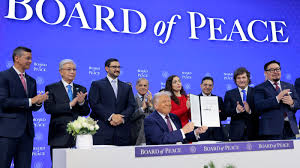
1/ China's response to Trump's invitation for Beijing to join the launch of his shambolic Board of Peace was direct - they're not interested. Officially, they cited their fidelity to the centrality of the UN as the reason for their denial. (short 🧵). Image
2/ Unofficially, Beijing likely did not want to give a boost to a US-led global initiative through its own participation. This has been a longstanding position. The US also typically withholds its participation and endorsement for Chinese-led initiatives.
3/ Privately, I expect Chinese leaders were bemused by the outcome of Trump's effort. He assembled a rogue's gallery of leaders for his launch, and in the process, advertised how much connectivity the US has lost with its closest allies and partners.
Read 6 tweets
Jan 3
1/ As details emerge about the US capture of Maduro and his wife, there will be an impulse among foreign policy analysts to draw analogies to Taiwan and to warn about Trump setting a precedent Beijing could use against Taiwan. I would caution against that impulse. (short 🧵).
2/ Beijing will be unsentimental about events in Caracas. They will move to secure their interests in Venezuela and broader region. They also will condemn US actions and aim to draw a sharp contrast with US actions by presenting themselves as committed to upholding intl law.
3/ Privately, I expect Beijing will emphasize to Washington it expects to be given the same latitude for great power exemptions to international law that the US takes for itself. In other words, Beijing will request the US mute its invocations of intl law in SCS and elsewhere.
Read 7 tweets
Dec 7, 2025
1/ I'm glad Bill (@niubi) is exploring this question. It's important and often misunderstood. The US has refrained from opposing Taiwan independence (or unification) out of deference to the principle that the US isn't the arbiter of Taiwan's future political status. (short 🧵).
2/ Instead, the US traditionally has maintained a posture of opposing unilateral changes to status quo and supporting any peaceful resolution of cross-Strait disputes that enjoys support of people on both sides of Strait. (At times, the US has said "...support of Taiwan people.")
3/ Historically, US policy has insisted on non-violent, non-coerced outcome to cross-Strait disputes while leaving it to leaders in Taipei and Beijing to determine formula. If US moves to opposing TW independence, it would begin deciding what outcomes it would/wouldn't accept.
Read 9 tweets
Nov 7, 2025
1/ I've noticed a fair bit of commentary and discussion in PRC and Taiwan media recently around whether views in the US policy community are shifting on America's support for Taiwan. As someone who lives in this community and its debates, here are a few quick reflections (🧵):
2/ I think it's fair to observe that US-Taiwan relations are evolving under Trump. The same could be said about America's relationships with virtually all its partners. Trump is de-prioritizing shared values and demanding partners contribute more to security, including Taiwan.
3/ I also think it's fair to observe that Trump's iconoclastic approach to foreign relations has opened space for debate in the US about America's role in the world. For some, Trump's approach will prod allies to become more capable and thus will strengthen US partnerships.
Read 10 tweets
Oct 28, 2025
1/ The Chicago Council published new findings on American attitudes toward China and US-China relations. The results are notable, showing that America's broader social and political divisions are now also being reflected in sentiment toward China. (🧵). globalaffairs.org/research/publi…
2/ The findings show the bipartisan consensus (on China) "no longer seems to hold among the American public. Republicans and Democrats now hold distinctly different views on a range of China-related questions. Republicans are more confident in US power...Democrats less so."
3/ Republicans "favor decoupling from China, and favor containment over cooperation. By contrast, Democrats don’t see China as a top threat, oppose decoupling, and favor cooperation over containment, especially on issues of common concern like arms control and climate change."
Read 5 tweets

Did Thread Reader help you today?

Support us! We are indie developers!


This site is made by just two indie developers on a laptop doing marketing, support and development! Read more about the story.

Become a Premium Member ($3/month or $30/year) and get exclusive features!

Become Premium

Don't want to be a Premium member but still want to support us?

Make a small donation by buying us coffee ($5) or help with server cost ($10)

Donate via Paypal

Or Donate anonymously using crypto!

Ethereum

0xfe58350B80634f60Fa6Dc149a72b4DFbc17D341E copy

Bitcoin

3ATGMxNzCUFzxpMCHL5sWSt4DVtS8UqXpi copy

Thank you for your support!

Follow Us!

:(