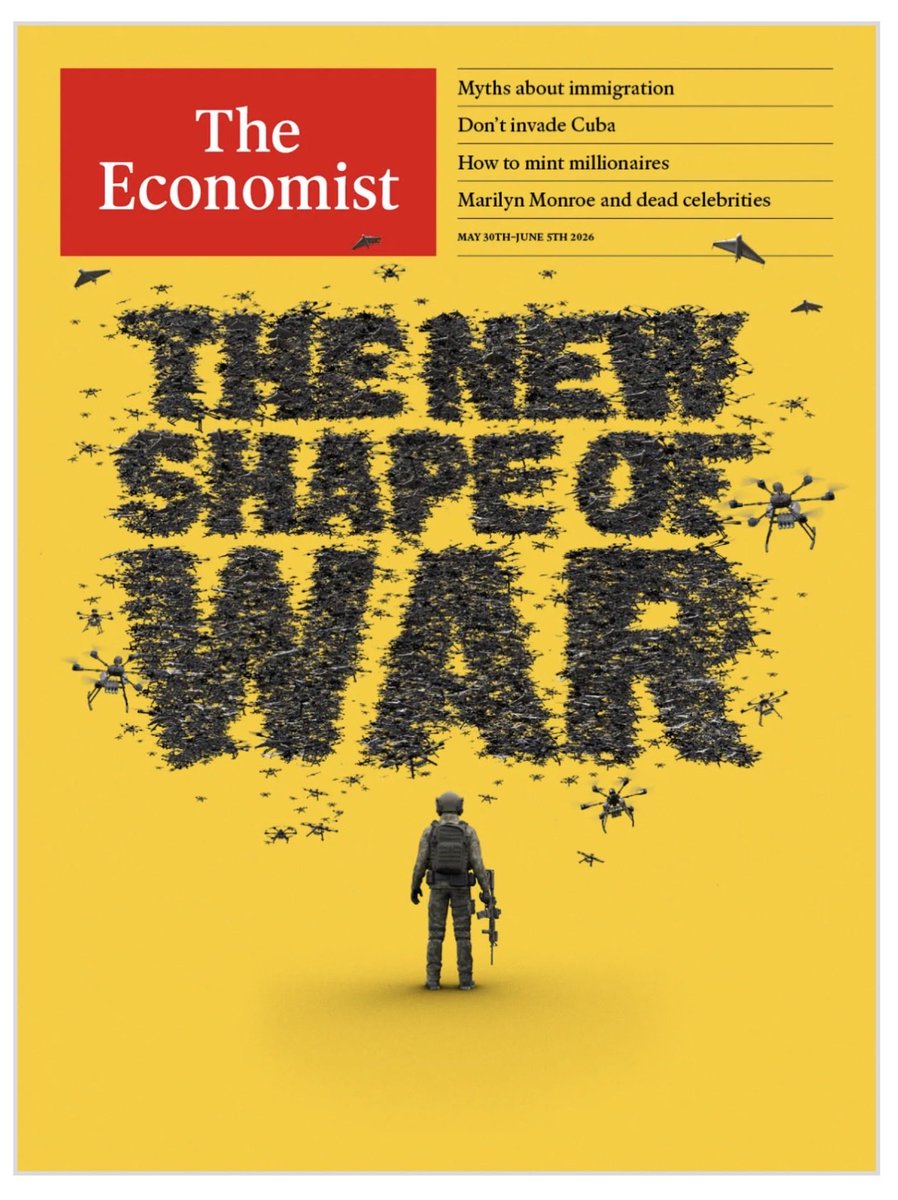
Britain is nearing the end of an "integrated review" of its defence (and foreign, security & aid) policy. Its contours are looking clearer: focus on a wider range of threats, including in "greyzone", and shift from "mass" to "speed & readiness". My piece: economist.com/britain/2020/0…
'Though Russia is ranked as the biggest military threat to Europe, China is looming as a problem. “China poses the greatest threat to world order,” says General Hockenhull, “seeking to impose Chinese standards and norms and using its economic power to influence and subvert.”...'
'...In place of “mass and mobilisation”, said [UK defence minister @BWallaceMP], “this future force will be about speed, readiness and resilience, operating much more in the newest domains of space, cyber and sub-sea” ...' economist.com/britain/2020/0…
"the emphasis on greyzone threats ... is fraught with risk ... @blagden_david ... points out that Russia’s invasion of Ukraine, which is often held up as a canonical example of greyzone war, involved several armoured divisions and veiled nuclear threats" economist.com/britain/2020/0…
• • •
Missing some Tweet in this thread? You can try to
force a refresh

1/ The UK Parliament's intelligence & security committee (ISC) has published its first full annual report in two years, covering the administration and finance of the UK intelligence community. A few highlights below. isc.independent.gov.uk/wp-content/upl…
2/ As in previous reports, the committee notes that more & more departments are doing security & intel work compared to the past, and that the ISC doesn't have sight of these. "The impact of these matters has become more serious since then," it says. isc.independent.gov.uk/wp-content/upl…
3/ ISC: "China’s state intelligence apparatus – almost certainly the largest in the world – targets the UK and its interests prolifically and aggressively, presenting a challenge for our Agencies to cover" isc.independent.gov.uk/wp-content/upl…
1/ The first of two speeches by UK military / intelligence leaders today. The later one by Rich Knighton, the new chief of defence staff. This one by Blaise Metreweli, the chief of MI6. "We are now operating in a space between peace and war." gov.uk/government/spe…
2/ Metreweli says speech is not a "global threat tour". Says China "a central part of the global transformation taking place this century" and "essential that we, as MI6, continue to inform the govt's understanding of China’s rise and the implications for UK national security."
3/ Metreweli says "Russia is testing us in the grey zone with tactics that are just below the threshold of war" and includes "Drones buzzing airports and bases." About as close to an official attribution as you're going to get. gov.uk/government/spe…
Trump's national security strategy is out and some of the Europe sections are shocking. "...the growing influence of patriotic European parties indeed
gives cause for great optimism." whitehouse.gov/wp-content/upl…
Trump national security strategy: Make Europe White Again.
"Over the long term, it is more than plausible that within a few decades ...certain NATO members will become majority non-European"
"the real and more stark prospect of civilizational erasure"
As far as I can see, this nat sec strategy is far harsher on Europe than on Russia. There is no mention of a threat from Russia or of deterrence, only that "re-establishing strategic stability" is a priority. Europe is cast as a major threat to freedom.
The proposal is nothing short of a very bad joke. I mean, read this:
"$100 billion in frozen Russian assets will be invested in US-led efforts to rebuild and invest in Ukraine;
-- The US will receive 50% of the profits from this venture."
The fact that this absurd and unworkable clause is in there is itself a suggestion that the proposal is the basis for further negotiation and not a "take it or leave it"
"military assessments seen by the FT show that Yantar was one of several Russian naval vessels that congregated in UK waters for 13 months of sustained surveillance around nodes of critical infrastructure starting in the autumn of 2023." ft.com/content/0b3510…
"adversaries could interfere with the timing signals in underwater communication cables by altering the frequency of pulses passing through them — causing severe disruption in time-sensitive industries such as high-frequency trading." ft.com/content/0b3510…
AIS/radar analysis "suggests that this vessel [Yantar] was stationary for several hours in a small stretch of sea containing three major cables — the CeltixConnect-2, Geo-Eirgrid and Rockabill—all of which are data connections linking Ireland with the UK." ft.com/content/0b3510…
Some defence stories in this week’s @TheEconomist. First, we looked at Ukraine’s new cruise missile. ‘Production…at least partially carried out abroad, but “over 90%”, the company says, of final assembly is in secret sites dispersed throughout Ukraine’ economist.com/europe/2025/08…
We reported on the Wagner group’s meltdown in Mali. “Murdering ordinary Malians, it turns out, is a bad way to win over ordinary Malians. Informants have dried up.” economist.com/middle-east-an…
We examined the US naval buildup in the Caribbean & whether it’s really for counter-narcotic purposes. ‘This “looks just right to scare the daylights out of Maduro’s supporters”, says Evan Ellis of the US Army War College.’ economist.com/the-americas/2…