
X : What's the best way of implementing pioneer, settler and town planner? (PST)
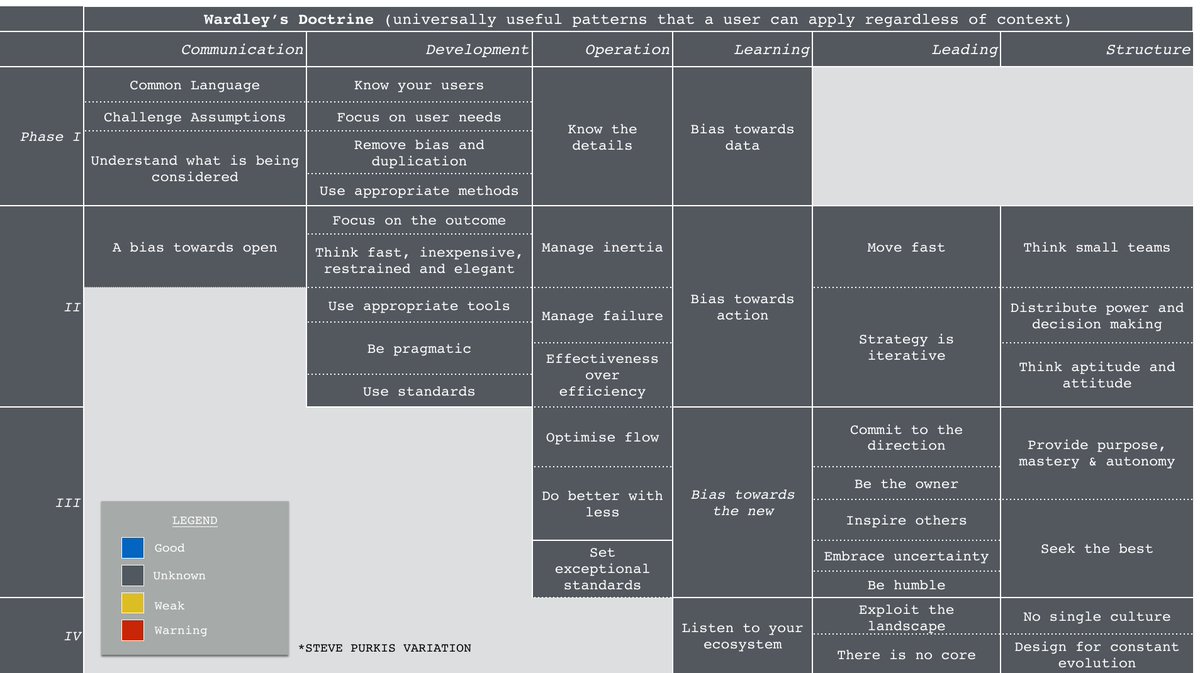
Me : Follow the doctrine, get good at that. In order, phase I first.
X : But when do you implement PST?
Me : Don't worry. Follow the doctrine and the organisational model you need will emerge.
Me : Follow the doctrine, get good at that. In order, phase I first.
X : But when do you implement PST?
Me : Don't worry. Follow the doctrine and the organisational model you need will emerge.
X : Won't chanigng the organisational model help to change doctrine?
Me: That's a question hoping for the answer "yes".
X : Well?
Me : No. But this is the point where you're going to tell me that you will be different or that you will create the right culture.
X : And?
Me : No.
Me: That's a question hoping for the answer "yes".
X : Well?
Me : No. But this is the point where you're going to tell me that you will be different or that you will create the right culture.
X : And?
Me : No.
X : Can you prove this?
Me : Maps can only prove they are wrong. They're imperfect by nature and they're models. They just happen to be useful. The doctrine is derived from maps and at its heart, encapsulated in phase I, is a principle that situational awareness matters
Me : Maps can only prove they are wrong. They're imperfect by nature and they're models. They just happen to be useful. The doctrine is derived from maps and at its heart, encapsulated in phase I, is a principle that situational awareness matters
X : So, the doctrine could be wrong?
Me : Of course. It's also not exhaustive.
X : So, I could just ignore your doctrine and implement PST?
Me : You're free to do whatever you want. Just don't come asking me later why it failed because you already know the answer.
Me : Of course. It's also not exhaustive.
X : So, I could just ignore your doctrine and implement PST?
Me : You're free to do whatever you want. Just don't come asking me later why it failed because you already know the answer.
X : But we could be different?
Me : Do you want to know how many times I've heard that? How many times I've heard of people rushing to PST without implementing doctrine and subsequently failing? Doctrine is a path, laid out in easy to follow steps. It's upto you.
Me : Do you want to know how many times I've heard that? How many times I've heard of people rushing to PST without implementing doctrine and subsequently failing? Doctrine is a path, laid out in easy to follow steps. It's upto you.
X : Is "doctrine" true?
Me : It's my best path (hence Wardley's doctrine) for creating a more adaptive organisation. If you want to create a PST structure (also my model) then I would suggest you use my doctrine and my maps to get there. It's not "true" any more than maps are.
Me : It's my best path (hence Wardley's doctrine) for creating a more adaptive organisation. If you want to create a PST structure (also my model) then I would suggest you use my doctrine and my maps to get there. It's not "true" any more than maps are.
X : Does doctrine only apply at a company level?
Me : It's derived from maps and has the characterstics of maps. So it applies to any collective i.e. nation state, industry, company, project and even the team level, You can start doctrine anywhere.
Me : It's derived from maps and has the characterstics of maps. So it applies to any collective i.e. nation state, industry, company, project and even the team level, You can start doctrine anywhere.
X : I don't see why you won't say that doctrine is "true".
Me : Because it's not, it's my path (hence Wardley's doctrine). It's no different with maps. Maps are an approximation.
A key phase I doctrine is "challenge assumptions" that applies to both maps and the doctrine ...
Me : Because it's not, it's my path (hence Wardley's doctrine). It's no different with maps. Maps are an approximation.
A key phase I doctrine is "challenge assumptions" that applies to both maps and the doctrine ...
... i.e. don't blindly follow the path (i.e. the doctrine) but challenge it as you go. If something isn't working i.e. "focusing on user needs" isn't helping then be prepared to challenge it and say the doctrine is wrong. Create your own doctrine and create your own path.
X : Well my doctrine will be to create a PST structure.
Me : Fine.
X : So you agree?
Me : No, not without all the other bits laid out in the path I've given you.
Me : Fine.
X : So you agree?
Me : No, not without all the other bits laid out in the path I've given you.
X : But that implies your doctrine is right?
Me : Jezzus. Look, my doctrine is wrong, just like my maps. But it's the best path and the best tool that I have until someone makes a better version. And even that better version won't be right, it'll just be less wrong.
Me : Jezzus. Look, my doctrine is wrong, just like my maps. But it's the best path and the best tool that I have until someone makes a better version. And even that better version won't be right, it'll just be less wrong.
• • •
Missing some Tweet in this thread? You can try to
force a refresh






