Does diversity matter? It sure does. Just one consequence: by shutting out women, the SciPy team arguably bears considerable responsibility for driving women to R. 3/ reshamas.github.io/why-women-are-…
A debate about R vs. Python can be settled elsewhere, but it doesn’t seem too much to insist that programming language choices should not be influenced by sexism. 4/
As a result, the @numpy_team gets away with always promising the future. Every year it’s the same refrain: “wait till next year, we're doing much better now.” 6/
Arguably the most boring step in genomics is the first one: normalization. Settled science. Scale + log. Move on.
Except that here's been a huge blind spot in the field. And it matters for AIxBio. A 🧵about what I think may be one of the most important papers I've written. 1/
The standard normalization is log(x/s*K+1) w/ K=10,000 in Seurat and Scanpy. It's been used in hundreds of thousands of studies. AI agents nowadays run it routinely.
In an expansive benchmark in @naturemethods, Ahlmann-Eltze & Huber conclude it's pretty much best in class. 2/
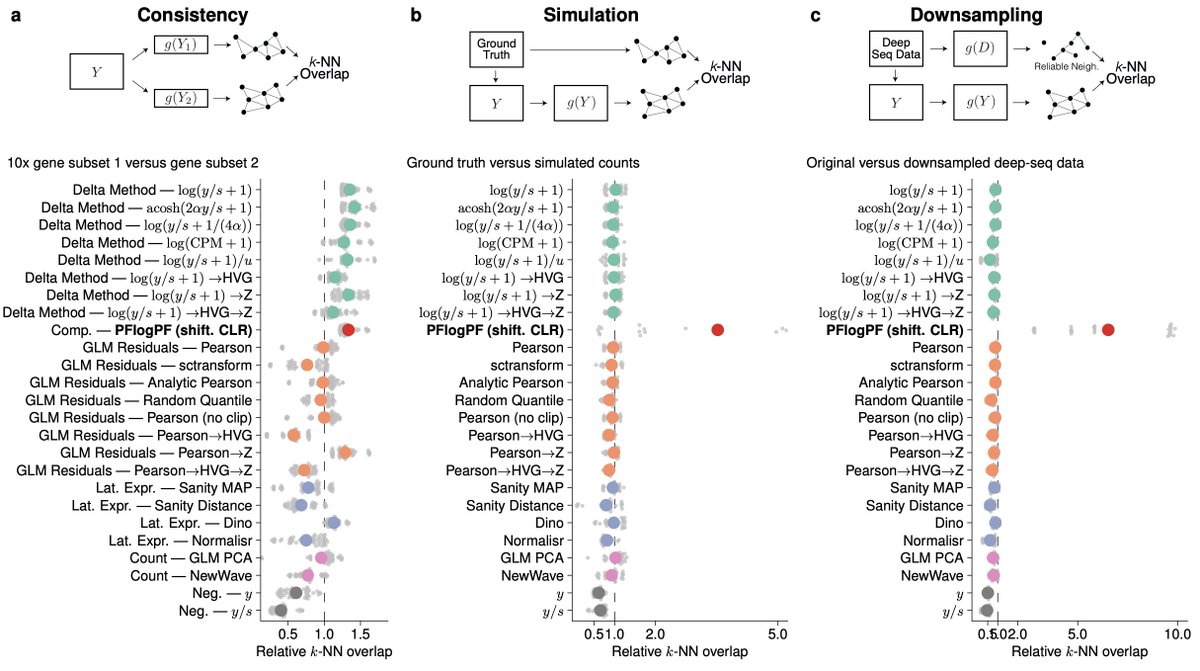
Except it isn't. Not even close. In a project that is four years in the making, we show that another transformation massively outperforms existing methods on the Ahlmann-Eltze & Huber benchmarks (red dots below). Moreover, it's optimal. What is this new method? How can it be? 3/
So this plagiarism thing has happened to our lab.. again. This time it's plagiarism of our poseidon syringe pump paper @booeshaghi et al., 2019 in @SciReports:
Text has been plagiarized, as well as figures copied directly here: 1/🧵nature.com/articles/s4159… ijirset.com/upload/2024/ma…
Here is figure 1 from our paper (LHS) and figure 1 in the plagiarized paper (RHS) published in the "International Journal of Innovative Research" 2/ ijirset.com/upload/2024/ma…
The text seems to have been rewritten with an LLM. Our introduction (LHS) vs. the plagiarized version (RHS): 3/
I've checked this paper out, as instructed. I was also interested in the main result for personal reasons: I'm 51 years old. Is it true that I've just gone through a major change? And that another one awaits me in just a few years?
The main result about major changes in the mid 40s and 60s is shown in this plot (Fig. 4a). First, I redrew it with axes that start at 0, so the scale of change here was clearer. Not as impressive, but maybe it's a thing? 2/
The authors say that this finding is even corroborated in another study (ref 14). But that's not true. I looked it up, and it shows something totally different (see RHS Fig 3c from ref 14). No change in mid 40s, but a change in the mid 30s, and the real change in the 80s 😕 3/
I recently posted on @bound_to_love's work quantifying long-read RNA-seq. In response, a scientist acting in bad faith (Rob Patro @nomad421) trashed our work. This kind of mold in science's bathroom is extremely damaging so here's a bit of bleach. 1/🧵
At issue are benchmarking results we performed comparing our tool, lr-kallisto, to other programs including Patro's Oarfish. Shortly after we posted our preprint Patro started subtweeting our work, claiming we'd run an "appallingly wrong benchmark" and that we're "bullies". 2/
This was followed, within days, by Patro posting a hastily written preprint disguised as research work on benchmarking, but really just misusing @biorxivpreprint to broadcast the lie that our work "... may be repeatable, but it appears neither replicable nor reproducible." 3/