ET Money Profile picture
Sep 18, 2020 6 tweets 2 min read Read on X
Recently, we had a session with @KalpenParekh, President @dspmf to discuss the mistakes he has himself made and what other investors can learn from them. Here is a brief summary of those 5 mistakes
(A thread)
Mistake #1 Not realizing that markets have cycles. Assuming that if they are down, they will stay down forever, or if they are going up they will keep going up is wrong. An investor should judge a fund by the valuation of its asset class. If the peak is near, it should be avoided
Mistake #2 Try timing the market and exiting an asset class when things go bad. An investor should neither get too optimistic or too pessimistic during market movements. Instead maintaining proper diversification of asset classes in one's portfolio can help counter market stimuli
Mistake #3 To not check the drivers of returns of a particular fund. The past performance of a fund doesn't mean that its future would be good as well. So Kalpen believes that a proper understanding of the fund and the category it belongs to is very important before investing
Mistake #4 Getting carried away by the narratives. If a particular fund or category is performing well and everyone is investing there it doesn't mean that you should invest in it. One should take decisions basis their asset allocation and own risk profile
The fifth and the final mistake Kalpen says is to not look after star funds or star companies or star fund managers. An investor should choose a fund basis its exposure and the kind of companies the fund invests in rather than just the legacy of a particular fund

• • •

Missing some Tweet in this thread? You can try to force a refresh

 

Keep Current with ET Money

ET Money Profile picture

Stay in touch and get notified when new unrolls are available from this author!

Read all threads

This Thread may be Removed Anytime!

PDF

Twitter may remove this content at anytime! Save it as PDF for later use!

Try unrolling a thread yourself!

how to unroll video
  1. Follow @ThreadReaderApp to mention us!

  2. From a Twitter thread mention us with a keyword "unroll"
@threadreaderapp unroll

Practice here first or read more on our help page!

More from @ETMONEY

Apr 29
“₹10 crore isn’t enough to retire. You actually need ₹100 CRORE!”

That’s the kind of advice doing the rounds on financial Twitter these days.

But do you really need ₹100 crore if you are retiring today or in 15 or 30 years’ time? A 🧵 Image
First, a question nobody’s asking:

Is ₹100 crore here your net worth or the actual corpus you can spend?

Your HOUSE, CAR and GOLD are your net worth.

You can't pay your electricity bill with them during retirement.
So, let’s assume we are talking about retirement corpus here 👇

What if you retire with a ₹100 crore corpus today?

You can afford to withdraw ₹33.3 lakh every month for the next 37 years!

(Assuming 6.8% post-tax returns on a 50:50 Equity-Debt mix, 6% inflation)
Read 11 tweets
Apr 26
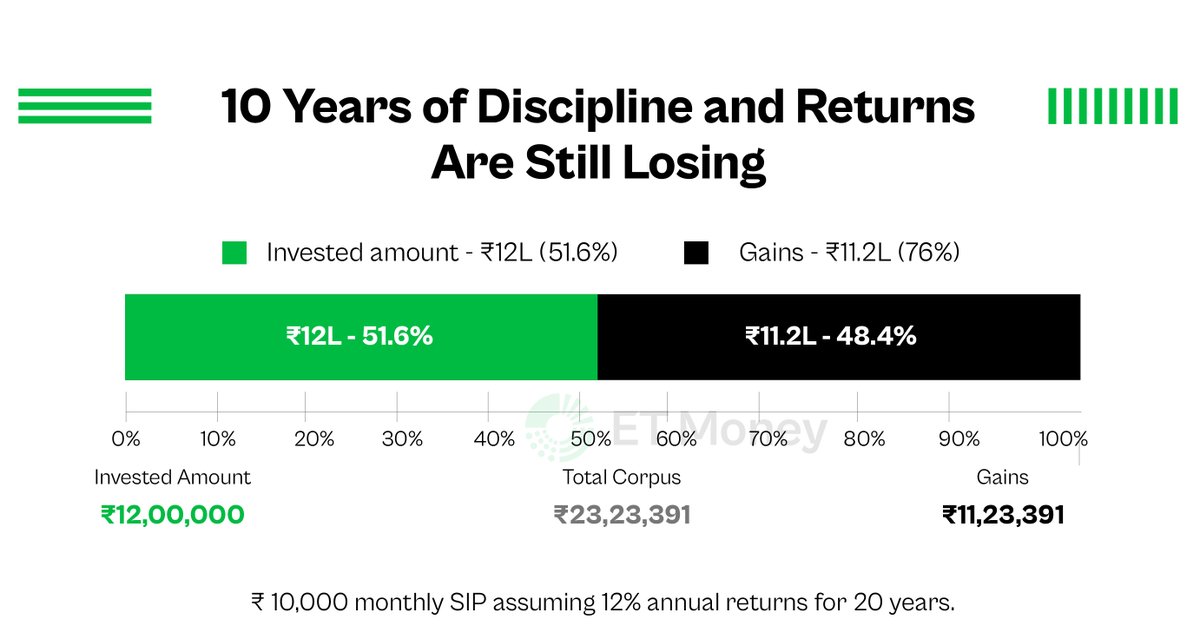
A few years back, we met an investor, Rohan, who was about to quit his SIP after 10 years.

He had:
- Invested ₹12L
- Earned just ₹11.2L

15 minutes later, we laid out one rule that helped him reach ₹1 CRORE.

Just ONE. Everything else was noise.

Here it is… 🧵 Image
Rohan was the kind of investor everyone tells you to be.

He started an SIP and continued it for 10 years without missing a SINGLE instalment!

But to his surprise, the gains hadn’t even crossed what he had invested after 10 years.

What went wrong? 👇
Rohan didn’t do anything wrong. This is simply how SIPs begin.

By the third year, for every ₹100 in Rohan’s portfolio, ₹83 was his own money.

The market had just added ₹17 worth of gains.

Three years of discipline, yet compounding barely made a dent.

What happened next?
Read 10 tweets
Mar 31
You’ve most likely seen this headline:

“HDFC Gold ETF may invest up to 50% in DERIVATIVES.”

But does that mean Gold ETFs will now only hold 50% in physical gold?

Not exactly.

Here’s what most people missed about this big update. A 🧵
First, let’s understand how Gold ETFs actually work.

When you invest in them, the fund buys physical gold and stores it in vaults.

Your units represent that gold.

So when gold prices move, the ETF also moves.

As simple as that.

But here’s where it gets interesting 👇
Because of this structure, Gold ETFs closely track gold prices.

If the ETF price drifts away from gold prices, it creates a “TRACKING ERROR”.

And regulators require this gap to remain small.

For this reason, fund houses must buy gold at prices close to the market.
Read 16 tweets
Mar 28
Why do returns of REITs vary so widely?

Past year return:
- Mindspace Business Parks: 28%
- Brookfield India: 13%

Is this because some paid higher dividends?

Or are mutual funds investing heavily in some and ignoring others?

Or, is it something else?

Let’s find out. A 🧵 Image
To know the answer, we looked at six different parameters:

1) Valuations
2) Traded Volume
3) Institutional Holding
4) Distribution (Dividend)
5) Debt Levels
6) Occupancy
1) VALUATIONS (Traded Price vs NAV)

REITs declare their Net Asset Value (NAV) every six months.

NAV is the fair (or actual price) of the REIT unit.

If the price is below NAV, it’s at a discount.

If the price is above NAV, it’s at a premium.

Here’s what the data suggests 👇
Read 18 tweets
Mar 24
There are HUNDREDS of index funds in the market.

But not even ONE takes care of asset allocation.

However, a new offering from @EdelweissMF could fix this 👇

- Passively invests 70% in Equities, 30% in Debt
- Rebalances monthly (no tax)
- Outperforms other hybrid funds

A 🧵 Image
This fund combined TWO indices into one.

It tracks the Nifty LargeMidcap250 Plus 8-13 yr G-Sec 70:30 index.

- 70% of your money goes to the Nifty Large Midcap 250 index
- 30% goes to the NIFTY 8-13 YR GSEC index.
To give you a clear picture, we analysed this index on 5 key metrics:

- Performance vs Peers
- Risk and Volatility
- How the Equity side is built
- How the Debt side works
- The Standout factor.

Let's start.
Read 17 tweets
Mar 5
Rajeev Thakkar and Sankaran Naren together manage nearly ₹2.35 LAKH CRORE!

Both are hardcore value investors.

Yet, their portfolios today look nothing alike.

And when two of the most celebrated fund managers disagree…

It’s worth paying attention 👇🧵 Image
1) CASH HOLDINGS

Let’s analyse three key metrics, starting with cash.

Parag Parikh Flexi Cap is holding close to 20% in cash.

Meanwhile, its cash holding in the ELSS Fund is down from 18% to around 13%.

For Diversified Equity funds, that is a meaningful liquidity cushion. Image
Overall, PPFAS’s stance remains cautious.

And it’s not surprising TBH…

The fund has historically been willing to take Cash calls when valuations appear stretched.

That pattern has continued in the current market.

Interestingly, the picture completely changes for ICICI 👇
Read 14 tweets

Did Thread Reader help you today?

Support us! We are indie developers!


This site is made by just two indie developers on a laptop doing marketing, support and development! Read more about the story.

Become a Premium Member ($3/month or $30/year) and get exclusive features!

Become Premium

Don't want to be a Premium member but still want to support us?

Make a small donation by buying us coffee ($5) or help with server cost ($10)

Donate via Paypal

Or Donate anonymously using crypto!

Ethereum

0xfe58350B80634f60Fa6Dc149a72b4DFbc17D341E copy

Bitcoin

3ATGMxNzCUFzxpMCHL5sWSt4DVtS8UqXpi copy

Thank you for your support!

Follow Us!

:(