Let's dig into the details of the lost wheel on the No. 23 and why the jackman wasn't wrong to drop the car when he did.
The stop on the right side goes reasonably well but where things go wrong is when the left front wheel is pulled and the key to the chaos happens as the wheel nut separates from the the socket on the pull.
The moment of disaster happens as the wheel is being pulled off and we can see the wheel nut separate and fall to the ground.
The issue here is that the separation happens behind the changer so he doesn't realize it and goes back on with no wheel nut in the socket.
One storyline that didn't get much attention at Indy is the fact that @keselowski and the No. 6 group were really close to an upset based on the overcut strategy that they were on towards the end of the race.
It all started with this strategy discussion at the end of Stage 2.
They pitted with 57 laps to go and decided to hold for fuel to fill up the car as much as possible to let them get close to the end of the race.
The fueler was likely plugged in for around 14 or 15 seconds which should have allowed them to get the fuel cell pretty packed.
They ran a couple of laps under yellow which burned minimal fuel so Keselowski need to make the rest last for as much as possible of those remaining 55 laps.
With green flag running, he would have needed a 3-4 second splash of fuel towards the end to make it.
The fuel battle between @BubbaWallace and @WilliamByron was incredibly close and some started fairly early in the race.
@charlesdenike and @JRHouston20 decided to hedge as early as lap 53 and held the car an additional second for fuel on that stop while the 24 went on tires.
Byron has an elite pit crew and that means that going on tires meant that their stop was completed in just 8.4 seconds and with how these dump cans flow that could be as much as two less gallons of fuel in exchange for track position.
One of the battles with elite pit crews getting faster on tire changes is the fact that cars will often have to be held for fuel so crew chiefs and engineers have to make decisions on what's important in the moment.
The battery issues in the No. 2 and the No. 21 and the disqualification of the No. 43 at Martinsville are likely all related.
Let's talk about weight at Martinsville and what happened to those cars.
Let's start with the basics of what makes a car race well at Martinsville and discuss some concepts of the physics of a race car.
The first thing we need to consider is lateral stability which in its simplest explanation is a gauge of how well a car stays in a straight line.
Having great lateral stability helps a driver have better control of a race car but the nature of an oval track means that there is centrifugal force once the car reaches a corner.
This force tries to push to car towards the outside of a turn.
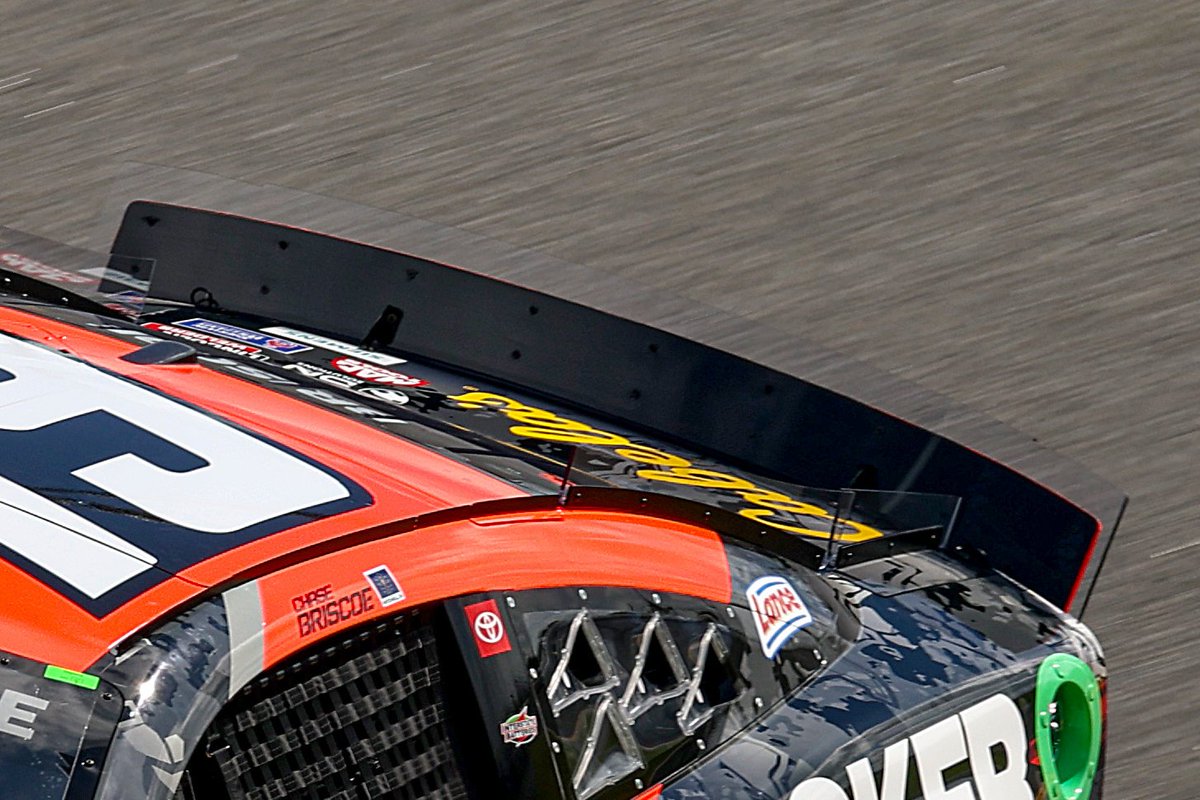
The No. 19 of Chase Briscoe was hit with a large penalty for modification of a single source supplied
part under the following sections of the rulebook:
Cup series cars are required to run a 7″ x 60″ spoiler face (F) on a tall spoiler base (E) for superspeedway races which is shown on the bottom half of this illustration.
NASCAR runs such a large spoiler base in order to slow the cars down and teams obviously want to find ways to make speed so getting air away from the spoiler is a priority whenever possible but NASCAR tries to make sure that the spoilers cannot flex through multiple methods.
We saw that pit crew members from @JoeGibbsRacing had tablets that would light up in green as a car reached its fuel fill target to tell the driver and fueler that the car can take off.
Let's dig into how this works and how they choose the time when it should change colors.
In this video we see a fuel only pit stop on the No. 11 of Denny Hamlin in the Duels last night.
Due to the distance of the race being so short, the car does not need a full fill of fuel so teams try to predict exactly how much fuel to add in order to maximize track position.
In the first part of the stop, we see the fueler approach the car and as soon as he plugs in, the crew member at the front of the car presses a button to start the timer on the tablet. The timer starts with a yellow bar that counts down and turns green at a predetermined time.