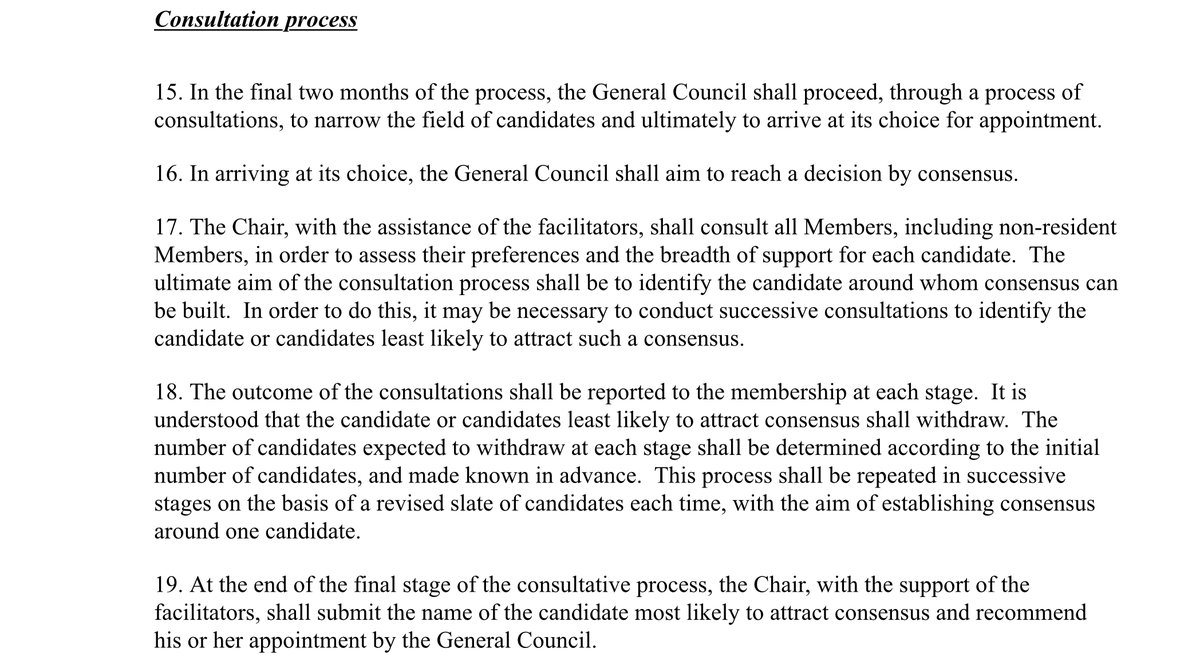
The WTO describes the process in its document WT/L/509. Available here (the WTO links it) wto.org/english/thewto…
The customary decision-making procedure of the WTO is: consensus. In short: nobody says no. So if China and the EU are against a candidate - fully against - that candidate won’t become DG. End of story.
How then does the WTO go through this consensus-building exercise? The description is here
An iterative consultation process eliminating candidates unable to attract consensus. So what happens if in the end the only candidates left standing ... don’t attract a consensus?
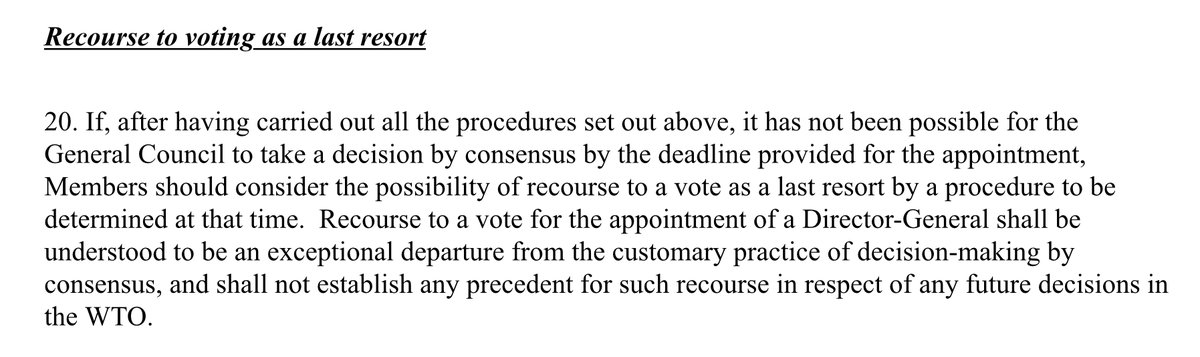
At that point, members “shall consider” the possibility of voting. Voting, though, goes against an engrained consensus culture at the WTO. And when I say goes against: articles have been written about how unrealistic a vote would be on certain matters.
It is, for most watchers, a complete surprise that Seade - a Mexican with tons of experience in the field - is out, Fox is still in. But the reason is certainly not that the EU and China wanted him out at all cost. The reason is that they did NOT want him out at all cost.
What that means and why that is - hard to tell. Tactics, or simply not as hard opposition, who knows.
• • •
Missing some Tweet in this thread? You can try to
force a refresh

I wish I could share the optimism of John Curtice. But behind the -250 Conservative seats +213 Labour seats and +63 LibDem seats I cannot help but see a populist rather than a competence revolution /1
First of all Labour only gained 1.7% of the votes, the victory is due to reform winning 14.3%. That, my friends, is more than the AfD has won in German parliamentary elections. What protected Parliament is that the 14.3% translated into a Tory loss rather than a populist win/2
And while amongst the Tory losses there inevitably were some non-fact-based "big beasts", some of those who tended to consistently be on the wrong side of facts retained them. Instead, some of those who worked well behind the scenes lost theirs. /3
I fear the framing of the discussions surrounding EU-UK relations under Labour is still quite wrong when sources say the "EU will not rush to reopen Brexit talks". Let me explain. /1
The UK and the EU chose an FTA as the basis for their trade relations. There are quite a few additional add-ons, it's a very broad FTA, but that's what it is. /2
That basic logic is currently uncontested. The Tories don't want to change it. But Labour does not, either. We will remain within the logic of an FTA. But that does not mean that nothing can be done. /3
"The ICC is a basic achievement of the international community that Germany always supported. Germany respects its independence and its procedures as those of other international courts. /2
Part of that is that that the pretrial chamber now has to decide on the applications of the chief prosecutor. /3
I know some will brush off @RishiSunak 's comments on the ECtHR and the ECHR as irrelevant given that his days in office are almost over. They are not. They are dangerous for the UK and show some politicians have not learned a thing. Why? /1
First: Once again a UK leader makes a commitment to leave an international system to limit immigration without any regard to the impact of leaving. That impact? /2
The UK was instrumental in drafting the ECHR. The agreement is at the core of the Council of Europe, underlies the good Friday agreement and the TCA. Leaving it means the UK leaves the CoE, destroys the Belfast Agreement and ultimately terminates significant chunks of the TCA. /3
Sorry to emphasize this again, but please note the "direct and public incitement to commit genocide" aspect of the case, which weirdly is often left out of commentary on the ICJ case. It is incredibly important. /1
South Africa submitted numerous statements that show that a cavalier attitude has developed to say truly horrendous things. Now that does not equal showing a state policy of genocide. But it is deeply troubling. And the court decided to remind Israel of what needs to be done /2
And the order of the Court in this regard is all the more stronger by who voted for it: Also Israel's ad hoc judge Barak, the former President of Israel's Supreme Court. /3