
Check out my @RoamResearch notes on @balajis "Applications: Today & 2025", with Anki deck - a great overview of the crypto landscape for newbies like me, and also is full of high-level startup ideas. My fave takeaways (thread)
cc @RoamBrain @RoamPublic
marknagelberg.com/roam-notes-on-…
cc @RoamBrain @RoamPublic
marknagelberg.com/roam-notes-on-…
He frames Bitcoin as the latest step in the evolution of digital dash 

Bitcoin is a protocol that's entirely "packet-driven" without reference to a bank or other intermediary. It's just bytes and a transparent protocol for managing these bytes on the internet. What this means is our machines can now hold and send money.
Blockchain breaks [[network effects]] because token upside is inversely proportional to network effects. For example, a competitor to Facebook could issue tokens to new users, giving value to early users that decline in value as the network size increases.
[[crypto cliff]]
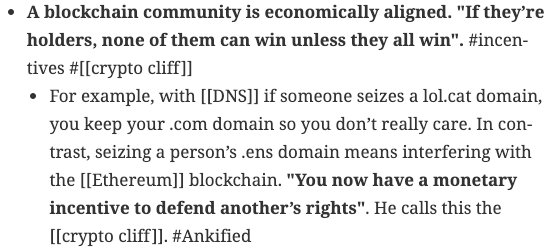
@balajis is bullish on [[tasking]], which could help reduce reliance on the current advertising / attention model. "It’s the better-than-free economy. Rather than trying to hack your [[attention]], they are paying you for it"
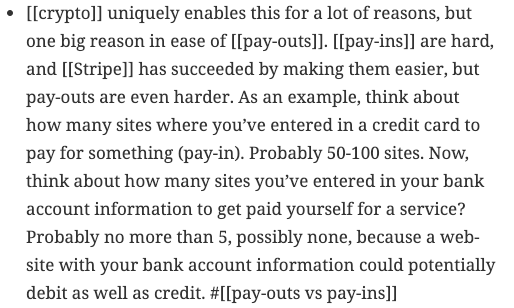
[[crypto]] uniquely enables this for a lot of reasons, but one big reason in increasing ease of [[pay-outs]]. [[pay-ins]] are hard, and [[Stripe]] has succeeded by making them easier, but pay-outs are even harder.
And here's the link to the original video on YouTube
• • •
Missing some Tweet in this thread? You can try to
force a refresh






